Agave cocui
Trel.
Cocuy

(c) Jessica Lisiewski, some rights reserved (CC BY-NC)

(c) Jessica Lisiewski, some rights reserved (CC BY-NC)

(c) Jessica Lisiewski, some rights reserved (CC BY-NC)
What to Eat
Edible parts: Flowers, Buds, Plant heart
The heart of the rosette, with the leaves removed, was used traditionally as a staple food. After slow-baking the hearts become very sweet because the carbohydrates in the heart are converted into sugars. The cooked hearts were eaten immediately after cooking as a main food, or were dried for later use. They could also be juiced to make a sweet drink, which was then sometimes fermented to make an alcoholic drink[1851. In more modern times, the juice is often distilled to make a strong, mezcal-like drink called 'cocuy de penca'. It has become very popular in Venezuela. The flowers and flower buds are used to make preserves and pickles.
Known Hazards
Where to Find It
It is a tropical plant.
Antilles, Aruba, Colombia, South America, Venezuela,
How to Identify
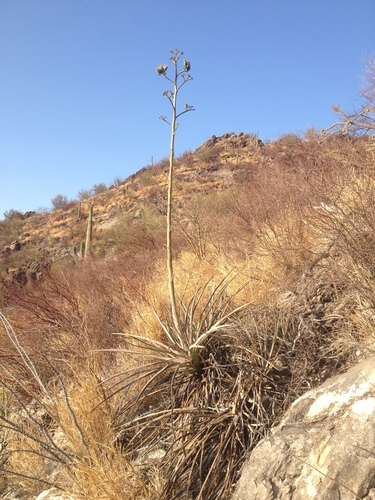
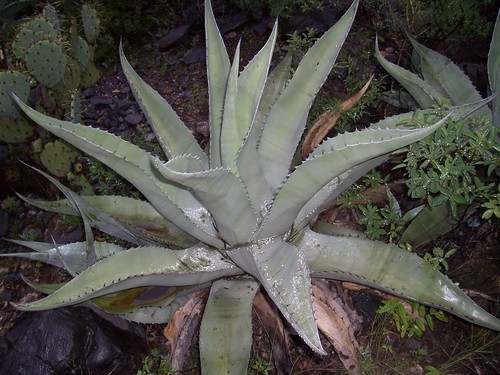
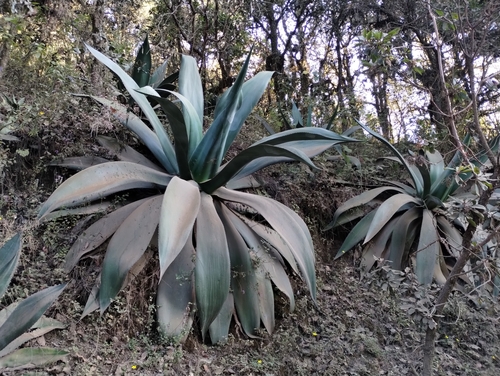
A large tropical plant in the Asparagaceae family (genus Agave).
How to Grow
Agave species generally require a sunny position, succeeding in most soils of medium-fertility so long as they are very well-drained. Most species are undemanding as to the soil pH, though those found in the wild on limestone soils will grow better in neutral to alkaline conditions. Plants are generally very tolerant of dry conditions and of extended periods of drought. Most Agave species are monocarpic, individual rosettes living for a number of years without flowering before sending up an often very large flowering stem and then dying after flowering and setting seed. This species, however, produces a number of new rosettes from suckers or offsets during its lifespan and these new plants will continue to grow after the death of the parent plant. In addition, many bulbils are usually produced on the flowering stem, these root easily and can be used for propagation. Individual plants take about 7 - 15 years in their native habitat, considerably longer in colder climates, before flowering. This species uses the 'Crassulacean Acid Metabolism' (CAM) pathway to photosynthesis, a mechanism which aids in conserving moisture. The plant keeps its stomata closed during the day, opening them during the night when it takes in carbon dioxide and stores it in compounds such as malic acid. It then utilizes this carbon dioxide when photosynthesizing during the day. This type of mechanism is used by a range of mainly succulent plants, including cacti and Euphorbia species. Members of this genus are rarely if ever troubled by browsing deer.
Propagation: Seed - surface sow in a container in a light position. The seed usually germinates in 1 - 3 months at 15 - 20°c. Prick out the seedlings into individual pots of well-drained soil when they are large enough to handle and grow them on in a sunny position until they are at least 10cm tall before planting out. Offsets and suckers can be potted up at any time they are available. Bulbils, where produced, are an easy method of propagation. Simply pot them up and plant out at the beginning of a growing season when they are 10cm or more tall.
Medicinal Uses
The plant (part not specified) is used as an antiseptic dressing on wounds.
Other Uses
A good quality, soft and strong fibre is obtained from the young leaves. Called 'dispopo', it is used to make hammocks, ropes, footwear, dolls, bags and various other crafts. The leaves contain saponins and can be used to make soap. The dried flowering stems are used as beams and frames in traditional houses.
Names & Synonyms
References (2)
- Kew Plants of the World Online
- Nugent, J., 1999, Agaves and cacti., Permaculture plants. Sustainable Agriculture Research Institute. PO Box 10, Nanup, WA, 6275