Convallaria majalis
L.
Lily of the Valley
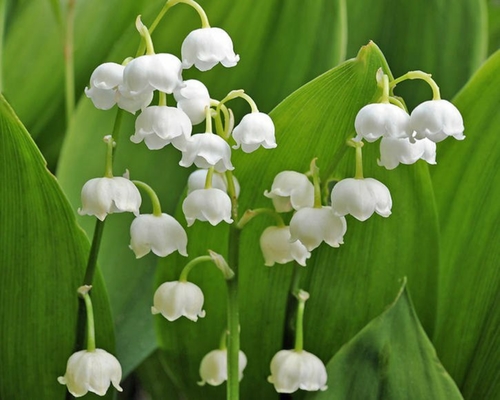
(c) prellinchen, some rights reserved (CC BY-NC)

(c) Vladimir Bryukhov, some rights reserved (CC BY-NC)

(c) Vladimir Bryukhov, some rights reserved (CC BY-NC)
What to Eat
Edible parts: Flowers - drink
A wine can be prepared from the flowers, mixed with raisins.
Known Hazards
Where to Find It
It is a temperate plant. It grows in moist places and shady hillsides between 800-2,500 m above sea level in north China.
Albania, Asia, Austria, Balkans, Belgium, Britain, Bulgaria, China, Czech, Denmark, Europe, Finland, France, Germany, Greece, Hungary, India, Italy, Japan, Korea, Luxembourg, Macedonia, Mediterranean, Mongolia, Myanmar, Netherlands, North America, Norway, Poland, Romania, Russia, Slovenia, Spain, Switzerland, Yugoslavia,
How to Identify
A herb. It grows 18-30 cm tall. The leaf stalk is 8-20 cm long. The leaves are shiny bluish green underneath. They are oval to sword shaped and 7-20 cm long by 3-9 cm wide. The base is wedge shaped. The flower stalk is slightly curved and 15-30 cm long. The flowers are white. The fruit is a red berry 6-12 mm across.
How to Grow
Succeeds in almost any situation, including the dense dry shade of large trees. Prefers a position in semi-shade in a moderately fertile well-drained moist woodland soil. Grows well in heavy clay, sand or chalky soils. Dislikes pure clay soils and boggy sites. Plants are hardy to -20°c or lower. A polymorphic species. It is a very ornamental plant, though it can become very invasive once it is established. Plants can take a couple of years to become established. There are several named varieties, selected for their ornamental value. The flowers are sweetly scented. Lily of the valley is occasionally cultivated as a medicinal plant for herbalists and allopaths. Plants seem to be immune to the predations of rabbits. A good bee plant.
Propagation: Sow seed as soon as it is ripe, or in late winter, in a cold frame. Germination, particularly of stored seed, can be very slow, taking 2 to 12 months or more at 15°C. Sow thinly so seedlings can remain undisturbed in the pot for their first year. Apply liquid feed during the growing season to keep seedlings well nourished. Divide young plants into individual pots when they die down in late summer and grow on in a shady cold frame for at least another year before planting out into permanent positions while dormant. Division in September is straightforward; larger clumps can go directly into permanent positions, while smaller clumps are better potted up in a cold frame until rooting well, then planted out in spring.
Medicinal Uses
Lily of the valley has a long and well-established reputation in herbal medicine for treating heart complaints. It contains the glycosides convallarin and convallamarin, which are powerful cardiac tonics and diuretics also used in allopathic medicine. Because of the plant's potential toxicity, it should never be used without expert guidance. All parts are antispasmodic, cardiotonic, strongly diuretic, emetic, febrifuge, laxative, and sedative. The plant is usually harvested in flower and can be dried, though it is more potent when fresh. The inflorescence is considered the most medicinally active part and is often harvested separately. An infusion of the flowers and roots serves as a less powerful digitalis substitute, particularly useful for valvular heart disease, cardiac debility, dropsy, and chronic lung conditions such as emphysema. It encourages the heart to beat more slowly, regularly, and efficiently while acting as a strong diuretic to reduce blood volume and lower blood pressure. Its effects are less cumulative than digitalis, making it safer for elderly patients. It is often prescribed alongside the fruits of Crataegus species. An ointment made from the roots is used to treat burns and help prevent scar tissue. The German Commission E Monographs approve Convallaria majalis for arrhythmia, cardiac insufficiency, and nervous heart complaints.
Other Uses
An essential oil obtained from the flowers is used in perfumery and for snuff. A green dye is obtained from the leaves in spring, and a yellow dye from the leaves in autumn. Plants can be grown as ground cover in woodland shade or in a shrubbery. As a garden ornamental it has received the Royal Horticultural Society's Award of Garden Merit.
Wikipedia
Source ↗Perennial groundcover reaching 0.2 m tall and spreading 0.3 m at a fast rate. Hardy to UK zone 3 and frost-hardy. Flowers May to June with seeds ripening in October. Hermaphroditic, self-fertile, pollinated by bees and flies. Noted for attracting wildlife. Grows in light sandy, medium loamy, or heavy clay soils, including poor soils, with mildly acid, neutral, or mildly alkaline pH. Tolerates full shade, semi-shade, or full sun, and adapts to dry, moist, or wet soil.
Notes
There is one Convallaria species.
Names & Synonyms
šmarnica