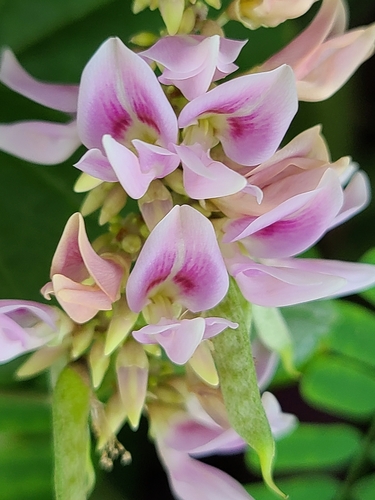
Brownea coccinea subsp. capitella
(Jacq. ) D. Velasquez & Agostini
Rose of Venezuela, Scarlet Flame bean, Rose of the mountain

(c) jramadas, some rights reserved (CC BY-NC)

(c) jramadas, some rights reserved (CC BY-NC)

(c) jramadas, some rights reserved (CC BY-NC)
What to Eat
Edible parts: Bark - drink
The bark is boiled to make a chocolate-like drink.
Where to Find It
It is a tropical plant. It grows in forests near river banks.
Colombia, Guyana, South America, Venezuela,
How to Identify
A small tree. It grows 15 m tall and the trunk is 15 cm across. The outer bark is grey-brown and the inner bark is reddish brown and has a sweet scent. The leaves have 5-7 leaflets. They are pink to brown when young. The leaflets have a long tip. The flowers are in red clumps and hang between the leaves. The fruit are dark brown pods.
How to Grow
It is slow growing.
Medicinal Uses
In Trinidad, infusions of the flowers are consumed as a remedy for colds and coughs. The fresh bark of the tree is used as an anti-hemorrhagic and applied to wounds. Other uses for the plant are as an emmenagogue to stimulate blood flow to the pelvic area and uterus in order to stimulate menstruation, and as an abortifacient. It is commonly used to treat gynecological disorders such as dysmenorrhea and menorrhagia.
Wikipedia
Source ↗Brownea coccinea is a species of small evergreen tree with compound leaves and clusters of bright scarlet flowers in the subfamily Detarioideae of the family Fabaceae. Common names include scarlet flame bean, mountain rose, rose of Venezuela and cooper hoop. The species is native to Colombia, Ecuador and Venezuela. Brownea coccinea, is a small to mid-sized tree with slender branches and a rounded crown and reaches a height of about 12 ft . Brownea coccinea trees have compound leaves which are 10–35 cm. long, containing 4-10 leaflets. Leaflets are oblong or elliptic, pointed at the apex and 4–23 cm. long and 1.5-6.5 cm. wide and smooth. Flowers are tubular with orange-scarlet calyx and petals and 10-12 protruding stamens in heads 7–9 cm. wide surrounded by downy red bracts and in clusters of 2–3 on branches are trunks. Seed pods are brown and 12–24 cm. long, 4 cm. wide and contain 4-10 flat seeds.
Names & Synonyms
Atarno, Bimiti-wallaban, Hichi okobia, Hotoquai aha, Hukuhuku ahobi arau, Tukusyi wokuru
References (3)
- Altschul, S.V.R., 1973, Drugs and Foods from Little-known Plants. Notes in Harvard University Herbaria. Harvard Univ. Press. Massachusetts. no. 1666 (As Brownea sp. indet.)
- Maas, P.J. M., Useful plants of Guyana. Non-Timber Forest Products of the North-West District of Guyana Part 1. p 103 (As Brownea latifolia)
- Maas, P.J. M., Non-Timber Forest Products of the North-West District of Guyana Part 2. The 85 most important NTFP species. p 38 (As Brownea latifolia)