Butea superba
Roxb.
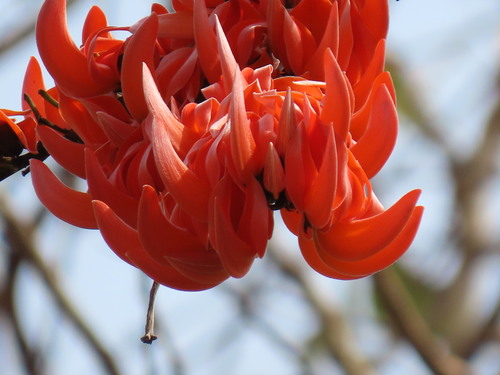
(c) Rujuta Vinod, some rights reserved (CC BY-NC)
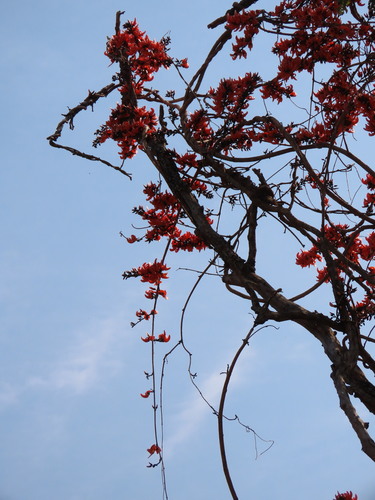
(c) Rujuta Vinod, some rights reserved (CC BY-NC)
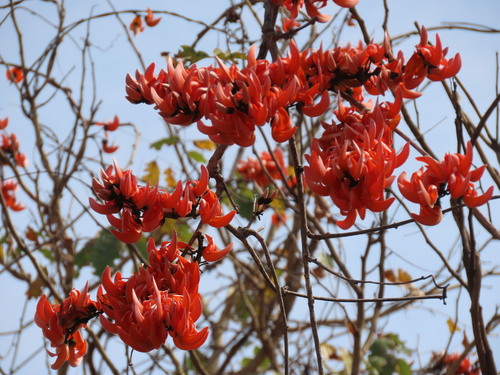
(c) Rujuta Vinod, some rights reserved (CC BY-NC)
What to Eat
Edible parts: Sap - drink, Caution
The sap is drunk.
Known Hazards
Where to Find It
It is a tropical plant. It grows in deciduous forest.
Asia, China, India, Indochina, Indonesia, Myanmar, SE Asia, Thailand, Vietnam,
How to Identify
A woody tropical shrub of the Fabaceae family with a tuber or fattened root, found in deciduous forest.
How to Grow
Butea species generally prefer a moist, well-drained soil and a position where it can grow into full sun.
Propagation: Seed - Air layering.
Medicinal Uses
A gum obtained from the bark is astringent. The root is used as a rejuvenative. A spoonful of a paste made from the root is taken in a cup of water by a woman to facilitate an easy delivery. The root is combined with an equal proportion of the roots of Nyctanthes and Woodfordia floribunda, the seeds of Cassia tora and Vernonia anthelmintica, and the stem juice of Trichosanthes palmata - these are made into a paste with cow's urine and used as a local application to treat the poisonous bites of animals. An ethyl alcohol extract of the root has shown interesting oestrogenic properties. In addition, it has been shown to reduce cell death from oxidation. The plant has potential as an active ingredient in preparations for the treatment of skin-ageing in post-menopausal women.
Other Uses
A gum is obtained from the plant. A juice, which naturally exudes from cracks and wounds in the bark, hardens into a most beautiful, ruby-coloured, brittle, astringent gum. It dissolves perfectly in water and partially in spirit. It is said to be similar to the gum obtained from Burtea monosperma. The following is an account of the gum for Butea monosperma:- A red exudate is obtained from the tannin-rich vesicles in the bark. It hardens into a gum, known as Butea gum, or Bengal kino and can be used medicinally, as a dye or for tannin. It occurs in the form of round tears, often fragmentary. It may be purified by solution in water. It is of a brilliant ruby-red colour, translucent and brittle, heat rendering it more so instead of melting it. Infusions of the flowers are used as a dye. When applied to cotton cloth that has previously been impregnated with a solution of alum, a beautiful bright yellow is obtained; a little alkali changes it to a deep reddish orange. A yellow dye can be obtained from the leaves A strong fibre is obtained from the roots and young branches. The dark-brown wood is porous and very fibrous.
Wikipedia
Source ↗Butea superba is a vining shrub in the legume family Fabaceae, native to India and mainland Southeast Asia. It is thought by locals to be an aphrodisiac, among other effects.
Notes
It affects sexual function.
Names & Synonyms
Bhadrosi bela, Kao-hko, Kosot-lot, Laipalasa, Palas-noi, Pauk-nwe, Paw-tohkaw
References (3)
- Misra, S., 2020, Survey of edible plants for human consumption in south Odisha, India. Journal of Emerging Technologies and Innovative Research (JETIR) Vol. 7, Issue 12 p 278
- Pandy, R. K. & Saini, S. K., 2007, Edible plants of tropical forests among tribal communities of Madhya Pradesh. Indian Journal of Traditional Knowledge. 6(1), pp 185-190 (Possibly miss-identification)
- Sukarya, D. G., (Ed.) 2013, 3,500 Plant Species of the Botanic Gardens of Indonesia. LIPI p 167




