Lilium lankongense
Franch.
LiliaceaeRoots
iNaturalist · cc-by-nc
(c) Lukasz Madrzynski 孟巨石, some rights reserved (CC BY-NC), uploaded by Lukasz Madrzynski 孟巨石
(c) Lukasz Madrzynski 孟巨石, some rights reserved (CC BY-NC), uploaded by Lukasz Madrzynski 孟巨石
iNaturalist · cc-by-nc
(c) Jing-Yi Lu, some rights reserved (CC BY-NC), uploaded by Jing-Yi Lu
(c) Jing-Yi Lu, some rights reserved (CC BY-NC), uploaded by Jing-Yi Lu
iNaturalist · cc-by-nc
(c) Jing-Yi Lu, some rights reserved (CC BY-NC), uploaded by Jing-Yi Lu
(c) Jing-Yi Lu, some rights reserved (CC BY-NC), uploaded by Jing-Yi Lu
What to Eat
Edible parts: Root, Bulb
The bulbs are stewed with meat as a traditional dish.
Where to Find It
It is a subtropical plant. It grows in alpine grassland between 1,800-3,200 m above sea level in SW China. In Yunnan.
Asia, China, Tibet,
Countries: United Arab Emirates, Afghanistan, Armenia, Azerbaijan, Bangladesh, Bahrain, Brunei, Bhutan, China, Georgia, Indonesia, Israel, India, Iraq, Iran, Jordan, Japan, Kyrgyzstan, Cambodia, North Korea, South Korea, Kuwait, Kazakhstan, Laos, Lebanon, Sri Lanka, Myanmar, Mongolia, Maldives, Malaysia, Nepal, Oman, Philippines, Pakistan, Qatar, Saudi Arabia, Singapore, Syria, Thailand, Tajikistan, Timor-Leste, Turkmenistan, Turkey, Taiwan, Uzbekistan, Vietnam, Yemen
How to Identify
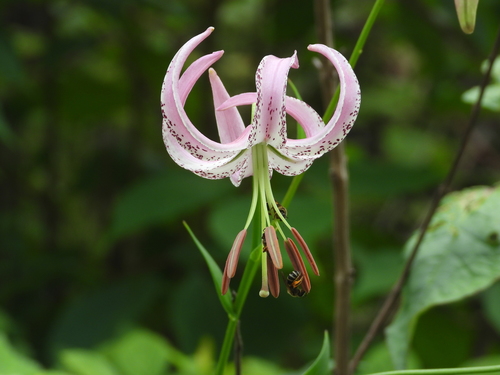
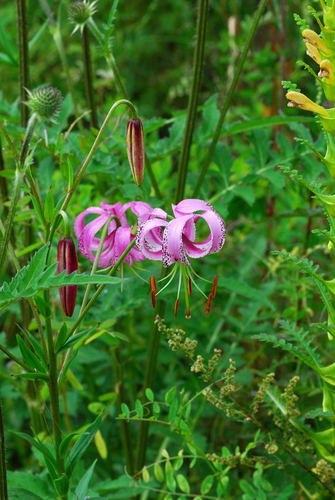
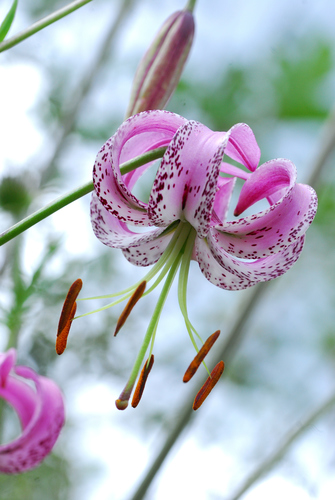
A herb. It is a lily bulb plant. The bulbs are oval and 3-4 cm across. It has stolons. The stem is pale purple and 40-150 cm tall. The leaves are scattered. They are oblong or sword shaped and 3-10 cm long by 1-2 cm wide. The flowers can occur singly or as several in a group. They are nodding and have a scent. They are pink with deep red spots.
Names & Synonyms
Baihe
Lilium duchartrei var. lankongense (Franch.) K. KrauseLilium ninae Vrishcz
References (1)
- Zhang, L. et al, 2013, An Ethnobotanical Study of Traditional Edible Plants Used by Naxi People in Northwestern Yunnan, China. - A Case Study in Wenhai Village. Plant Diversity and Resources. p 5


