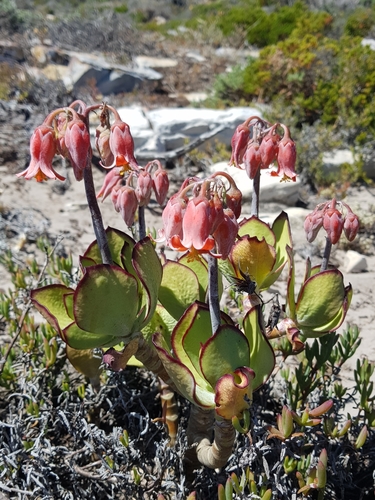
Orostachys malacophylla
(Pall.) Fisch.
CrassulaceaeLeaves
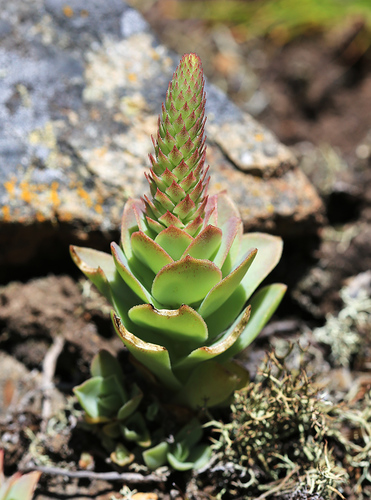
iNaturalist · cc-by-nc
(c) V.S. Volkotrub, some rights reserved (CC BY-NC), uploaded by V.S. Volkotrub
(c) V.S. Volkotrub, some rights reserved (CC BY-NC), uploaded by V.S. Volkotrub
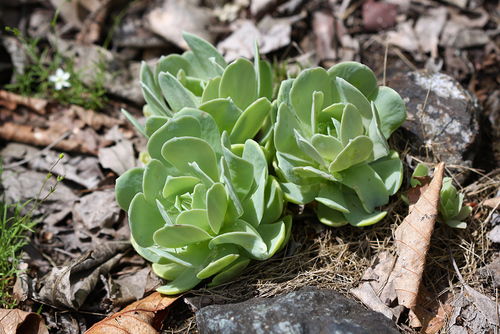
iNaturalist · cc-by-nc
(c) V.S. Volkotrub, some rights reserved (CC BY-NC), uploaded by V.S. Volkotrub
(c) V.S. Volkotrub, some rights reserved (CC BY-NC), uploaded by V.S. Volkotrub
What to Eat
Edible parts: Leaves
The tender leaves are eaten raw.
Where to Find It
It is a temperate plant. It grows in rock crevices between 1,200-1,800 m above sea level in northern China. In Inner Mongolia.
Asia, China, Japan, Korea, Mongolia, Russia,
Countries: United Arab Emirates, Afghanistan, Armenia, Azerbaijan, Bangladesh, Bahrain, Brunei, Bhutan, China, Georgia, Indonesia, Israel, India, Iraq, Iran, Jordan, Japan, Kyrgyzstan, Cambodia, North Korea, South Korea, Kuwait, Kazakhstan, Laos, Lebanon, Sri Lanka, Myanmar, Mongolia, Maldives, Malaysia, Nepal, Oman, Philippines, Pakistan, Qatar, Russia, Saudi Arabia, Singapore, Syria, Thailand, Tajikistan, Timor-Leste, Turkmenistan, Turkey, Taiwan, Uzbekistan, Vietnam, Yemen
How to Identify
A herb. It has a ring of leaves 4-15 cm across. The leaves are narrowly oval and 2-7 cm long by 1-3 cm across.
Names & Synonyms
Muur in himusu, Suan ta
Cotyledon malacophylla Pall.Orostachys malacophylla subsp. malacophyllaSedum malacophyllum (Pall.) Steud.Umbilicus malacophyllus (Pall.) DC.
References (3)
- Flora of China @ efloras.org Volume 8
- Khasbagan, Yeruhan and Zhao Hui, 2011, Study on Traditional Knowledge of Wild Edible Plants Used by the Mongolians in Xilingol Typical Steppe Area. Plant Diversity and Resources. 33(2): 239-246
- Sachula, et al, 2020, Wild edible plants collected and consumed by the locals in Daqinggou, Inner Mongolia, China. Journal of Ethnobiology and Ethnomedicine (2020) 16:60