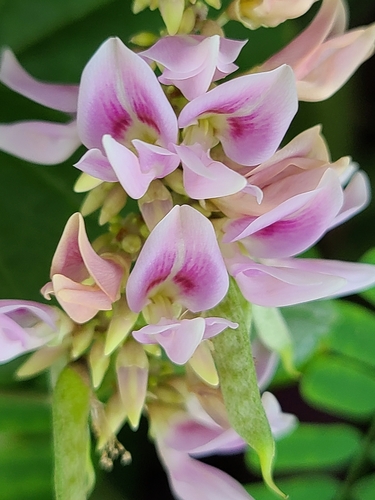
Erythrina arborescens
Roxb.
Sunshine coral tree

(c) Woudloper, some rights reserved (CC BY-SA)

(c) Bon Pradhan, some rights reserved (CC BY-NC)
What to Eat
Edible parts: Flowers
The flowers are eaten.
Known Hazards
Where to Find It
It is a tropical plant. It grows in mountain valleys and grassy slopes up to 2,100 m above sea level. In Yunnan.
Asia, Bangladesh, Bhutan, China, Himalayas, India, Indochina, Myanmar, Nepal, SE Asia, Sikkim, Thailand,
How to Identify
A tree. The trunk and branches have prickles. The leaves have leaflets and the end leaflet is kidney shaped and 8-20 cm long. The base is heart shaped. The side leaflets are broadly heart shaped. The flowers are in the axils of the last leaf. There are 3 flowers in a cluster. The are red and hang down. The pod is curved and 12-19 cm long by 2-3 cm wide. It has a beak at the end. There are 5-10 seeds. They are white or brown and kidney shaped. They are 2 cm across.
How to Grow
Plants can be grown by seeds or cuttings.
Propagation: Like many species within the family Fabaceae, once they have been dried for storage the seeds of this species may benefit from scarification before sowing in order to speed up and improve germination. This can usually be done by pouring a small amount of nearly boiling water on the seeds (being careful not to cook them!) and then soaking them for 12 - 24 hours in warm water. By this time they should have imbibed moisture and swollen - if they have not, then carefully make a nick in the seedcoat (being careful not to damage the embryo) and soak for a further 12 hours before sowing. Cuttings - even quite large branches root easily in the open ground.
Medicinal Uses
A decoction of the bark is taken internally as an anthelmintic. The juice of the bark is applied topically to treat boils.
Other Uses
The wood is soft, light and fairly durable. It is used for various purposes, such as making sieve frames, flooring. The plant is grown as a hedge. It is grown at the edges of cultivated, terraced fields in order to bind the soil and prevent landslides. Most Erythrina species are very easy to grow from cuttings, with even quite large branches striking well. In addition, they generally fix atmospheric nitrogen, have nutrient-rich leaves that make an excellent soil-enriching mulch, often have open crowns that do not overly restrict light, and are also often quite thorny and can provide impenetrable barriers to protect from unwelcome intrusions. Many species are therefore used as living fences to provide boundaries and livestock-proof hedges.
Names & Synonyms
Kathit, Maga, Phaledo, Pohon dadap mentari, Theki kath
References (2)
- Liu, Yi-tao, & Long, Chun-Lin, 2002, Studies on Edible Flowers Consumed by Ethnic Groups in Yunnan. Acta Botanica Yunnanica. 24(1):41-56
- Sukarya, D. G., (Ed.) 2013, 3,500 Plant Species of the Botanic Gardens of Indonesia. LIPI p 261