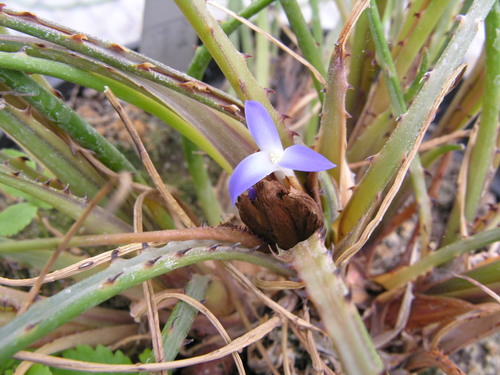
Aechmea distichantha
Lem.
Cardo, Brazilian vase plant

(c) Luís Roberto da Silva, some rights reserved (CC BY-NC), uploaded by Luís Roberto da Silva

(c) Josef Stulz, some rights reserved (CC BY-NC), uploaded by Josef Stulz

(c) Michelle Delaloye, some rights reserved (CC BY-NC), uploaded by Michelle Delaloye
What to Eat
Edible parts: Fruit
The fruit is edible.
Where to Find It
It is a tropical plant. It suits USDA hardiness zones 10b-11.
Argentina, Asia, Bolivia*, Brazil, India, Paraguay, South America*, Uruguay,
How to Identify
A pineapple like plant with a ring of leaves. It grows 1 m tall. The leaves are spiky and grey-green. They are 2-3 cm wide. The flowers are bright pink. They are at the top of the plant on a stiff stalk. The fruit is white and wooly and berry-like
How to Grow
It can be grown by suckers.
Wikipedia
Source ↗Aechmea distichantha, the Brazilian vaseplant, or vase plant, is a bromeliad typical of Cerrado vegetation in Brazil, which is also native to northern Argentina, Bolivia, Paraguay, and Uruguay. This plant is often used as an ornamental plant. The following varieties are recognized: Aechmea distichantha var. distichantha - Brazil, Argentina, Paraguay, Uruguay Aechmea distichantha var. glaziovii (Baker) L.B.Sm.(1943) - southeastern Brazil Aechmea distichantha var. schlumbergeri E.Morren ex Mez (1892) - Bolivia, Brazil, Argentina, Paraguay Aechmea distichantha var. vernicosa E.Pereira (1979) - Rio de Janeiro State
Other Information
It is probably minor.
Names & Synonyms
Caraguata-chuca, Cardo amarillo
References (4)
- Bortolotto, I. M., et al, 2018, Lista preliminar das plantas alimenticias nativas de Mato Grosso do Sul, Brasil. Iheringia, Serie Botanica, Porto Alegre, 73 (supl.):101-116
- Keller, H., et al, 2010, Ethnobotanical resources of multipe-use Guarani Reserve, Misiones (Argentina): their importance to indigenous communities of Caramelito and Taruma Poty-1. Ethnobotany Bol. 22, 2010 pp 38-54
- Kermath, B. M., et al, 2014, Food Plants in the Americas: A survey of the domesticated, cultivated and wild plants used for Human food in North, Central and South America and the Caribbean. On line draft. p 24
- Scarpa, G. F., 2009, Wild food plants used by the indigenous peoples of South American Gran Chaco: A general synopsis and intercultural comparison. Journal of Applied Botany and Food Quality 83:90-101