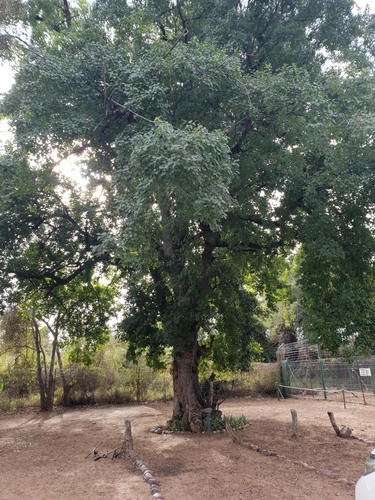
Condalia warnockii
M. C. Johnst.

(c) Don, some rights reserved (CC BY-NC), uploaded by Don

(c) Alex Abair, some rights reserved (CC BY), uploaded by Alex Abair

(c) Catherine C. Galley, some rights reserved (CC BY), uploaded by Catherine C. Galley
What to Eat
Edible parts: Fruit
High-quality edible fruit. Equivalent in value and use to knifeleaf condalia. Edible Uses & Rating: The fruits are edible fresh or cooked and are high-quality desert fruits. Food value is high for arid environments and excellent within the Condalia genus. Taste, Processing & Kitchen Notes: The fruits are small, black, sweet, slightly bitter, and mildly mucilaginous, with hard pits. Fresh fruits are palatable, but cooking dramatically improves their culinary quality. Boiling breaks down mucilage and creates a thick, dark, reddish-black broth with a naturally sweet, earthy flavor profile. The pulp separates cleanly from pits after cooking, making processing efficient. The broth is especially useful in rice dishes, stews, vegetable soups, and reductions. The flavor profile is savory rather than fruity-sweet and integrates well into cooked foods. Seasonality (Phenology): Flowering occurs in midsummer. Fruits ripen from late summer into early autumn. Ripening is staggered, and fruiting is often irregular between seasons. Safety & Cautions (Food Use): No toxicity issues reported. Safe for consumption when properly identified. Harvest & Processing Workflow: Best harvested using tarps and branch agitation rather than hand-picking due to spines. Fully ripe fruits detach more easily. Fruits can be boiled whole, pulp separated from pits, and broth reduced for culinary use. Cultivar / Selection Notes: No cultivars exist. Look-Alikes & Confusion Risks: Commonly confused with knifeleaf condalia (Condalia spathulata) and Mexican bluewood (Condalia mexicana). Taxonomic separation is unclear and disputed in historical literature. Traditional / Indigenous Use Summary: Likely used opportunistically as a wild food in desert regions, though specific ethnobotanical documentation is limited.
Known Hazards
Where to Find It
It is a temperate plant.
North America, USA,
How to Identify
A shrub in the Rhamnaceae family found in temperate regions, producing edible fruit.
How to Grow
Warnock’s condalia is best understood not as a distinct functional species, but as part of the edible-fruited condalia complex. From a foraging and food systems perspective, it represents a valuable desert-native fruit shrub with real nutritional potential in arid ecosystems. Growing Conditions: Highly drought-adapted and tolerant of extreme heat, alkaline soils, rocky substrates, and low fertility. Thrives in arid upland desert environments. Habitat & Range: Occurs in desert upland communities of West Texas, southern New Mexico, and northern Mexico. Prefers rocky slopes, desert scrub, and arid hillsides rather than riparian zones. Size & Landscape Performance: Typically reaches 1–3 meters in height and forms dense, thorny shrubs. Growth is slow but persistent. Long-lived once established. Cultivation (Horticulture): Not cultivated commercially. Potential value for native desert landscaping, habitat restoration, and edible native plant systems. Unsuitable for residential gardens due to spines and harvesting difficulty. Pests & Problems: Fruits frequently damaged by insects. Dense spines complicate harvesting. Fruit damage is often visually subtle due to dark skin color. Pollination: Likely insect-pollinated via small, inconspicuous flowers. Identification & Habit: Warnock’s condalia forms dense, rigid, spiny shrubs with short, armored branches and small spoon-shaped leaves clustered along woody stems. The growth habit is defensive, compact, and thorn-dominated, typical of desert-adapted shrubs that experience heavy herbivory pressure. Morphological differences cited in taxonomic literature are subtle, inconsistent, and unreliable in field conditions, making separation from knifeleaf condalia impractical for non-specialists. FAMILY: Buckthorn family (Rhamnaceae) – Condalia genus. COMMON NAMES: Warnock’s condalia, Kearney’s condalia. USDA HARDINESS ZONES: 8–10. HARDINESS / RANGE: West Texas, New Mexico, northern Mexico. GROWTH FORM: Spiny desert shrub, 1–3 m tall.
Propagation: Primarily by seed. Germination is slow and irregular. Natural regeneration depends on rainfall cycles and animal dispersal.
Names & Synonyms
Crucillo
References (2)
- Desert Survivors Online Plant Database (Ss var. kearneyana)
- Tull, D., Edible and Useful Plants of the Southwest: Texas, New Mexico and Arizona p 198