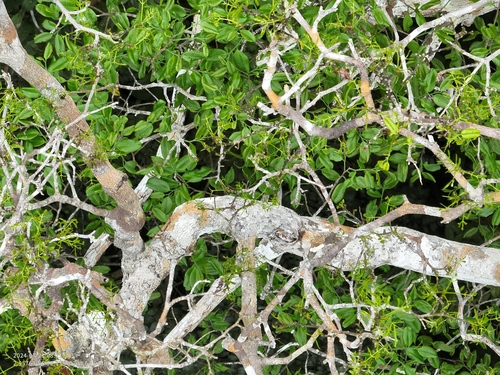
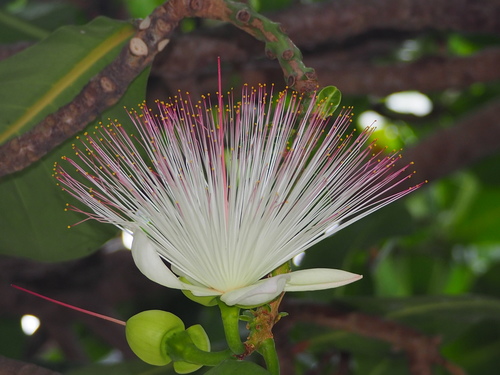
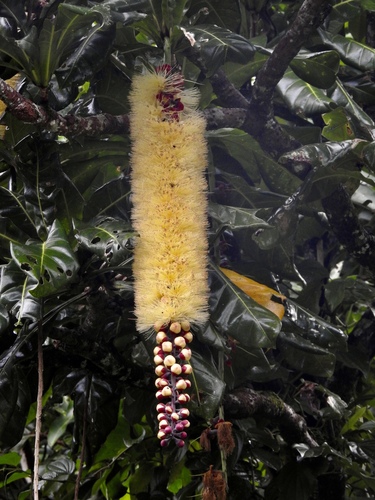
Couratari guianensis
Aubl.
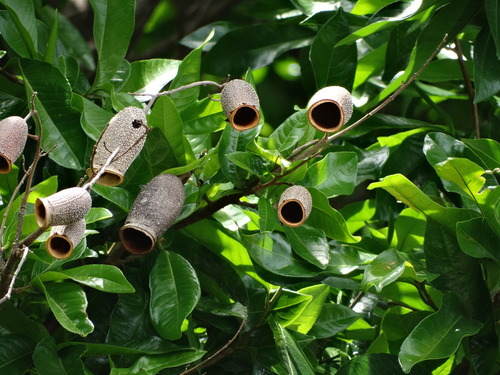
(c) Rebecca Hill, some rights reserved (CC BY-NC), uploaded by Rebecca Hill
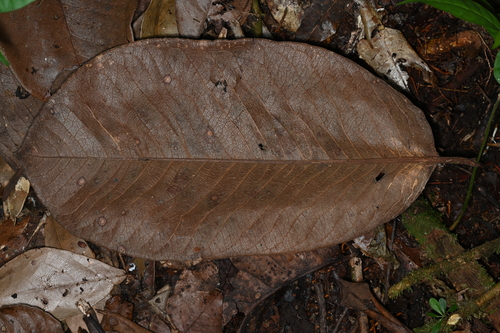
(c) Robin Heymans, some rights reserved (CC BY-NC)
What to Eat
Edible parts: Wood - salt
The trunk is burnt to produce vegetable salt.
Where to Find It
It is a tropical plant.
Amazon, Bolivia, Brazil, Central America, Costa Rica, Guianas, South America,
How to Identify
A tropical tree in the Lecythidaceae family, the trunk of which is traditionally burnt to produce a vegetable salt product.
Medicinal Uses
The peeled bark is used in a cold water infusion to treat fevers. The inner bark, combined with the bark of Amasonia campestris, is rasped into cold water and the infusion used as a wash for effectively remedying fevers.
Other Uses
The reddish-brown wood is hard and heavy. A sought after wood. The heartwood is cream coloured to light brown, with a pinkish or yellowish tinge; it is not clearly demarcated from the yellowish-white sapwood. The texture is medium, grain straight to interlocked, lustre moderate to low. The wood contains silica but is not very durable, being susceptible to attacks by fungi and insects. It is variable in machining properties but generally machines readily, producing smooth surfaces. It may present some dulling effect on cutting edges. Easy to polish but requires filling. Takes nails and screws moderately well with a slight tendency to split. Glues well. Resistant to marine borer. Weathering characteristics fair. The wood is used in construction, for furniture, plywood and is suitable for marine piling. The following report is for the related Couratari tauari - it almost certainly also applies to this species as well. The inner bark is extracted in thin layers, appearing somewhat like paper, and in this form has been used for wrapping cigarettes and cigars. It is also used for cordage, for rough clothing, and bedding by the natives of many South American countries. The bark is removed from the tree by means of a knife or other sharp instrument. Two cuts are made in the bark of the tree at different heights, surrounding the entire tree, and then another cut is made longitudinal to the first two. This section of the bark is then torn or stripped off the tree, it is pounded and then washed to separate the parenchyma from the fibre, thus obtaining a textile substance. In other cases the bark is loosened by continued blows or beating. The fibre is traditionally used to make clothing, blankets etc. Some of the blankets appear as if made from soft, pliable leather, others look like cotton. It is also used for mats, carpets, and to take the place of paper in wrapping cigarettes. One of the blankets made by beating the bark is described as being 180cm long and 270cm wide. The women of the tribe of the Churruyes, of Colombia, use the bark in the fashioning of a sort of garment called farquina, which is secured to the shoulders by strands of palm fibre, probably an Astrocaryum. 'The fibre is separated by blows and jerks into sheets, resembling cloth, which, when rubbed, washed, and exposed to the sun and dew, becomes light in colour and flexible.'' The garment is sometimes dyed red. Some of the Indians of Peru and Bolivia make shirts of the fibre; these being dyed in red and other colours.
Wikipedia
Source ↗Couratari guianensis, the fine-leaf wadara, cachimbo caspi, cachimbo, capa de tabaco, coco cabuyo, or tauari, is a species of woody plant in the family Lecythidaceae. It is found in Brazil, Colombia, Costa Rica, French Guiana, Guyana, Panama, Peru, Suriname, and Venezuela. It is threatened by habitat loss.
Names & Synonyms
Bitumbo, Cachimbo, Cachimbo caspi, Sabaleto, Saeana, Tuari
References (1)
- Kermath, B. M., et al, 2014, Food Plants in the Americas: A survey of the domesticated, cultivated and wild plants used for Human food in North, Central and South America and the Caribbean. On line draft. p 272