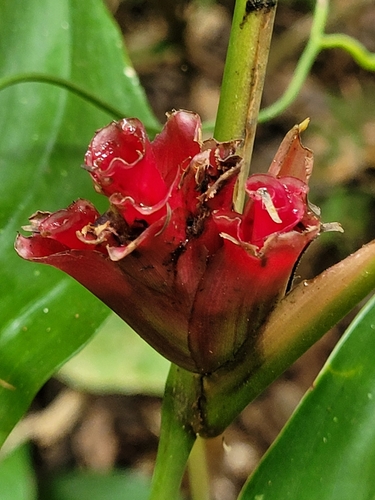
Maranta gibba
Sm.

(c) Line Juul Nielsen, some rights reserved (CC BY), uploaded by Line Juul Nielsen

(c) Line Juul Nielsen, some rights reserved (CC BY)
What to Eat
Edible parts: Root, Stalk, Leaves
The roots, stalks, and leaves are all edible.
Where to Find It
It is a tropical plant.
Brazil, Costa Rica, Ecuador, Nicaragua, Paraguay, South America*,
How to Identify
A tropical shrub reaching up to 2.5 m tall with leaves 7–27 cm long by 2–11 cm wide, used as a famine food when other resources are scarce.
Wikipedia
Source ↗Maranta gibba is a plant species native to Mexico (Campeche, Chiapas, Jalisco, Morelos, Oaxaca, Quintana Roo, Puebla, San Luis Potosí, Veracruz, Yucatán), Central America, northern South America (Brazil, Peru, Colombia, Venezuela, Guyana, French Guiana, Suriname), and the Island of Trinidad. It is reportedly naturalized in the Lesser Antilles. Maranta gibba is a shrubby perennial with ovate leaves. Flowers are borne in panicles. Fruits are gibbous. Plant was originally described from specimens grown in a garden on Barbados and shipped from there to Liverpool.
Other Information
It is a famine food.
Names & Synonyms
Araruta-do-mato, Caete, Cana de macaco, Tapioca
References (8)
- Cruz, M. P., et al, 2013, Knowledge, use and management of native wild edible plants from a seasonal dry forest (NE, Brazil) Journal of Ethnobiology and Ethnomedicine 2013, 9:79
- Cruz, M. P., et al, 2014, Local perceptions and consumption of native wild edible plants from seasonal dry forests in Brazil. Journal or Ethnobiology and Ethnomedicine 10:45
- Kermath, B. M., et al, 2014, Food Plants in the Americas: A survey of the domesticated, cultivated and wild plants used for Human food in North, Central and South America and the Caribbean. On line draft. p 523 (As Maranta divaricata)
- Kew Plants of the World On line
- Kinupp, V. F., 2007, Plantas alimenticias nao-convencionais da regiao metropolitana de Porto Alegre, RS, Brazil p 82 (As Maranta divaricata)
- Nascimento, V. T. D., et al, 2013, Knowledge and Use of Wild Food Plants in Areas of Dry Seasonal Forests in Brazil. Ecology of Food and Nutrition, 52:317–343 (As Maranta divaricata)
- Scarpa, G. F., 2009, Wild food plants used by the indigenous peoples of South American Gran Chaco: A general synopsis and intercultural comparison. Journal of Applied Botany and Food Quality 83:90-101 (As Maranta divaricata)
- Torre, de la, L., et al, 2008, Enciclopedia de las Plantas Útiles del Ecuador. Herbario QCA. Pontificia Universidad Católica del Ecuador. p 420