Cistus ladanifer
L.
Common Gum Cistus, Spanish manna

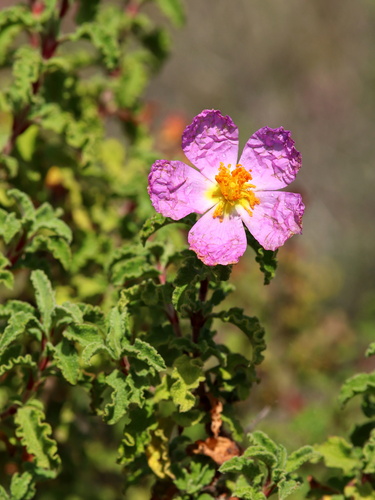
(c) Borja Fierro, some rights reserved (CC BY), uploaded by Borja Fierro

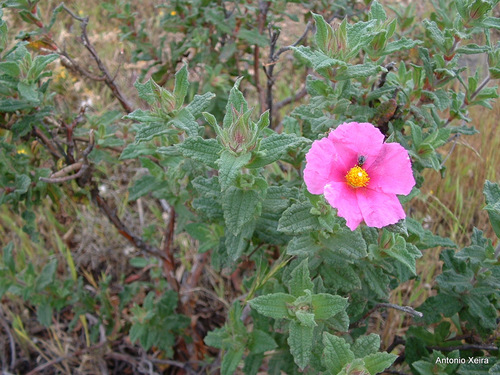
(c) Octávio Mateus, some rights reserved (CC BY-NC), uploaded by Octávio Mateus

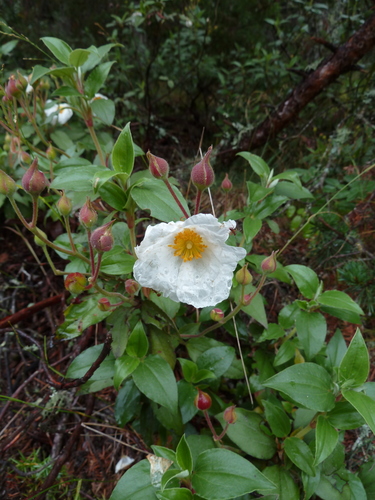
(c) Thijs Valkenburg, some rights reserved (CC BY-NC), uploaded by Thijs Valkenburg
What to Eat
Edible parts: Gum, Manna, Seeds, Flowers, Sap
Seeds can be ground into a powder and mixed with cereal flours for making cakes and breads. An oleo-resin obtained from the leaves and stems is eaten raw or used as a commercial food flavouring in baked goods, ice cream, and chewing gum. The plant is also said to yield a sweet manna, a report that likely refers to this same oleo-resin.
Where to Find It
It is a warm temperate plant. It can withstand light frosts. It grows on dry hillsides. It suits hardiness zones 8-10. Adelaide Botanical Gardens.
Africa, Algeria, Australia, Europe, France, Greece, Mediterranean, Morocco, North Africa, Portugal, Spain, Turkey, Türkiye,
How to Identify
A shrub. It grows 1.5-1.8 m high and spreads 1.2-1.5 m wide. The leaves are narrow and green. They are slightly sticky and have a smell. The leaves are narrow and sword shaped and 40-80 mm long. They are deep green above and have 3 veins in the lower half. They are paler and have white hairs underneath. The flowers are large and white. They are 70-100 mm across. They often have chocolate coloured blotches around a yellow centre. It has been used to breed other varieties. The fruit has 10 valves.
How to Grow
Requires a sunny position in a well-drained light sandy soil, growing well in poor soils. Withstands drought once it is established. Plants are fairly wind resistant, tolerating maritime exposure. Resents root disturbance. Plants are hardy to about -10c, but they require protection in severe winters. Plants are somewhat hardier when grown in poor soils. Individual flowers only last one day but there is a long succession of them. Labdanum dislikes pruning, especially as it gets older and so any formative work should be restricted to removing dead, straggly or damaged growths. The plant also resents root disturbance. Plants should be pot grown and then planted out in their final positions whilst still small. Sometimes cultivated for its gum, which is known as 'Labdanum', this is exuded in such quantity in hot weather that the plant becomes very sticky. The leaves have glandular hairs which produce an aromatic gum. The sweet balsamic smell is most apparent in the summer in the early morning. A very ornamental plant, it is very free-flowering and fast growing. There are a number of named forms developed for their ornamental value. An excellent nurse plant for sheltering young seedlings. This species is notably resistant to honey fungus. The flowers are very attractive to bees. Hybridizes freely with other members of this genus.
Propagation: Gather seed when ripe and store dry. Surface sow in late winter in a greenhouse; germination usually takes 1–4 weeks at 20°C. Prick out seedlings into individual pots as soon as they are large enough to handle. Overwinter in the greenhouse and plant out the following spring or early summer, after the last expected frosts. Seed stores for at least 3 years. Softish to half-ripe cuttings, 8cm long with a heel or at a node, taken June–August in a frame; roots form within 3 weeks, with a high success rate. Near-mature wood cuttings, 8–12cm with a heel or at a node, taken September–October in a frame, also achieve a high percentage. Lift and pot in spring, planting out once a good root system has formed. Layering can also be done in spring.
Medicinal Uses
Labdanum is an aromatic, expectorant, stimulant herb that controls bleeding and has antibiotic effects. It is used internally to treat catarrh and diarrhoea, and as an emmenagogue. Leaves are harvested in late spring and early summer and can be dried for later use or processed to extract the resin.
Other Uses
The glandular hairs on the leaves produce the oleo-resin known as ladanum, which is used medicinally and in soaps, perfumes, and fumigation. This resin is an acceptable substitute for ambergris (derived from the sperm whale), making it important in perfume manufacture. It is collected either by dragging a rake-like tool through the plant — with the resin adhering to the teeth — or by boiling the twigs and skimming off the resin. Most resin is produced during the hottest time of year.
Wikipedia
Source ↗Cistus ladanifer is a species of flowering plant in the family Cistaceae. It is native to the western Mediterranean region. Common names include gum rockrose, labdanum, common gum cistus, and brown-eyed rockrose.
Other Information
It is cultivated.
Notes
There are about 20 Cistus species.
Names & Synonyms
Gum Cistus, Gum rock-rose, Jara, Labdanum, Laudanum
References (19)
- Aceituno-Mata, L., et al, 2021, The Persistence of Flavor: Past and Present Use of Wild Food Plants in Sierra Norte de Madrid, Spain. Front. Sustain. Food Syst., 11 January 2021
- Blamey, M and Grey-Wilson, C., 2005, Wild flowers of the Mediterranean. A & C Black London. p 141
- Blanco-Salas, J., et al, 2019, Wild Plants Potentially Used in Human Food in the Protected Area “Sierra Grande de Hornachos” of Extremadura (Spain). Sustainability 2019, 11, 456
- Bremness, L., 1994, Herbs. Collins Eyewitness Handbooks. Harper Collins. p 98
- Brown, D., 2002, The Royal Horticultural Society encyclopedia of Herbs and their uses. DK Books. p 170
- Cundall, P., (ed.), 2004, Gardening Australia: flora: the gardener's bible. ABC Books. p 381
- Etherington, K., & Imwold, D., (Eds), 2001, Botanica's Trees & Shrubs. The illustrated A-Z of over 8500 trees and shrubs. Random House, Australia. p 212
- Facciola, S., 1998, Cornucopia 2: a Source Book of Edible Plants. Kampong Publications, p 78
- Hedrick, U.P., 1919, (Ed.), Sturtevant's edible plants of the world. p 193 (As Cistus ladaniferus)
- Hibbert, M., 2002, The Aussie Plant Finder 2002, Florilegium. p 67
- Joyce, D., 1998, The Garden Plant Selector. Ryland, Peters and Small. p 132
- Lord, E.E., & Willis, J.H., 1999, Shrubs and Trees for Australian gardens. Lothian. p 216
- Morley, B. & Everard, B., 1970, Wild Flowers of the World. Ebury press. Plate 34
- Plants for a Future database, The Field, Penpol, Lostwithiel, Cornwall, PL22 0NG, UK. http://www.scs.leeds.ac.uk/pfaf/
- Sp. pl. 1:523. 1753 "ladanifera"
- Tardio, J., et al, Ethnobotanical review of wild edible plants in Spain. Botanical J. Linnean Soc. 152 (2006), 27-71
- Wiersema, J. H. & Leon, B., 2013, World Economic Plants. A Standard Reference CRC Press. 2nd Ed. p 178
- World Checklist of Useful Plant Species 2020. Royal Botanic Gardens, Kew
- Young, J., (Ed.), 2001, Botanica's Pocket Trees and Shrubs. Random House. p 248