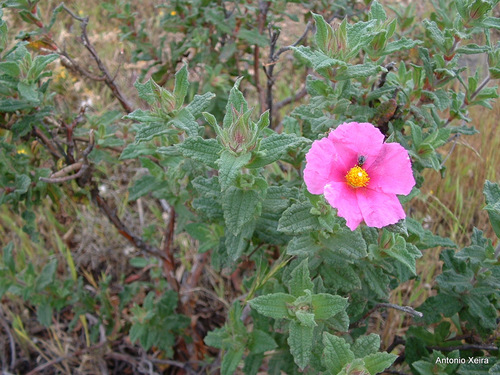
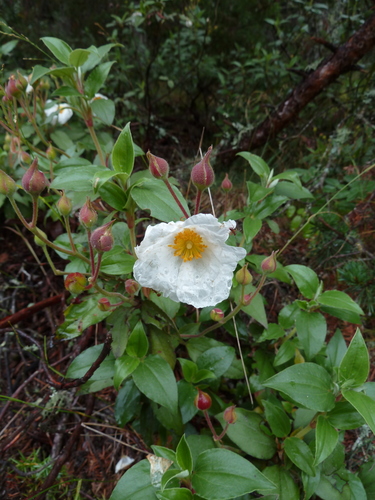
Cistus creticus
L.
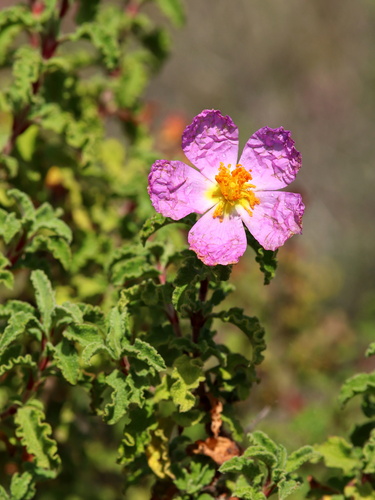
(c) František Lamla, some rights reserved (CC BY-NC), uploaded by František Lamla
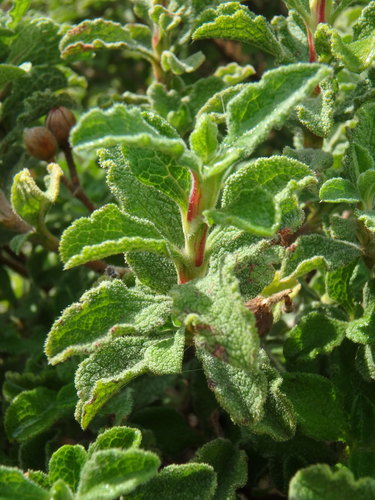
(c) Daniel Cahen, some rights reserved (CC BY), uploaded by Daniel Cahen
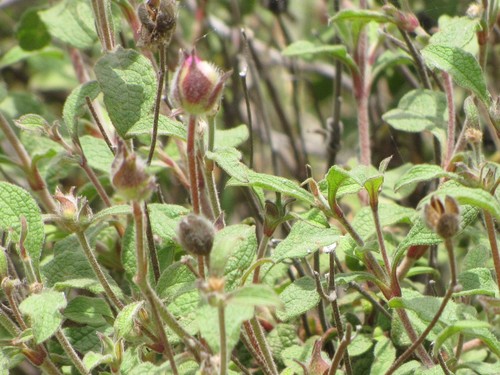
(c) Παναγιώτης Ραφαηλίδης, some rights reserved (CC BY-NC), uploaded by Παναγιώτης Ραφαηλίδης
What to Eat
Edible parts: Leaves, Leaves - tea, Seeds - seasoning
The leaves can be used as a tea substitute. The oleo-resin obtained from the leaves and stems is used as a commercial food flavouring in baked goods, ice cream, chewing gum, and similar products.
Where to Find It
It is a temperate plant.
Africa, Europe, Morocco, Turkey, Türkiye,
How to Identify
An evergreen shrub growing to 1 m (3ft 3in) tall and wide at a medium rate. Hardy to UK zone 8. Year-round foliage with bee-pollinated hermaphroditic flowers in June and seeds ripening in August. Self-fertile and noted for attracting wildlife. Tolerates sandy and loamy well-drained soils with mildly acid to basic pH. Requires full sun, tolerates drought, and withstands maritime exposure.
How to Grow
Requires a sunny position in a dry or moist well-drained light sandy soil. Withstands drought once it is established. Tolerates maritime exposure. Plants are hardy to about -15°c, but they require protection in severe winters. Plants are somewhat hardier when grown in poor soils. This is usually a short-lived plant in cultivation, it probably exhausts itself by its very free-flowering habit. Plants often self-sow when growing in a suitable position. Dislikes pruning or root disturbance. Plants should be pot-grown and then planted out in their final positions whilst still small. Individual flowers only last one day but there is a long succession of them. A polymorphic species, some forms do not yield much gum. Hybridizes freely with other members of this genus. This species is notably resistant to honey fungus. The flowers are very attractive to bees. The leaves exuding a balsamic resin are especially fragrant on warm sunny days. Cistus creticus is a moderately fast-growing plant, reaching about 3 to 4 feet (0.9 to 1.2 meters) in height within a few years under optimal conditions. Seeds can be harvested in late summer to early autumn, typically from August to September. Cistus creticus usually flowers from late spring to early summer.
Propagation: Gather seed when ripe and store dry. Surface sow in late winter in a greenhouse; germination usually occurs within 1–4 weeks at 20°C. Prick out seedlings as soon as they are large enough to handle into individual pots, grow on in the greenhouse through their first winter, and plant out the following spring or early summer after the last expected frosts. Seed stores for at least 3 years. Take softish to half-ripe cuttings 8cm long with a heel or at a node in June–August in a frame; roots form within 3 weeks at a high success rate. Alternatively, take cuttings of almost mature wood 8–12cm with a heel or at a node in September–October in a frame, also at a high percentage. Lift and pot up in spring, planting out once a good root system has formed. Layering can be done in spring.
Medicinal Uses
This plant is an aromatic, expectorant, stimulant herb that controls bleeding and has antibiotic effects. It is used internally in the treatment of catarrh and diarrhoea and as an emmenagogue. Leaves are harvested in late spring and early summer and can be dried for later use or have their resin extracted.
Other Uses
The glandular hairs on the leaves yield the oleo-resin known as ladanum, used medicinally and in soaps, perfumery, and fumigation. This resin is an acceptable substitute for ambergris and is valued in perfume manufacture. It is collected either by dragging a rake-like tool through the plant — the resin adhering to the teeth — or by boiling the twigs and skimming off the resin. Most resin is produced during the hottest part of the year. A mauve-flowered variety of this species is the most prolific producer. The plant is also used for erosion control, particularly on poor soils, and provides ground cover and wildlife habitat.
Wikipedia
Source ↗Cistus creticus (pink rock-rose, hoary rock-rose) is a species of shrubby plant in the family Cistaceae. Though it usually has pink flowers, of 4.5–5 cm (1.8–2.0 in) diameter, this species is very variable. It is widely known as a decorative plant. It is frequently called "Cistus incanus". (The true Cistus × incanus is the hybrid C. albidus × C. crispus.) It is native to the central and eastern Mediterranean Basin, including Morocco, Corsica and Sardinia, Italy and southeastern Europe, Turkey, and the Levant.
Names & Synonyms
Irgual, Istifiza, Karagan, Laden
References (4)
- Ertug, F, Yenen Bitkiler. Resimli Türkiye Florası -I- Flora of Turkey - Ethnobotany supplement
- Ghanimi, R., et al, 2022, Ethnobotanical study on wild edible plants traditionally used by Messiwa people, Morocco. Journal of Ethnobiology and Ethnomedicine. 18:16
- Gurdal, B. & Kultur, S., 2014, The edible and miscellaneous useful plants in Marmaris (Southwest Turkey). İstanbul Ecz. Fak. Derg. / J. Fac. Pharm. Istanbul 44(1) 2014 pp.69-78
- Kizilarslan, C. & Ozhatay, N., 2012, An ethnobotanical study of the useful and edible plants of İzmit. Marmara Pharmaceutical Journal 16: 134-140, 2012.