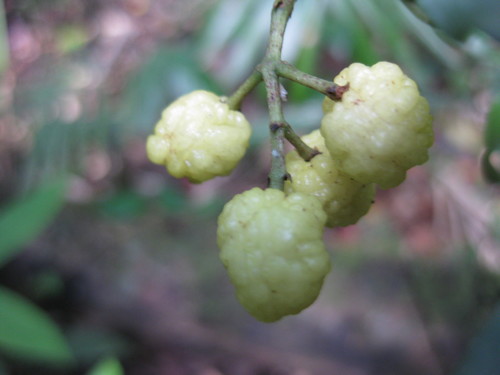
Citrus microcarpa
Bunge
Musk lime, Panama orange

(c) Steve Gallagher, some rights reserved (CC BY-NC)

(c) Steve Gallagher, some rights reserved (CC BY-NC)

(c) Steve Gallagher, some rights reserved (CC BY-NC)
What to Eat
Edible parts: Fruit
The fruit are sour and are used for drinks or pickled.
Where to Find It
A tropical plant. They grow naturally in sandy soil near the coast. At MARDI.
Asia, Australia, China, Fiji, Indochina, Indonesia, Malaysia, Pacific, Philippines, SE Asia, Solomon Islands, South America, Suriname, Taiwan, Thailand, Vietnam,
How to Identify
A small tree. It grows about 3-4 m tall. The branches are thorny. The leaves are slightly shiny and simple. The tip has a small notch. The leaf stalks have narrow wings. The flowers are small and white. They have 5 petals. The fruits are small. They are round and 2.5-4 cm across. They have a smooth thin skin. Fruit are green when young but turn yellow or orange when ripe. Each fruit has 6-8 segments. These often contain seeds.
Nutrition Score: 5/100
| Part | Moisture | kJ | kcal | Protein | Vit A | Vit C | Iron | Zinc |
|---|---|---|---|---|---|---|---|---|
| Fruit | 168 | 40 | 0.4 | — | 45 | 0.8 | — | — |
How to Grow
Trees can be grown from seed. Trees can be grown by cuttings and air layering.
Production
The tree fruits all year round.
Notes
There are 20 Citrus species. Several hybrids have been formed. This is probably a hybrid between Citrus reticulata and Citrus (Fortunella) japonica.
Names & Synonyms
Calamondin, Four Seasons Orange, Kalamansi, Limau Kesturi, Siji Ju
References (17)
- Bodner, C. C. and Gereau, R. E., 1988, A Contribution to Bontoc Ethnobotany. Economic Botany, 43(2): 307-369
- Bremness, L., 1994, Herbs. Collins Eyewitness Handbooks. Harper Collins. p 47 (As Citrofortunella microcarpa)
- Brickell, C. (Ed.), 1999, The Royal Horticultural Society A-Z Encyclopedia of Garden Plants. Convent Garden Books. p 271 (As Citrofortunella microcarpa)
- Burkill, I.H., 1966, A Dictionary of the Economic Products of the Malay Peninsula. Ministry of Agriculture and Cooperatives, Kuala Lumpur, Malaysia. Vol 1 (A-H) p 580
- Cheifetz, A., (ed), 1999, 500 popular vegetables, herbs, fruits and nuts for Australian Gardeners. Random House p 178 (As Citrofortunella microcarpa)
- Chin, H.F., & Yong, H.S., 1996, Malaysian Fruits in Colour. Tropical press, Kuala Lumpur p 46
- Enum. pl. China bor. 10. 1833 (Mem. Acad. Imp. Sci. St.-Petersbourg Divers Savans 2:84. 1835)
- Food Composition Tables for use in East Asia FAO http://www.fao.org/infoods/directory No. 831
- Hibbert, M., 2002, The Aussie Plant Finder 2002, Florilegium. p 67 (As Citrofortunella microcarpa)
- Hu, Shiu-ying, 2005, Food Plants of China. The Chinese University Press. p 495 (As Citrus mitis)
- Kuo, W. H. J., (Ed.) Taiwan's Ethnobotanical Database (1900-2000), http://tk.agron.ntu.edu.tw/ethnobot/DB1.htm
- Plants for a Future database, The Field, Penpol, Lostwithiel, Cornwall, PL22 0NG, UK. http://www.scs.leeds.ac.uk/pfaf/ (As Citrofortunella microcarpa)
- PROSEA (Plant Resources of South East Asia) handbook, Volume 2, 1991, Edible fruits and nuts. (As Citrofortunella microcarpa)
- Solomon, C., 2001, Encyclopedia of Asian Food. New Holland. p 194
- McMakin, P.D., 2000, Flowering Plants of Thailand. A Field Guide. White Lotus. p 80
- Solomon Islands Ministry of Agriculture, 1996, Solomon Islands: Country report to the FAO International Technical Report of Plant Genetic Resources. Leipzig. p 23 (As Citrofortunella microcarpa)
- Sukarya, D. G., (Ed.) 2013, 3,500 Plant Species of the Botanic Gardens of Indonesia. LIPI p 201