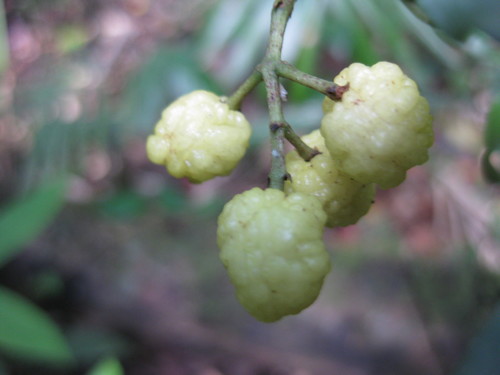
Clausena dentata
(Willd.) M. Roemer and Schult.
Wampee
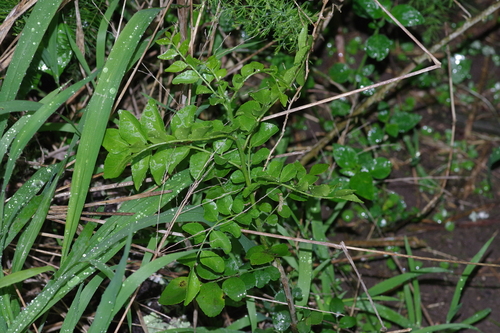
(c) Craig Peter, some rights reserved (CC BY-NC)

(c) David Maphisa, some rights reserved (CC BY-NC)
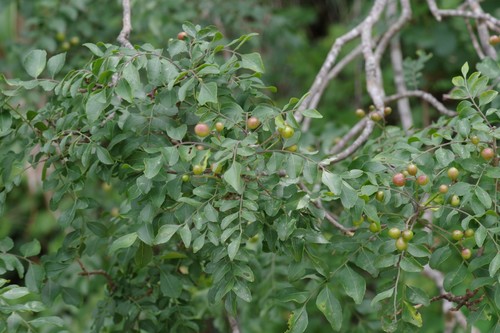
(c) Craig Peter, some rights reserved (CC BY-NC)
What to Eat
Edible parts: Fruit, Leaves
The fruit are eaten raw. The leaves are edible.
Where to Find It
A tropical plant. It grows in evergreen forests. In Sikkim it grows between 800-1,800 m above sea level.
Asia, China, Himalayas, India, Indochina, Laos, Myanmar, Nepal, Northeastern India, SE Asia, Sikkim, Sri Lanka, Thailand,
How to Identify
A small tree. There are some varieties. The bark is black. The leaves have an anise scent. The flowers are white and have scent. The fruit is oval and whitish green. There are 1 or 2 seeds.
Medicinal Uses
The leaf oil is used as a mosquito repellent.
Production
In Sikkim fruit are available in May and June.
Other Information
It is cultivated.
Notes
There are about 23-30 Clausena species. The leaf oil is used as a mosquito repellant.
Names & Synonyms
Ichang, Kariveppila, Katukkariveppilai, Nana chedi Sidemyok
References (14)
- Altschul, S.V.R., 1973, Drugs and Foods from Little-known Plants. Notes in Harvard University Herbaria. Harvard Univ. Press. Massachusetts. no. 1936
- Ambasta, S.P. (Ed.), 2000, The Useful Plants of India. CSIR India. p 130
- Dobriyal, M. J. R. & Dobriyal, R., 2014, Non Wood Forest Produce an Option for Ethnic Food and Nutritional Security in India. Int. J. of Usuf. Mngt. 15(1):17-37
- Fam. nat. syn. monogr.-Hesperides 1:44. 1846
- Kannan, M., et al, 2015, Ethnobotanical survey on wild edible plants of Kalrayan Hills, Salem District, Tamil Nadu, India. Global J. Res. Med Plants & Indigen. med. 4(12): 236-246
- Purseglove, J.W., 1968, Tropical Crops Dicotyledons, Longmans. p 493
- Sasi, R. & Rajendran, A., 2012, Diversity of Wild Fruits in Nilgiri Hills of the Southern Western Ghats - Ethnobotanical Aspects. IJABPT, 3(1) p 82-87
- Singh, H.B., Arora R.K.,1978, Wild edible Plants of India. Indian Council of Agricultural Research, New Delhi. p 53
- Singh, V. B., et al, (Ed.) Horticulture for Sustainable Income and Environmental Protection. Vol. 1 p 215
- Sundriyal, M., et al, 1998, Wild edibles and other useful plants from the Sikkim Himalaya, India. Oecologia Montana 7:43-54
- Sundriyal, M., et al, 2004, Dietary Use of Wild Plant Resources in the Sikkim Himalaya, India. Economic Botany 58(4) pp 626-638
- USDA, ARS, National Genetic Resources Program. Germplasm Resources Information Network - (GRIN). [Online Database] National Germplasm Resources Laboratory, Beltsville, Maryland. Available: www.ars-grin.gov/cgi-bin/npgs/html/econ.pl (10 April 2000)
- Wild edible plants of Himachal Pradesh
- Zeven, A. C. & de West, J. M. J., 1982, Dictionary of cultivated plants and their regions of diversity. Wageningen. p 79