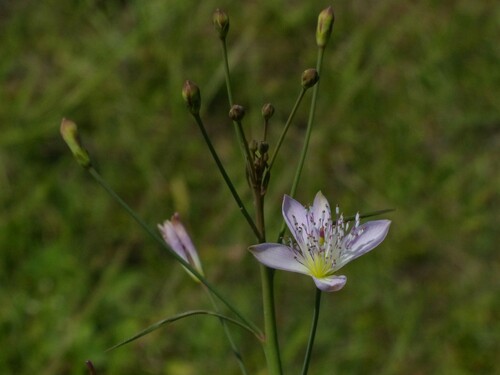
Cleome hirta
(Klotzsch) Oliv.
Pretty lady, Spider flower, Sticky purple cleome

(c) i_c_riddell, some rights reserved (CC BY), uploaded by i_c_riddell

(c) Tony Benn, some rights reserved (CC BY-NC)

(c) Christine Sydes, some rights reserved (CC BY-NC), uploaded by Christine Sydes
What to Eat
Edible parts: Leaves, Seeds, Vegetable
The leaves are eaten cooked, typically collected, wilted, chopped, and boiled in combination with other vegetables. The seeds are also edible.
Where to Find It
A tropical plant. It grows in the lowlands. It grows in the grassy savannah and swamps in West Africa. It is in lower rainfall areas. It grows in areas with a rainfall between 150-750 mm per year. It grows from sea level to 1,800 m above sea level. It needs well-drained soils. It can grow in arid places.
Africa, Angola, Botswana, Central Africa, Congo, East Africa, Eswatini, Ethiopia, Kenya, Malawi, Mozambique, Namibia, Rwanda, Somalia, South Africa, Southern Africa, Swaziland, Tanzania, Uganda, West Africa, Zambia, Zimbabwe,
How to Identify
A small herb. It grows 1 m high. The branches have lines along them. They are hairy. The leaves have 5-9 small leaflets. It is sticky to the touch. The leaflets are 1-5 cm long by 0.1-0.5 cm wide. They are narrow and sword shaped. They are wedge shaped at the base. The flower are at the top. The petals are pink or purple. The fruit is a capsule 16 cm long by 0.4 cm wide. The seeds are about 2 mm across.
How to Grow
It can be grown from seeds.
Medicinal Uses
The leaves are eaten to reduce hypertension. The roots and leaves are boiled and used as a medicine for measles.
Production
The young shoots are collected during the early rains.
Other Information
It is a minor vegetable. It is of moderate palatability.
Notes
There are about 150 Cleome species. It has also been put in the family Capparaceae and Brassicaceae.
Names & Synonyms
Akayobyo akasajja, Bastard mustard, Cetandambudo, Kabangaseshe, Kabangasheshe, Kakunguni, Kekeneka, Malomaarotho, Mhilile, Mhilili, Musambe, Natserume, Nyausako, Nyiragasogereza, Sau
References (28)
- Agea, J. G., et al 2011, Wild and Semi-wild Food Plants of Bunyoro-Kitara Kingdom of Uganda: etc. Environmental Research Journal 5(2) 74-86
- Burkill, H. M., 1985, The useful plants of west tropical Africa, Vol. 1. Kew.
- East African Herbarium records, 1981,
- Fl. trop. Afr. 1:81. 1868
- Flora Zambesiaca. http://apps.kew.org/efloras
- Fowler, D. G., 2007, Zambian Plants: Their Vernacular Names and Uses. Kew. p 16
- Godfrey, J. et al, 2013, Harvesting, preparationand preservation of commonly consumed wild and semi-wild food plants in Bunyoro-Kitara Kingdom, Uganda. Int. J. Med. Arom. Plants. Vol.3 No.2 pp 262-282
- Grivetti, L. E., 1980, Agricultural development: present and potential role of edible wild plants. Part 2: Sub-Saharan Africa, Report to the Department of State Agency for International Development. p 49
- Grubben, G. J. H. and Denton, O. A. (eds), 2004, Plant Resources of Tropical Africa 2. Vegetables. PROTA, Wageningen, Netherlands. p 195
- Heywood, V.H., Brummitt, R.K., Culham, A., and Seberg, O. 2007, Flowering Plant Families of the World. Royal Botanical Gardens, Kew. p 101
- Jardin, C., 1970, List of Foods Used In Africa, FAO Nutrition Information Document Series No 2.p 67
- Long, C., 2005, Swaziland's Flora - siSwati names and Uses http://www.sntc.org.sz/flora/
- Malaisse, F., 1997, Se nourrir en floret claire africaine. Approche ecologique et nutritionnelle. CTA., p 59
- Malaisse, F., 2010, How to live and survive in Zambezian open forest (Miombo Ecoregion). Les Presses Agronomiques de Gembloux.
- Martin, F.W. & Ruberte, R.M., 1979, Edible Leaves of the Tropics. Antillian College Press, Mayaguez, Puerto Rico. p 181
- Martin, F.W. & Ruberte, R.M., 1979, Edible Leaves of the Tropics. Antillian College Press, Mayaguez, Puerto Rico. p 181 (As Polanisia hirta)
- Mutie, F. M., et al, 2023, Important Medicinal and Food Taxa (Orders and Families) in Kenya, Based on Three Quantitative Approaches. Plants 2023, 12, 1145
- Okigbo, B.N., Vegetables in Tropical Africa, in Opena, R.T. & Kyomo, M.L., 1990, Vegetable Research and development in SADCC countries. Asian Vegetable Research and development Centre. Taiwan. p 38
- Peters, C. R., O'Brien, E. M., and Drummond, R.B., 1992, Edible Wild plants of Sub-saharan Africa. Kew. p 77
- Pickering, H., & Roe, E., 2009, Wild Flowers of the Victoria Falls Area. Helen Pickering, London. p 48
- Reis, S. V. and Lipp, F. L., 1982, New Plant Sources for Drugs and Foods from the New York Botanical Garden herbarium. Harvard. p 91
- Roodt, V., 1998, Common Wild Flowers of the Okavango Delta. Medicinal Uses and Nutritional value. The Shell Field Guide Series: Part 2. Shell Botswana. p 61
- Royal Botanic Gardens, Kew (1999). Survey of Economic Plants for Arid and Semi-Arid Lands (SEPASAL) database. Published on the Internet; http://www.rbgkew.org.uk/ceb/sepasal/internet [Accessed 7th April 2011]
- Ruffo, C. K., Birnie, A. & Tengnas, B., 2002, Edible Wild Plants of Tanzania. RELMA p 202
- Ruiters-Welcome, A. K., 2019, Food plants of southern Africa. Ph.D. thesis. Univ. of Johannesburg p 44
- Vernon, R., 1983, Field Guide to Important Arable Weeds of Zambia. Dept of Agriculture, Chilanga, Zambia. p 36
- Welcome, A. K. & Van Wyk, B.-E., 2019, An inventory and analysis of the food plants of southern Africa. South African Journal of Botany 122 (2019) 136–179
- World Checklist of Useful Plant Species 2020. Royal Botanic Gardens, Kew