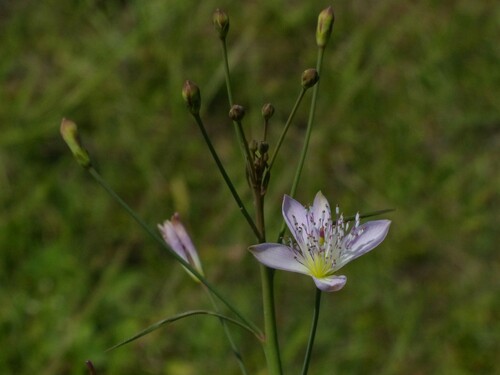
Cleome icosandra
L.

wikimedia · cc-by-sa
Wikimedia Commons - Krzysztof Ziarnek, Kenraiz
Wikimedia Commons - Krzysztof Ziarnek, Kenraiz

wikimedia · cc-by-sa
Wikimedia Commons - Krzysztof Ziarnek, Kenraiz
Wikimedia Commons - Krzysztof Ziarnek, Kenraiz
What to Eat
Edible parts: Leaves, Seeds
The leaves are boiled with chillies and salt; the seeds are used as a mustard substitute in curries; the pods are made into pickles.
Where to Find It
A tropical plant.
Asia, India, Pan tropical,
Countries: United Arab Emirates, Afghanistan, Armenia, Azerbaijan, Bangladesh, Bahrain, Brunei, Bhutan, China, Georgia, Indonesia, Israel, India, Iraq, Iran, Jordan, Japan, Kyrgyzstan, Cambodia, North Korea, South Korea, Kuwait, Kazakhstan, Laos, Lebanon, Sri Lanka, Myanmar, Mongolia, Maldives, Malaysia, Nepal, Oman, Philippines, Pakistan, Qatar, Saudi Arabia, Singapore, Syria, Thailand, Tajikistan, Timor-Leste, Turkmenistan, Turkey, Taiwan, Uzbekistan, Vietnam, Yemen
How to Identify
A sticky herbaceous plant of the Cleomaceae family native to tropical regions, with edible leaves, seeds, and pods.
Notes
There are about 150 Cleome species. It is also used in medicine.
Names & Synonyms
Adityabhakta, Anchang-anchang, Ariavila, Arkakanta, Bobowan, Hulhul, Hurhur, Hurhuria, Kanphuti, Ketepeng, Kukhavominta, Maman jerok, Maman pantai, Maman puteh, Mamang kebo, Mamang laki, Mamang utan, Naaikkadugu, Nayibela, Nayikkadugu, Pak sien phi, Talvani, Vellai keerai
Cleome viscosa L.Polanisia icosandra W. & A.Polanisia viscosa DC
References (7)
- Ambasta, S.P. (Ed.), 2000, The Useful Plants of India. CSIR India. p 131
- Arinathan, V., et al, 2007, Wild edibles used by Palliyars of the western Ghats, Tamil Nadu. Indian Journal of Traditional Knowledge. 6(1) pp 163-168
- Bandana, P. & Debabrata, P., 2015, Wild Edible Plant Diversity and its Ethno-medicinal use by Indigenous Tribes of Koraput, Odisha, India. Research Journal of Agriculture and Forestry Sciences. Vol. 3(9), 1-10, October (2015)
- Burkill, I.H., 1966, A Dictionary of the Economic Products of the Malay Peninsula. Ministry of Agriculture and Cooperatives, Kuala Lumpur, Malaysia. Vol 1 (A-H) p 588
- Facciola, S., 1998, Cornucopia 2: a Source Book of Edible Plants. Kampong Publications, p 78 (As Cleome viscosa)
- Martin, F.W. & Ruberte, R.M., 1979, Edible Leaves of the Tropics. Antillian College Press, Mayaguez, Puerto Rico. p 181
- Singh, H.B., Arora R.K.,1978, Wild edible Plants of India. Indian Council of Agricultural Research, New Delhi. p 22, 81