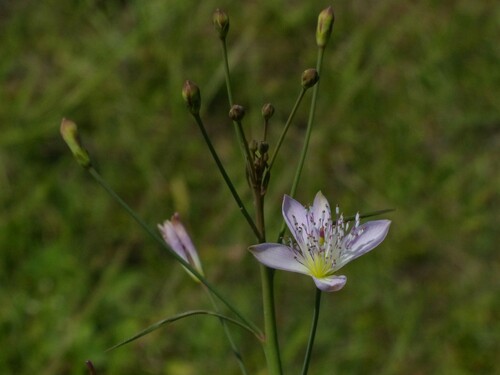
Cleome viscosa
L.
Sticky Cleome, Asian spiderflower
no rights reserved, uploaded by 葉子
no rights reserved, uploaded by 葉子
(c) Andrés Verver, some rights reserved (CC BY-NC), uploaded by Andrés Verver
What to Eat
Edible parts: Leaves, Fruit, Seeds, Oil, Vegetable, Spice
Leaves and young shoots are cooked as a vegetable and have a sharp, mustard-like flavour. The pungent seeds can be pickled or used as a mustard substitute in curries. Seedpods are also made into pickles. The juice of the plant is used as a condiment. An oil extracted from the seeds is used for cooking.
Where to Find It
It is a tropical plant. They are found in waste places at low and medium altitudes throughout the Philippines. In Nepal it grows up to 1200 m altitude. It is damaged by drought and frost. It grows in wetlands. It can grow in arid places. It restricts the germination and growth of Pearl millet. In central China it grows from sea level to 300 m above sea level. In Yunnan.
Afghanistan, Africa, Antigua-Barbuda, Asia, Australia, Barbados, Belize, Benin, Bermuda, Bhutan, Brazil, Burkina Faso, Cambodia, Cameroon, Cape Verde, Central Africa, Central America, Chad, China, Comoros, Côte d'Ivoire, Cuba, Dominica, Dominican Republic, East Africa, East Timor, Egypt, El Salvador, Ethiopia, Fiji, Gambia, Ghana, Grenada, Guadeloupe, Guatemala, Guinea, Guinée, Guinea-Bissau, Haiti, Himalayas, Honduras, India, Indochina, Indonesia, Iraq, Ivory Coast, Jamaica, Japan, Laos, Liberia, Madagascar, Malaysia, Maldives, Mali, Marquesas, Martinique, Mauritania, Mauritius, Mexico, Middle East, Myanmar, Nauru, Nepal, Nicaragua, Niger, Nigeria, North Africa, North America, Northeastern India, Pacific, Pakistan, Papua New Guinea, PNG, Philippines, Puerto Rico, Sahel, Samoa, Saudi Arabia, SE Asia, Senegal, Seychelles, Sierra Leone, Socotra, South America, Sri Lanka, Sudan, Taiwan, Tanzania, Thailand, Timor-Leste, Togo, Trinidad-Tobago, Tuvalu, Vietnam, Virgin Islands, West Africa, West Indies, Yemen,
How to Identify
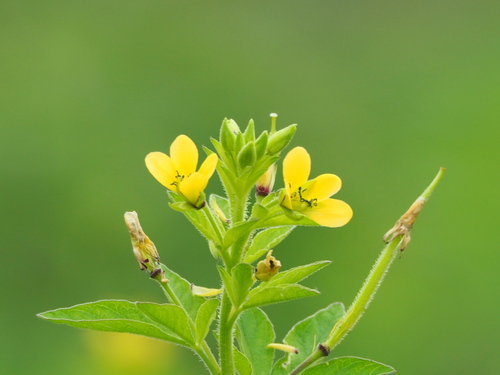
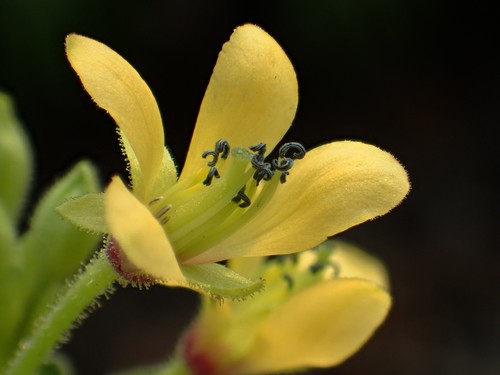
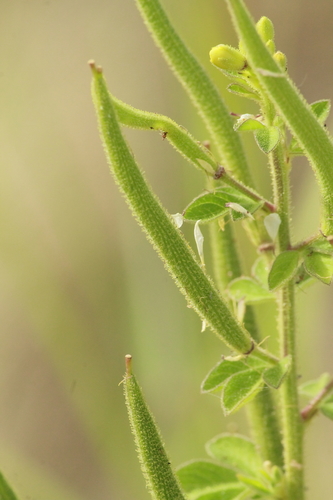
An erect annual herb. It is sticky. It has a rank smell and is about 0.3 to 1 m high. The leaves are made up of 3 to 5 leaflets each 1 to 3 cm long. The flowers are in leafy groups at the end of branches. The flowering shoots are 5-10 cm long. The flower stalks are less than 1 cm long. The petals are yellow and 7 to 8 mm long. The fruit is a capsule 3-10 cm long by 2-4 mm wide. It has ridges along it. It partly splits open. It is narrow. It narrows and gradually tapers near the tip. The stems and seed pods are hairy. The seeds are round, black and 1 mm across. There are 25-40 seeds. They are light brown and 1.2-1.8 mm long by 1-1.2 mm wide. They have fine ridges.
Nutrition Score: 30/100
| Part | Moisture | kJ | kcal | Protein | Vit A | Vit C | Iron | Zinc |
|---|---|---|---|---|---|---|---|---|
| Leaves | 80.4 | — | — | 5.6 | — | — | 24 | — |
How to Grow
Prefers a light fertile soil in a warm dry sunny position with plenty of room to spread. A frost tender plant, it can be grown as a summer annual in Britain.
Propagation: Surface sow or only lightly cover seed in spring in a greenhouse. Germination usually takes 5–14 days at 25°c. Prick seedlings into individual pots when large enough to handle and plant out in late spring. Daytime temperatures below 20°c depress germination, though a night-time drop to 20°c is necessary.
Medicinal Uses
The leaves are diaphoretic, rubefacient and vesicant, and are applied externally to wounds and ulcers. Leaf juice has been used to relieve earache. The seeds are anthelmintic, carminative, rubefacient, stimulant and vesicant, and contain 0.1% viscosic acid and 0.04% viscosin. A paste of the root is applied externally to treat earache.
Other Uses
Oil is obtained from the seeds.
Wikipedia
Source ↗Cleome viscosa, the Asian spiderflower or tick weed is an annual herb that grows up to a meter high. It belongs to the family Cleomaceae. It is considered an invasive species and is widely distributed in warm and humid habitats across the Americas, Africa and Asia, and in Australia (where it is considered a native). It is commonly found during the rainy season. The crushed leaves have been investigated as a treatment for stored seeds of cowpea, to prevent weevil infestation. The leaves are used as external application to wounds and ulcers. The seeds are anthelmintic and carminative. The juice of the leaves is used as a remedy against discharge of pus from the ear. In a study comparing C. viscosa to standard antibiotics, it was proven to be effective at inhibiting microbial growth. This demonstrates its effectiveness as an antimicrobial agent in comparison to the antibiotic tetracycline. In northern India, the seeds (called Jakhya) are used as a culinary herb, mainly for tempering. in Australia, the Walmajarri people of the southern Kimberley call it Jirlpirringarni.
Production
In China plants flower July to September and fruit in October.
Other Information
It is a minor leaf vegetable but becoming more popular as a seed condiment.
Notes
There are about 150 Cleome species. Chemical composition (per 100g) (leaves, raw): Protein = 5.5g. Fat = .9g. Calcium - 454 mg. Iron = 2.7 mg. Kcal = 57. The seeds are rich in oil (26%). They are also used in medicine.
Names & Synonyms
Bana-sorisha, Ban tori, Ganeragapa, Gant-galar, Huang hua cao, Huhul, Hulaga, Hulchul, Hulhul, Hurhura, Hurhure, Hushur, Kawal, Mangmang trin, Marang churamani, Momienh khma'ch, Mustard bush, Naikkadugu, Nal sirio, Namkani, Pak-sian-pee, Pingu-pan, Pivli-tilwan, Raa-beberi, Raa-beburi, Sirioarkho, Son tien, Swibhama, Tick weed, Tilwani, Tori jhar, Ujla hulhul, Yellow cleome
References (67)
- Belem, M., et al, 2017, Strategy of Conservation and Protection of Wild Edible Plants Diversity in Burkina Faso. ANADOLU 27 (2) 2017, 82- 90
- Balkrishna, A., et al, 2022, Indigenous Uses of Plants among Forest-dependent Communities of Seijosa, Arunachal Pradesh. International Journal of Economic Plants 2022, 9(1):064-080
- BERRY-KOCH,
- Bodkin, F., 1991, Encyclopedia Botanica. Cornstalk publishing, p 265
- Burkill, H. M., 1985, The useful plants of west tropical Africa, Vol. 1. Kew.
- Codjia, J. T. C., et al, 2003, Diversity and local valorisation of vegetal edible products in Benin. Cahiers Agricultures 12:1-12
- Cooper, W. and Cooper, W., 2004, Fruits of the Australian Tropical Rainforest. Nokomis Editions, Victoria, Australia. p 111
- Cowie, I, 2006, A Survey of Flora and vegetation of the proposed Jaco-Tutuala-Lore National Park. Timor-Lests (East Timor) www.territorystories.nt/gov.au p 45
- Cronin, L., 1989, The Concise Australian Flora. Reed. p 78
- Dalziel, J. M., 1937, The Useful plants of west tropical Africa. Crown Agents for the Colonies London.
- Dangol, D. R. et al, 2017, Wild Edible Plants in Nepal. Proceedings of 2nd National Workshop on CUAOGR, 2017.
- Dey, A. & Mukhererjee, A., 2015, Living and Survival Amidst Hunger: Wild Edible Botanicals as a Prime Forest Productivity in the Rural Purulia District, West Bengal, India from Colonial to Present. Research Journal of Forestry 9(3): 71-86
- Dhyani, S.K., & Sharma, R.V., 1987, Exploration of Socio-economic plant resources of Vyasi Valley in Tehri Garwhal. J. Econ. Tax. Bot. Vol. 9 No. 2 pp 299-310
- Dobriyal, M. J. R. & Dobriyal, R., 2014, Non Wood Forest Produce an Option for Ethnic Food and Nutritional Security in India. Int. J. of Usuf. Mngt. 15(1):17-37
- Elliot, W.R., & Jones, D.L., 1984, Encyclopedia of Australian Plants suitable for cultivation. Vol 3. Lothian. p 48
- Facciola, S., 1998, Cornucopia 2: a Source Book of Edible Plants. Kampong Publications, p 78
- Flora of Australia, Volume 8, Lecythidales to Batales, Australian Government Publishing Service, Canberra (1982) p 224
- Flora of China. www.eFloras.org (As Arivela viscosa)
- Flora of Pakistan. www.eFlora.org
- Gallagher, D. E., 2010, Farming beyond the escarpment: Society, Environment, and Mobility in Precolonial Southeastern Burkina Faso. PhD University of Michigan.
- GAMMIE,
- Gautam, R. S., et al, 2022, Ethnobotanical Review of Wild Edible Plants of Nepal. Journal of Natural History Museum Volume 32, 2021-22 p 109
- Grubben, G. J. H. and Denton, O. A. (eds), 2004, Plant Resources of Tropical Africa 2. Vegetables. PROTA, Wageningen, Netherlands. p 198
- GUPTA & KANODIA,
- Hedrick, U.P., 1919, (Ed.), Sturtevant's edible plants of the world. p 204
- Jadhav, R., et al, 2015, Forest Foods of Northern Western Ghats: Mode of Consumption, Nutrition and Availability. Asian Agri-History Vol. 19, No. 4: 293-317
- Joshi, N., et al, 2007, Traditional neglected vegetables of Nepal: Their sustainable utilization for meeting human needs. Tropentag 2007. Conference on International Agricultural Research for Development.
- Joshi, N. & Siwakoti, M., 2012, Wild Vegetables Used by Local Community of Makawanpur District and Their Contribution to Food Security and Income Generation. Nepal Journal of Science and Technology Vol. 13, No. 1 (2012) 59-66
- Kenneally, K.E., Edinger, D. C., and Willing T., 1996, Broome and Beyond, Plants and People of the Dampier Peninsula, Kimberley, Western Australia. Department of Conservation and Land Management. p 82
- Kermath, B. M., et al, 2014, Food Plants in the Americas: A survey of the domesticated, cultivated and wild plants used for Human food in North, Central and South America and the Caribbean. On line draft. p 243
- Lazarides, M. & Hince, B., 1993, Handbook of Economic Plants of Australia, CSIRO. p 61
- Levitt, D., 1981, Plants and people. Aboriginal uses of plants on Groote Eylandt. Australian Institute of Aboriginal Studies, Canberra. p 88
- Manandhar, N.P., 2002, Plants and People of Nepal. Timber Press. Portland, Oregon. p 159
- Marandi, R. R. & Britto, S. J., 2015, Medicinal Properties of Edible Weeds of Crop Fields and Wild plants Eaten by Oraon Tribals of Latehar District, Jharkhand. International Journal of Life Science and Pharma Research. Vo. 5. (2) April 2015
- Martin, F.W. & Ruberte, R.M., 1979, Edible Leaves of the Tropics. Antillian College Press, Mayaguez, Puerto Rico. p 181
- McMakin, P.D., 2000, Flowering Plants of Thailand. A Field Guide. White Lotus. p 89
- Mehta, P. S. et al, 2010, Native plant genetic resources and traditional foods of Uttarakhand Himalaya for sustainable food security and livelihood. Indian Journal or Natural products and Resources. Vol 1(1), March 2010 pp 89-96
- Mertz, O., Lykke, A. M., and Reenberg, A., 2001, Importance and Seasonality of Vegetable Consumption and Marketing in Burkina Faso. Economic Botany, 55(2):276-289
- Misra, S., 2020, Survey of edible plants for human consumption in south Odisha, India. Journal of Emerging Technologies and Innovative Research (JETIR) Vol. 7, Issue 12 p 278
- Monsalud, M.R., Tongacan, A.L., Lopez, F.R., & Lagrimas, M.Q., 1966, Edible Wild Plants in Philippine Forests. Philippine Journal of Science. p 450
- Morley, B.D., & Toelken, H.R., (Eds), 1983, Flowering Plants in Australia. Rigby. p 102
- Narayanan Ratheesh, M. K. et al, 2011, Wild edible plants used by the Kattunaikka, Paniya and Kuruma tribes of Wayanad District, Kerala, India. Journal of Medicinal Plants Research Vol. 5(15), pp. 3520-3529
- Paczkowska, G. & Chapman, A.R., 2000, The Western Australian Flora. A Descriptive Catalogue. Western Australian Herbarium. p 195
- Pagag, K. & Borthakur, S.K., 2012, Wild edible wetland plants from Lakhimpur district of Assam, India. Pleione 6(2): 322 - 327
- Peters, C. R., O'Brien, E. M., and Drummond, R.B., 1992, Edible Wild plants of Sub-saharan Africa. Kew. p 77
- Petheram, R.J. and Kok, B., 2003, Plants of the Kimberley Region of Western Australia. UWA Press p 91
- Pham-Hoang Ho, 1999, An Illustrated Flora of Vietnam. Nha Xuat Ban Tre. p 598
- Phon, P., 2000, Plants used in Cambodia. © Pauline Dy Phon, Phnom Penh, Cambodia. p 163
- Plants for a Future database, The Field, Penpol, Lostwithiel, Cornwall, PL22 0NG, UK. http://www.scs.leeds.ac.uk/pfaf/
- Plants of Haiti Smithsonian Institute http://botany.si.edu/antilles/West Indies
- Radha, B., et al, 2013, Wild Edible Plant Resources of the Lohba Range of Kedarnath Forest Division (KFD), Garhwal Himalaya, India. Int. Res J. Biological Sci. Vol. 2 (11), 65-73
- Royal Botanic Gardens, Kew (1999). Survey of Economic Plants for Arid and Semi-Arid Lands (SEPASAL) database. Published on the Internet; http://www.rbgkew.org.uk/ceb/sepasal/internet [Accessed 7th April 2011]
- Sang, D. T., & Mizoue, K. O. N., 2012, Use of Edible Forest Plants among Indigenous Ethnic Minorities in Cat Tien Biosphere Reserve, Vietnam. Asian Journal of Biodiversity Vol. 3 (1), p 23-49
- SAXENA,
- SHANKARNARAYAN & SAXENA,
- Sinha, R. & Lakra, V., 2007, Edible weeds of tribals in Jharkhand, Orissa and West Bengal. Indian Journal of Traditional Knowledge 6(1) January 2007 pp 217-222
- Smith, A.C., 1981, Flora Vitiensis Nova, Lawaii, Kuai, Hawaii, Volume 2 p 700
- Sp. pl. 2:672. 1753
- Sujanapal, P., & Sankaran, K. V., 2016, Common Plants of Maldives. FAO & Kerala FRI, p 88
- Sukenti, K., et al, 2016, Ethnobotanical study on local cuisine of the Sasak tribe in Lombok Island, Indonesia. Journal of Ethnic Foods. 3 (2016) 189-200 p 198
- Tewari, D.N., 1994, Important Plants of India. International Book Distributors, India. p 111
- Thaman, R. R, 2016, The flora of Tuvalu. Atoll Research Bulletin No. 611. Smithsonian Institute p 75
- Uprety, Y., et al, 2011, Plant biodiversity and ethnobotany inside the projected impact area of the Upper Seti Hydropower Project, Western Nepal. Environ. Dev. Sustain. (2011) 13:463-492
- Uprety, Y., et al, 2012, Diversity of use and local knowledge of wild edible plant resources in Nepal. Journal of Ethnobotany and Ethnomedicine 8:16
- WATT,
- Wheeler, J.R.(ed.), 1992, Flora of the Kimberley Region. CALM, Western Australian Herbarium, p 262
- World Checklist of Useful Plant Species 2020. Royal Botanic Gardens, Kew