Clitoria ternatea
L.
Butterfly Bean, Darwin pea, Streaky Bean
no rights reserved, uploaded by 葉子
no rights reserved, uploaded by 葉子

(c) James Kuria NDUNG’U, some rights reserved (CC BY-NC), uploaded by James Kuria NDUNG’U
What to Eat
Edible parts: Leaves, Pods, Flowers - tea, Flowers
The young pods are eaten as a vegetable. The flowers are used to give a blue tinge to rice cakes and boiled rice, and the leaves can also be used to colour food. Young leaves are cooked and used as a vegetable. This plant is noted as a protein staple crop in carbon farming contexts.
Where to Find It
It is a tropical plant. It will grow on most soils. It needs a sheltered sunny position. It is drought and frost tender. Mostly they grow on the edge of forests. It grows where the minimum temperature is 16°C. In Nepal it grows to about 250 m altitude in hedges and thickets. It can grow in arid places. In XTBG Yunnan. It suits hardiness zones 10-12.
Africa, Angola, Antigua-Barbuda, Aruba, Asia, Australia, Bahamas, Bangladesh, Barbados, Belize, Benin, Bhutan, Bolivia, Brazil, Burkina Faso, Burundi, Cabinda, Cambodia, Cameroon, Cape Verde, Caribbean, Cayman Islands, Central Africa, Central America, Chad, China, Colombia, Comoros, Congo, Costa Rica, Côte d'Ivoire, Cuba, Djibouti, Dominica, Dominican Republic, East Africa, Ecuador, El Salvador, Ethiopia, Europe, Fiji, French Guiana, Gabon, Gambia, Germany, Ghana, Guadeloupe, Guianas, Guam, Guatemala, Guinea, Guinée, Guinea-Bissau, Guyana, Haiti, Hawaii, Himalayas, Honduras, India, Indochina, Indonesia, Iran, Iraq, Ivory Coast, Jamaica, Kenya, Kiribati, Laos, Madagascar, Malawi, Malaysia, Maldives, Mali, Marianas, Marquesas, Martinique, Mauritius, Mexico, Micronesia, Middle East, Montserrat, Mozambique, Myanmar, Namibia, Nauru, Nepal, New Caledonia, Nicaragua, Niger, Nigeria, North America, Niue, Pacific, Pakistan, Palau, Panama, Papua New Guinea, PNG, Paraguay, Peru, Philippines, Puerto Rico, Reunion, Sahel, Sao Tome and Principe, Saudi Arabia, SE Asia, Seychelles, Senegal, Sierra Leone, Singapore, Solomon Islands, Somalia, South Africa, Southern Africa, South America, Sri Lanka, Sudan, Suriname, Taiwan, Tanzania, Thailand, Togo, Tonga, Tuvalu, Uganda, Uruguay, USA, Venezuela, Vietnam, West Africa, West Indies, West Timor, Yemen, Zambia, Zimbabwe,
How to Identify
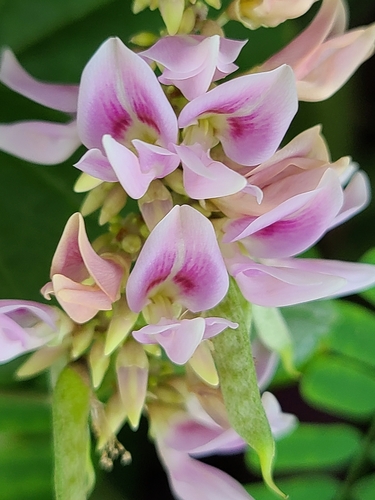
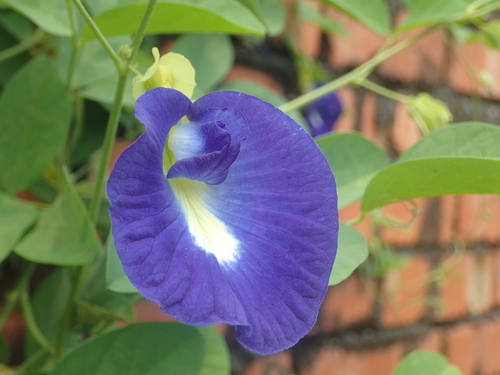
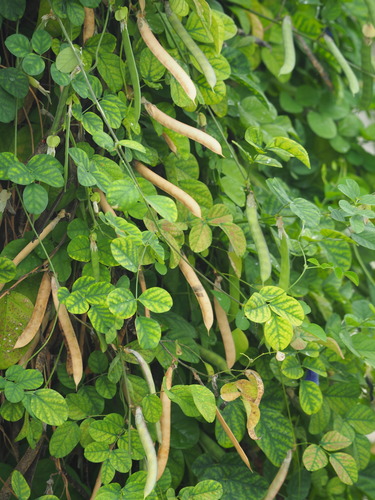
A perennial herb plant. It grows to 3-4.5 m tall and spreads to 4 m wide. The stem is slender and twines. The leaves are green and divided. They are 6-12 cm long. The 5-9 leaflets are oval. The flowers are bright purple. They are pea like and 3-5 cm across. They have yellow tinted white centres. The flowers occur either singly or in pairs. The fruit are flat pods. They are 7 cm long. After the seeds fall the pods twist. The seeds are dark brown to black.
Nutrition Score: 33/100
| Part | Moisture | kJ | kcal | Protein | Vit A | Vit C | Iron | Zinc |
|---|---|---|---|---|---|---|---|---|
| Pods & Seeds | 80 | 276 | 66 | 3.8 | — | — | 0.4 | — |
How to Grow
It is also grown as an annual in warm temperate areas. It grows best in areas with an annual rainfall in the region of 1,500mm, but it has a reputation for drought tolerance in the seasonally dry tropics (with 500 - 900 mm annual rainfall) and can probably survive with as little as 400mm annual rainfall. Its annual mean temperature range is 19 - 28°c and it has survived moderate frost damage in the subtropics (at a latitude of 26°S). Plants can succeed on a variety of soils as long as they are well-drained, but prefer a fertile, friable soil, growing poorly on infertile sandy soils if they not fertilized. It does well on heavy clay soils. Prefers a position in full sun. It succeeds within a pH range of 5.5 - 8.9. Butterfly pea is one of the few herbaceous legumes well adapted to heavy clay soils in the subhumid to semi-arid tropics and the only one with potential in irrigated pasture mixtures on these soils. Early growth of the plant from seed is rapid in warm moist conditions. Growth of established plants is mostly from the apices of the main axis and axillary branches; very few new shoots arise from ground level. Growth is more or less continuous in the humid tropics, or with irrigation in other hot regions. Individual plants may live for several years and grow into large vines if undisturbed. In the seasonally dry tropics and in cool regions, growth is limited by lack of moisture or low temperatures. Leaves are shed in response to these stresses and top growth may be killed by frost or fire. However, recovery during the following growing season is usually good Butterfly pea competes fairly well with weeds once established and can cover the ground in 4 - 6 weeks when sown at a population of 4 plants per square metre. Establishment may be a problem on fertile soils if sown with a vigorous companion grass or oversown into an existing pasture. It combines better with tussock than stoloniferous grasses in mixed pastures. The location of its growing points at the ends of the main branches makes it susceptible to frequent low cutting as well as to continuous heavy grazing. Flowers are cleistogamous but a small level of outcrossing occurs. Time to flowering can range from 7 - 11 weeks. Subsequent flowering flushes overlap pod maturation from the previous flush, and they continue throughout the year in frost-free regions. At higher latitudes in the tropics, there is usually a peak at the end of the wet season and again at the end of the cool season, if moisture is available. Pods mature in 8 - 10 weeks after flowering and shatter readily once fully dry. There is considerable variation in the size of flowers and leaflets. The plant is propagated by seed and readily self- propagates and spreads under favourable conditions by seed thrown vigorously from the dehiscing dry pods. Seed is also spread in cattle dung.Inoculation of butterfly pea seed with rhizobia is not usually necessary; but, if it is required, broad spectrum cowpea inoculum should be used. This species has a symbiotic relationship with certain soil bacteria, these bacteria form nodules on the roots and fix atmospheric nitrogen. Some of this nitrogen is utilized by the growing plant but some can also be used by other plants growing nearby. Climate: tropical. Humidity: semi-arid to humid. Carbon Farming - Cultivation: minor global crop. Management: hay.
Propagation: Seed — hand-harvested seed tends to remain hard for a long time and requires scarification before sowing. Dormancy can be broken by mechanical abrasion, hot water, or sulphuric acid treatment. Seed is normally sown from the beginning to the middle of the wet season at rates of 3–5 kg/ha (or 1 kg/ha under ideal conditions) in well-prepared seedbeds, placed 1.5–4 cm deep and lightly covered. Rates of 5–8 kg/ha may be needed when sowing into rough conditions. Germination is epigeal; the radicle emerges within 48–72 hours and seedlings appear within 3–6 days depending on planting depth.
Medicinal Uses
In traditional Ayurvedic medicine the plant is credited with memory-enhancing, nootropic, antistress, anxiolytic, antidepressant, anticonvulsant, tranquilizing, and sedative properties. Traditional Chinese medicine attributes effects on female libido to the plant, based on its resemblance to the female reproductive organ. The flowers are mixed with water and used to treat eye problems. The powdered ripe seeds are aperient and purgative. The roots are bitter, powerfully cathartic, diuretic, and purgative. The rootbark is diuretic and laxative. The plant is also used in the treatment of snakebites. The seeds contain a fixed oil, a bitter resinous compound, and tannins; the rootbark contains tannins.
Other Uses
Butterfly pea has a reputation as a potential fodder plant, hay crop, or cover crop, and has been extensively tested as such, particularly in subhumid to semi-arid tropical regions. It is used by smallholders as a cover crop in coconut plantations in southern India and in rubber plantations in Malaysia, providing good ground cover due to its fast growth. The leaves and flowers can be used as a dye. The seeds and bark are a source of tannins. In agroforestry, it serves as a nitrogen-fixing species.
Wikipedia
Source ↗Clitoria ternatea, commonly known as Shankhupushpam (conch-shaped flower), Asian pigeonwings, bluebellvine, blue pea, butterfly pea, cordofan pea, or Darwin pea, is a plant species belonging to the family Fabaceae and native to the Indonesian island of Ternate. In Indian Ayurveda it is commonly known by the name aparajita.
Notes
It becomes a weed in many places forming tangled hedges. There are about 40 Clitoria species. In the Botanical Gardens in Slovenia - presumably in a hot house.
Names & Synonyms
Anchan, Ang chan, Anjan, Aparijita, Aporajita, Asian pigeon wings, Aung-mai-hpyu, Aung-me-nyo, Azulejo, Bejuco de conchitos, Bunga biru, Bunga telang, Campanilla, Cordofan pea, Dau biec, Gokran, Gokurna, Kacang, Kachang telang, Kakkanam, Kakkattan, Kelang, Kembang telang, Kembang teleng, Latoalawa, Menteleng, Mparia, Nanreethimaa, Oporajita, Papito, Pe-nauk-ni, Pokindang, Pukunggan, Samsampin, Sangu pushpam, Supli, Uang-chan, Zapatillo de la reina
References (51)
- Ambasta, S.P. (Ed.), 2000, The Useful Plants of India. CSIR India. p 133
- Aniama, S. O., et al, 2016, Ethnobotanical documentaton of some plants among Igala people of Kogi State (Nigeria). The International Journal Of Engineering And Science (IJES). 5(4) pp 33-42
- Ara, R. I. T., 2015, Leafy Vegetables in Bangladesh. Photon eBooks. p 119
- Benvenuti, S. & Mazzoncini, M., 2021, The Biodiversity of Edible Flowers: Discovering New Tastes and New Health Benefits. Frontiers in Plant Science Article 569499.
- Bodkin, F., 1991, Encyclopedia Botanica. Cornstalk publishing, p 268
- Borrell, O.W., 1989, An Annotated Checklist of the Flora of Kairiru Island, New Guinea. Marcellin College, Victoria Australia. p 89
- Brickell, C. (Ed.), 1999, The Royal Horticultural Society A-Z Encyclopedia of Garden Plants. Convent Garden Books. p 282
- Burkill, I.H., 1966, A Dictionary of the Economic Products of the Malay Peninsula. Ministry of Agriculture and Cooperatives, Kuala Lumpur, Malaysia. Vol 1 (A-H) p 596
- Cooper, W. and Cooper, W., 2004, Fruits of the Australian Tropical Rainforest. Nokomis Editions, Victoria, Australia. p 205
- Cundall, P., (ed.), 2004, Gardening Australia: flora: the gardener's bible. ABC Books. p 394
- Engel, D.H., & Phummai, S., 2000, A Field Guide to Tropical Plants of Asia. Timber Press. p 196
- Facciola, S., 1998, Cornucopia 2: a Source Book of Edible Plants. Kampong Publications, p 103
- Flora of Pakistan. www.eFloras.org
- Food Composition Tables for use in East Asia FAO http://www.fao.org/infoods/directory No. 665
- Frantz, P. R., 1991, Ethnobotany of Clitoria. Economic Botany 45(4): 511-520
- Hardwick, G., 2001, Economically Useful Plants for Northern Australia: Master Species List. Crusader eBooks.
- Hedrick, U.P., 1919, (Ed.), Sturtevant's edible plants of the world. p 205
- Henty, E.E., & Pritchard, G.S., 1973, Weeds of New Guinea and their control. Botany Bulletin No 7, Division of Botany, Lae, PNG. p 119
- Hibbert, M., 2002, The Aussie Plant Finder 2002, Florilegium. p 70
- Hossain, U. & Rahman, A., 2018, Study and quantitative analysis of wild vegetable floral diversity available in Barisal district, Bangladesh. Asian J. Med. Biol. Res. 2018, 4 (4), 362-371
- Hussey, B.M.J., Keighery, G.J., Cousens, R.D., Dodd, J., Lloyd, S.G., 1997, Western Weeds. A guide to the weeds of Western Australia. Plant Protection Society of Western Australia. p 148
- ILDIS Legumes of the World http:www:ildis.org/Legume/Web
- Jackes, B.R., 2001, Plants of the Tropics. Rainforest to Heath. An Identification Guide. James Cook University. p 54
- Kaewnarin, K., et al, 2014, Antioxidant and Antiglycation Activities of Some Edible and Medicinal Plants. Chiang Mai J. Sci. 2014; 41(1) : 105-116
- Kenneally, K.E., Edinger, D. C., and Willing T., 1996, Broome and Beyond, Plants and People of the Dampier Peninsula, Kimberley, Western Australia. Department of Conservation and Land Management. p 153
- Lazarides, M. & Hince, B., 1993, Handbook of Economic Plants of Australia, CSIRO. p 62
- Liu, Yi-tao, & Long, Chun-Lin, 2002, Studies on Edible Flowers Consumed by Ethnic Groups in Yunnan. Acta Botanica Yunnanica. 24(1):41-56
- Llamas, K.A., 2003, Tropical Flowering Plants. Timber Press. p 217
- Lugod, G.C. and de Padua L.S., 1979, Wild Food Plants in the Philippines. Vol. 1. Univ. of Philippines Los Banos. p 46
- Maghirang, R. G., et al, 2018. Ethnobotanical Studies of Some Plants Commonly Used as Vegetables in Selected Provinces of the Philippines. Journal of Nature Studies. 17(2), 30-43.
- Manandhar, N.P., 2002, Plants and People of Nepal. Timber Press. Portland, Oregon. p 162
- Martin, F.W. & Ruberte, R.M., 1979, Edible Leaves of the Tropics. Antillian College Press, Mayaguez, Puerto Rico. p 71, 198
- McMakin, P.D., 2000, Flowering Plants of Thailand. A Field Guide. White Lotus. p 96
- Morley, B. & Everard, B., 1970, Wild Flowers of the World. Ebury press. Plate 53
- Mutie, F. M., et al, 2023, Important Medicinal and Food Taxa (Orders and Families) in Kenya, Based on Three Quantitative Approaches. Plants 2023, 12, 1145
- Paczkowska, G . & Chapman, A.R., 2000, The Western Australian Flora. A Descriptive Catalogue. Western Australian Herbarium. p 421
- Peekel, P.G., 1984, (Translation E.E.Henty), Flora of the Bismarck Archipelago for Naturalists, Division of Botany, Lae, PNG. p 247, 244
- Pham-Hoang Ho, 1999, An Illustrated Flora of Vietnam. Nha Xuat Ban Tre. p 953
- Plants of Haiti Smithsonian Institute http://botany.si.edu/antilles/West Indies
- Polinag, M. A., 2003, Food from the Wilderness. Department of Environment and Natural Resources. Laguna.
- Royal Botanic Gardens, Kew (1999). Survey of Economic Plants for Arid and Semi-Arid Lands (SEPASAL) database. Published on the Internet; http://www.rbgkew.org.uk/ceb/sepasal/internet [Accessed 28th April 2011]
- Shumsky, S., et al, 2014, Institutional factors affecting wild edible plant (WEP) harvest and consumption in semi-arid Kenya. Land Use Policy 38(2014) 48-69
- Sp. pl. 2:753. 1753
- Sujanapal, P., & Sankaran, K. V., 2016, Common Plants of Maldives. FAO & Kerala FRI, p 90
- Sukarya, D. G., (Ed.) 2013, 3,500 Plant Species of the Botanic Gardens of Indonesia. LIPI p 1090
- Tamil herbs, 2007, Edible Plants of the Tropical Dry Evergreen Forest.
- Thaman, R. R., 1987, Plants of Kiribati: A listing and analysis of vernacular names. Atoll Research Bulletin No. 296
- Thaman, R. R, 2016, The flora of Tuvalu. Atoll Research Bulletin No. 611. Smithsonian Institute p 89
- Wheeler, J.R.(ed.), 1992, Flora of the Kimberley Region. CALM, Western Australian Herbarium, p 378
- World Checklist of Useful Plant Species 2020. Royal Botanic Gardens, Kew
- Yuncker, T.G., 1959, Plants of Tonga, Bernice P. Bishop Museum, Hawaii, Bulletin 220. p 145