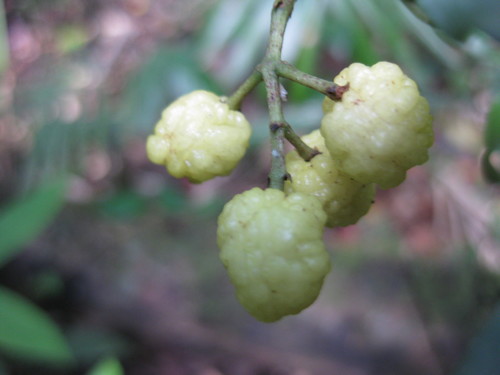
Clymenia polyandra
(Tanaka) Swingle
Clymenia, Polyandra kumquat

IRVC - University of California, Irvine Herbarium (IRVC-IRVC)

Carnegie Museum of Natural History
What to Eat
Edible parts: Fruit
The fruit are eaten fresh, with the flesh being edible.
Known Hazards
Where to Find It
A tropical plant. It is cultivated on Manus and New Ireland. It occurs in Bougainville. It only occurs in PNG.
Pacific, Papua New Guinea, PNG,
How to Identify
A citrus relative. The tree is 5-8 m tall. The leaves are large (18 cm x 6 cm) and simple. Young leaves have lobes. The leaves are more thin and papery than other citrus. The leaves taper towards the tip and have notched edges. The leaf stalks are short and without wings. It does not have thorns. The flowers are dark yellow and 2.5-3 cm across. They occur either singly, or as 2-4 together, in the axils of leaves. The fruit is yellow and the size of a large lime. They are 7-10 cm long by 6-8 cm wide. The flesh is edible. The skin of the fruit can irritate human skin. The seeds are flattish with lines on them.
How to Grow
Trees are grown from seed.
Production
Some kinds have sweet pleasant tasting fruit.
Other Information
In Papua New Guinea, fruit are of moderate importance in only a few limited areas. It could become important for breeding or rootstocks.
Names & Synonyms
References (8)
- French, B.R., 1986, Food Plants of Papua New Guinea, A Compendium. Asia Pacific Science Foundation p 232
- J. Arnold Arbor. 20:253. 1939
- Martin, F. W., et al, 1987, Perennial Edible Fruits of the Tropics. USDA Handbook 642 p 74
- Peekel, P.G., 1984, (Translation E.E.Henty), Flora of the Bismarck Archipelago for Naturalists, Division of Botany, Lae, PNG. p 272, 273
- Swingle, W. T. & P. C. Reece. 1967. The botany of Citrus and its wild relatives. (Bot Citrus)
- USDA, ARS, National Genetic Resources Program. Germplasm Resources Information Network - (GRIN). [Online Database] National Germplasm Resources Laboratory, Beltsville, Maryland. Available: www.ars-grin.gov/cgi-bin/npgs/html/econ.pl (10 April 2000)
- Wiersema, J. H. & Leon, B., 2013, World Economic Plants. A Standard Reference CRC Press. 2nd Ed. p 187
- World Checklist of Useful Plant Species 2020. Royal Botanic Gardens, Kew (Also as Citrus polyandra)