Cocculus hirsutus
(L.) Diels.
Python climber, Broom creeper, Bushveld moonseed creeper
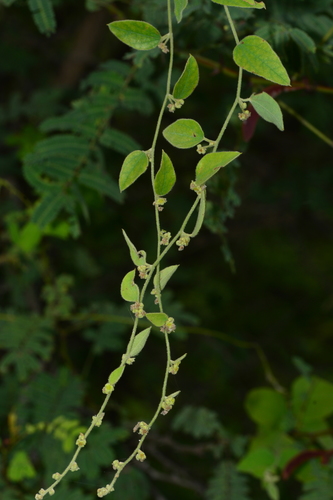
no rights reserved, uploaded by S.MORE
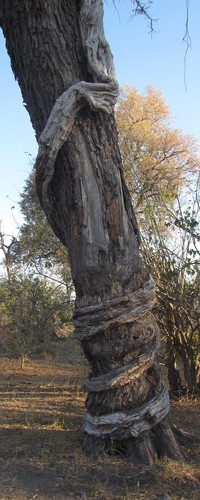
(c) Robert Taylor, some rights reserved (CC BY)
What to Eat
Edible parts: Leaves, Fruit
The leaves are eaten raw, used in curry preparations, or boiled with salt and chilli peppers. The fruit are eaten as a snack and as a vegetable, particularly by children.
Where to Find It
A tropical plant. It grows in hot arid places. It grows in dry rocky soils. It grows between 50-1,200 m above sea level. It can grow in arid places.
Africa, Angola, Asia, Botswana, Central Africa, East Africa, Eswatini, Ethiopia, Himalayas, India, Kenya, Malawi, Middle East, Mozambique, Myanmar, Namibia, Nepal, Pakistan, Saudi Arabia, SE Asia, Somalia, South Africa, Southern Africa, Sri Lanka, Sudan, Swaziland, Tanzania, Uganda, Yemen, Zambia, Zimbabwe,
How to Identify
A woody vine or climbing shrub. It is densely hairy. The bark is light grey and textured. The leaves are 4-8 cm long by 5-7 cm wide. They are oval. They can have 3-5 lobes. The leaves have 3 prominent veins that start at the base. The flowers are separate. The fruit is dark purple and fleshy. It is 4-8 mm long.
Nutrition Score: 56/100
| Part | Moisture | kJ | kcal | Protein | Vit A | Vit C | Iron | Zinc |
|---|---|---|---|---|---|---|---|---|
| Leaves | 44.4 | 790 | 189 | 9.1 | — | — | 10.7 | 1.4 |
| Leaves | 76.5 | — | — | 3.9 | — | — | 9.9 | 0.6 |
How to Grow
A dioecious species, both male and female forms need to be grown if fruit and seed are required.
Medicinal Uses
The leaves are used in medicine.
Other Uses
The stems are used in basketry. The are used in making basket chairs. A blue colouring obtained from the fruit is used to colour baskets blue. The fruits are combined with the seedpods of Acacia nilotica subalata in order to make the blue colour.
Wikipedia
Source ↗Cocculus hirsutus is a tropical flowering plant with the common name broom creeper or Patalgarudi (Sanskrit). It is native to South Asia, Southeast Asia, parts of East Asia, West Asia and tropical Africa. It is a vine climbing up to 3 metres (9.8 ft), with white to yellowish flowers and dark purple fruits 4 to 8 mm in diameter.
Other Information
The fruit are eaten by children.
Notes
There are about 8 Cocculus species. The leaves are used in medicine.
Names & Synonyms
Bosveld-halfmaanranker, Chireta, Dagadi, Dusaraitige, Dusari balli, Dusseru, Huyer, Jaljamni, Jamti-ki-bél, Jamtikibel, Karrom, Kattukkodi, Musakana, Muzwingo, Nguelana, Para-vel, Patalagarudi, Rupamane, Sisi, Sogadi-balli, Tsitsi, Ururio, Vasan vel, Vasanti tikta, Vasano, Vasu vel, Vellakattukkodi, Vevati
References (38)
- Ambasta, S.P. (Ed.), 2000, The Useful Plants of India. CSIR India. p 133
- Arinathan, V., et al, 2007, Wild edibles used by Palliyars of the western Ghats, Tamil Nadu. Indian Journal of Traditional Knowledge. 6(1) pp 163-168
- Bhaskarachary, K., et al, 1995, Carotene content of some common and less familiar foods of plant origin. Food Chemistry 54: 189-193
- Chauhan, S. H., et al, 2018, Consumption patterns of wild edibles by the Vasavas: a case study from Gujarat, India. Journal of Ethnobiology and Ethnomedicine (2018) 14:5
- Dobriyal, M. J. R. & Dobriyal, R., 2014, Non Wood Forest Produce an Option for Ethnic Food and Nutritional Security in India. Int. J. of Usuf. Mngt. 15(1):17-37
- H. G. A. Engler, Pflanzenr. IV. 94(Heft 46):236. 1910
- Flora of Pakistan. www.eFloras.org
- Fowler, D. G., 2007, Zambian Plants: Their Vernacular Names and Uses. Kew. p 48
- Fox, F. W. & Young, M. E. N., 1982, Food from the Veld. Delta Books. p 266
- GAMMIE, (As Cocculus villosus)
- Grivetti, L. E., 1980, Agricultural development: present and potential role of edible wild plants. Part 2: Sub-Saharan Africa, Report to the Department of State Agency for International Development. p 70
- GUPTA & KANODIA,
- Gupta, S., et al, 2005, Analysis of nutrient and antinutrient content of underutilized green leafy vegetables. LWT 38:339-345
- INFOODSUpdatedFGU-list.xls
- Jadhav, R., et al, 2015, Forest Foods of Northern Western Ghats: Mode of Consumption, Nutrition and Availability. Asian Agri-History Vol. 19, No. 4: 293-317
- Karthi, Sathya, & Salome, 2014, Uncultivated Edible Greens from Small Millet Farms Tamil Nadu India. IDRC
- Kuhnlein, H. V., et al, 2009, Indigenous Peoples' food systems. FAO Rome p 192
- Magwede, K., van Wyk, B.-E., & van Wyk, A. E., 2019, An inventory of Vhavenḓa useful plants. South African Journal of Botany 122 (2019) 57–89
- Misra, S., 2020, Survey of edible plants for human consumption in south Odisha, India. Journal of Emerging Technologies and Innovative Research (JETIR) Vol. 7, Issue 12 p 278
- Mutie, F. M., et al, 2023, Important Medicinal and Food Taxa (Orders and Families) in Kenya, Based on Three Quantitative Approaches. Plants 2023, 12, 1145
- Peters, C. R., O'Brien, E. M., and Drummond, R.B., 1992, Edible Wild plants of Sub-saharan Africa. Kew. p 147
- Pradhan, R., et al, 2020, Potential Wild Edible Plants and its Significance in Livelihood of Indigenous People of Male Mahadeshwara Hills, Karnataka. Economic Affairs Vol. 64, No. 4 pp. 01-14
- Rajasab, A. H. et al, 2004, Documentation of folk knowledge on edible wild plants of North Karnataka. Indian Journal of Traditional Knowledge. Vol 3(4) pp 419-429
- Rajkalkshmi, P. et al, 2001, Total carotenoid and beta-carotene contents of forest green leafy vegetables consumed by tribals of south India. Plant Foods for Human Nutrition 56:225-238
- Reddy, K. N. et al, 2007, Traditional knowledge on wild food plants in Andhra Pradesh. Indian Journal of Traditional Knowledge. Vol. 6(1): 223-229
- Roodt, V., 1998, Trees & Shrubs of the Okavango Delta. Medicinal Uses and Nutritional value. The Shell Field Guide Series: Part 1. Shell Botswana. p 35
- Royal Botanic Gardens, Kew (1999). Survey of Economic Plants for Arid and Semi-Arid Lands (SEPASAL) database. Published on the Internet; http://www.rbgkew.org.uk/ceb/sepasal/internet [Accessed 4th May 2011]
- Ruiters-Welcome, A. K., 2019, Food plants of southern Africa. Ph.D. thesis. Univ. of Johannesburg p 78
- Saidulu, P. et al, 2015, Ethnobotanical Knowledge Studied in Pocharam Wildlife Sanctuary, Telangana, India. Not Sci Biol, 2015, 7(2):164 -170
- Sarvalingam, A., et al, 2014, Wild edible plant resources used by the Irulas of the Maruthamalai Hills, Southern Western Ghats, Coimbatore, Tamil Nadu. Indian Journal of Natural Products and Resources 5(2):198-201
- Scudder, 1962, 1971,
- Shackleton, S. E., et al, 1998, Use and Trading of Wild Edible Herbs in the Central Lowveld Savanna Region, South Africa. Economic Botany, Vol. 52, No. 3, pp. 251-259
- Singh, H.B., Arora R.K.,1978, Wild edible Plants of India. Indian Council of Agricultural Research, New Delhi. p 39 (As Cocculus villosus)
- Tamil herbs, 2007, Edible Plants of the Tropical Dry Evergreen Forest.
- WATT, (As Cocculus villosus)
- Welcome, A. K. & Van Wyk, B.-E., 2019, An inventory and analysis of the food plants of southern Africa. South African Journal of Botany 122 (2019) 136–179
- Wild edible plants of Himachal Pradesh
- World Checklist of Useful Plant Species 2020. Royal Botanic Gardens, Kew


