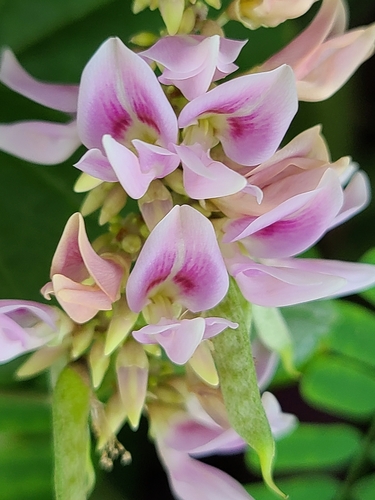
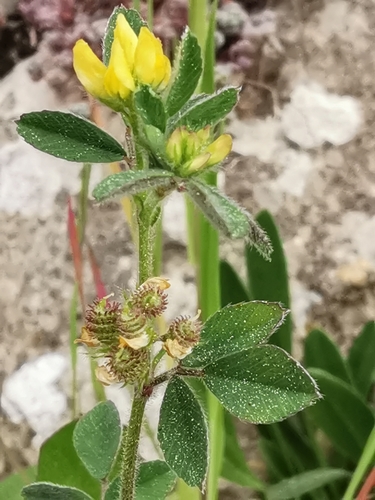
Medicago minima
(L.) L.
FabaceaeShoots
fodder

iNaturalist · cc-by-sa
(c) Fornax, some rights reserved (CC BY-SA)
(c) Fornax, some rights reserved (CC BY-SA)

iNaturalist · cc-by-sa
(c) Fornax, some rights reserved (CC BY-SA)
(c) Fornax, some rights reserved (CC BY-SA)
iNaturalist · cc-by-nc
(c) bscrl, some rights reserved (CC BY-NC), uploaded by bscrl
(c) bscrl, some rights reserved (CC BY-NC), uploaded by bscrl
What to Eat
Edible parts: Shoots
The shoots are eaten.
Where to Find It
It is a temperate plant.
Asia, Australia, Central Asia, Europe, Korea, Luxembourg, Pakistan, Tajikistan, Tasmania,
Countries: Andorra, United Arab Emirates, Afghanistan, Albania, Armenia, Austria, Australia, Azerbaijan, Bosnia & Herzegovina, Bangladesh, Belgium, Bulgaria, Bahrain, Brunei, Bhutan, Belarus, Switzerland, China, Cyprus, Czechia, Germany, Denmark, Estonia, Spain, Finland, France, United Kingdom, Georgia, Greece, Croatia, Hungary, Indonesia, Ireland, Israel, India, Iraq, Iran, Iceland, Italy, Jordan, Japan, Kyrgyzstan, Cambodia, North Korea, South Korea, Kuwait, Kazakhstan, Laos, Lebanon, Liechtenstein, Sri Lanka, Lithuania, Luxembourg, Latvia, Monaco, Moldova, Montenegro, North Macedonia, Myanmar, Mongolia, Malta, Maldives, Malaysia, Netherlands, Norway, Nepal, Oman, Philippines, Pakistan, Poland, Portugal, Qatar, Romania, Serbia, Russia, Saudi Arabia, Sweden, Singapore, Slovenia, Slovakia, San Marino, Syria, Thailand, Tajikistan, Timor-Leste, Turkmenistan, Turkey, Taiwan, Ukraine, Uzbekistan, Vietnam, Yemen
How to Identify
A temperate herbaceous plant in the legume family (Fabaceae).
Wikipedia
Source ↗Medicago minima is a plant species of the genus Medicago. It is native to the Mediterranean basin but is found worldwide. It forms a symbiotic relationship with the bacterium Sinorhizobium meliloti, which is capable of nitrogen fixation. Common names include bur medick, little bur-clover, little bur medick, little medick, small medick, and woolly bur medick.
Names & Synonyms
Pashtarey, Peshtarey, Shpaishtay
Medicago hirsuta (L.) All.and several others
References (3)
- Barkatullah, et al, 2009, Ethnobotanical studies of plants of Charkotli Hills, Batkhela District, Malakand, Pakistan. Front. Biol. China 2009, 4(4): 539–548
- Barkatullah and Ibrar, M., 2011, Plants profile of Malakand Pass Hills, District Malakand, Pakistan. African Journal of Biotechnology Vol. 10 (73) pp. 16521-16535 (with authority (L.) Grub)
- Sher, Z., Hussain, F., & Ibrar, M., 2014, Traditional knowledge on plant resources of Ashezai and Salarzai Valleys, District Buner, Pakistan. African Journal of Plant Science. Vol. 8(1), pp. 42-53, January 2014