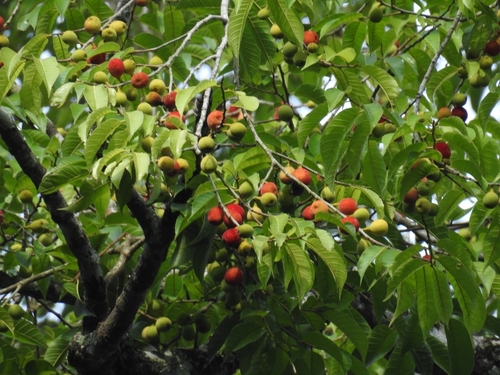
Ficus cyrtophylla
(Wall. ex Miq.) Miq.
iNaturalist · cc-by-nc
(c) Phuentsho, some rights reserved (CC BY-NC)
(c) Phuentsho, some rights reserved (CC BY-NC)
iNaturalist · cc-by-nc
(c) Phuentsho, some rights reserved (CC BY-NC)
(c) Phuentsho, some rights reserved (CC BY-NC)
iNaturalist · cc-by-nc
(c) Phuentsho, some rights reserved (CC BY-NC)
(c) Phuentsho, some rights reserved (CC BY-NC)
What to Eat
Edible parts: Fruit - drink
The fruit is consumed as a drink.
Where to Find It
It is a subtropical plant. It grows between 300-1,800 m above sea level in Sikkim. In Yunnan.
Asia, Bhutan, China, Himalayas, India, Myanmar, Northeastern India, SE Asia, Sikkim, Thailand, Tibet, Vietnam,
Countries: United Arab Emirates, Afghanistan, Armenia, Azerbaijan, Bangladesh, Bahrain, Brunei, Bhutan, China, Georgia, Indonesia, Israel, India, Iraq, Iran, Jordan, Japan, Kyrgyzstan, Cambodia, North Korea, South Korea, Kuwait, Kazakhstan, Laos, Lebanon, Sri Lanka, Myanmar, Mongolia, Maldives, Malaysia, Nepal, Oman, Philippines, Pakistan, Qatar, Saudi Arabia, Singapore, Syria, Thailand, Tajikistan, Timor-Leste, Turkmenistan, Turkey, Taiwan, Uzbekistan, Vietnam, Yemen
How to Identify
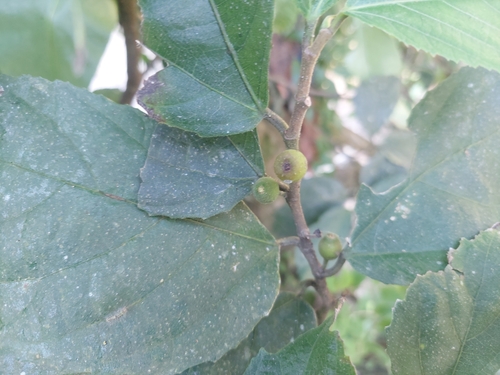
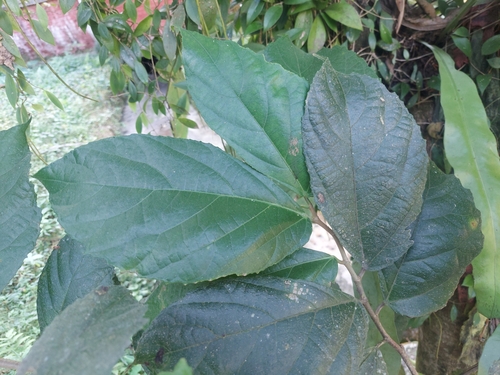
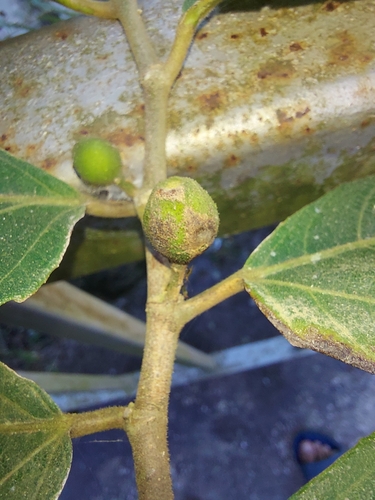
A fig tree. It grows 3-6 m tall The trunk is 5-6 cm across. The bark is grey and smooth. The small branches have short hairs. The leaves are oblong and strongly unequal on opposite sides. They are 9-15 cm long by 5-8 cm wide. The figs are in the axils of leaves on normal leafy shoots. They are in pairs or clusters. They are yellowish-orange when ripe. They are 8-10 mm across.
Names & Synonyms
Kalo khasrey, Pa-ju-ma
References (2)
- Li, S., et al, 2020, Monpa, memory, and change: an ethnobotanical study of plant use in Mêdog County, South-east Tibet, China. Journal of Ethnobiology and Ethnomedicine. (2020) 16:5 p 20
- Sharma, G., et al, 2016, Agrobiodiversity in the Sikkim Himalaya. International Centre for Integrated Mountain Development, ICIMOD Working Paper 2016/5 p 20