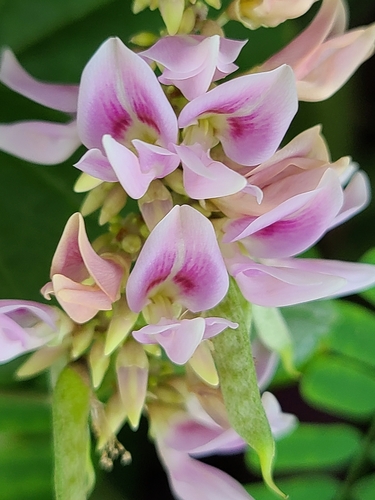
Exostyles venusta
Spreng.
Guaxingaba acu

(c) Geovane Siqueira, some rights reserved (CC BY-NC), uploaded by Geovane Siqueira

(c) Geovane Siqueira, some rights reserved (CC BY-NC), uploaded by Geovane Siqueira

(c) Geovane Siqueira, some rights reserved (CC BY-NC), uploaded by Geovane Siqueira
What to Eat
Edible parts: Fruit, Pod pulp
Fruits - raw. Both monkeys and humans appreciate the fruits.The fruit has a fleshy consistency when mature. It is a yellowish-green legume around 125 - 184mm long, 23 - 26mm wide and 3 - 8mm thick, containing 6 - 10 seeds.
Where to Find It
It is a tropical plant.
Brazil, South America,
How to Identify
A shrub or small tree. It grows 3.5-10 m tall. The fruit (pods) are 4-6 cm long.
How to Grow
A plant of dappled woodland shade. It grows on sany soils in the wild. Although many species within the family Fabaceae have a symbiotic relationship with soil bacteria, this species is said to be devoid of such a relationship and therefore does not fix atmospheric nitrogen.
Propagation: Seed - it has a hard seedcoat and may benefit from scarification before sowing to speed up and improve germination. This can usually be done by pouring a small amount of nearly boiling water on the seeds (being careful not to cook them!) and then soaking them for 12 - 24 hours in warm water. By this time they should have imbibed moisture and swollen - if they have not, then carefully make a nick in the seedcoat (being careful not to damage the embryo) and soak for a further 12 hours before sowing. The seed is best sown as soon as it is ripe in a partially shaded position in a nursery seedbed. A low germination rate can be expected from untreated seed, with the seed sprouting within a few weeks.
Other Uses
The wood is medium-textured, irregular-grained, moderately heavy, with a moderate resistance to wood-eating organisms. It is difficult to work and plane, being considered suitable only for internal construction.
Wikipedia
Source ↗Exostyles venusta is a species of legume found in Northeast Brazil and Southest Brazil. It is a tree that grows primarily in a wet, tropical, biome. It was first described by Heinrich Wilhelm Schott in 1827. It is a flowering plant and a legume, and grows a large trunk.
References (2)
- e-jardim.com
- www.colecionandofrutas.org