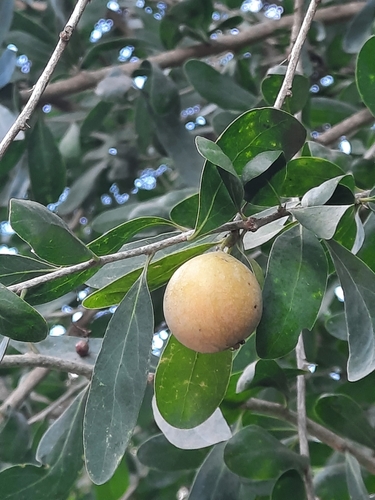
Colpoon compressum
Berg.
Cape sumach
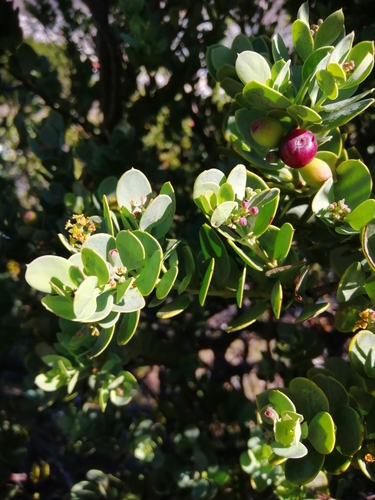
(c) jems, some rights reserved (CC BY-NC), uploaded by jems
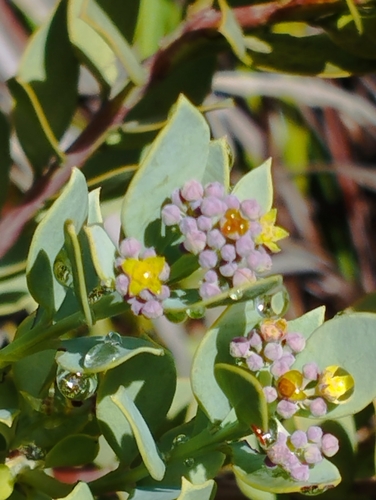
(c) sallyhey, some rights reserved (CC BY-NC)
What to Eat
Edible parts: Fruit
The fruit is eaten raw and can be stored.
Where to Find It
A tropical plant. It is common on sand dunes and in dune bush. It also grows among rocks on the lower slopes of mountains.
Africa, Angola, Central Africa, Mozambique, South Africa, Southern Africa,
How to Identify
A shrub or small tree. It grows up to 4.5 m tall. The bark is grey and thin. The leaves are oval and crowded up the stems in opposite pairs. They are 3.5 cm long by 1.7-2.7 cm wide. They are blue-green with a grey bloom. The flowers are small and yellowish-green. They occur in bunches on the ends of branches. Flowers contain both male and female flower parts. The fruit is oval and less than 1 cm across. They are dark purple to red when ripe. The fruit are edible.
Production
In South Africa the fruit ripen July to August.
Other Information
Fruit are stored.
Names & Synonyms
Bergbas, Imbulunyathi, Intekeza, Isiduli, Mtekaaza, Pruimbos, Umbalanythi, Umbulanyathi
References (6)
- Fox, F. W. & Young, M. E. N., 1982, Food from the Veld. Delta Books. p 331
- Palgrave, K.C., 1996, Trees of Southern Africa. Struik Publishers. p 156
- Palmer, E and Pitman, N., 1972, Trees of Southern Africa. Vol. 1. A.A. Balkema, Cape Town p 556
- Ruiters-Welcome, A. K., 2019, Food plants of southern Africa. Ph.D. thesis. Univ. of Johannesburg p 100
- Shava, S., 2000, The Use of Indigenous Plants as Food by a Rural Community in the Eastern Cape: an Educational Exploration. Masters Thesis Rhodes University. p 63
- Welcome, A. K. & Van Wyk, B.-E., 2019, An inventory and analysis of the food plants of southern Africa. South African Journal of Botany 122 (2019) 136–179