Colubrina asiatica
(L.) Brongn.
Beach berry bush, Asian Colubrina
(c) Ehoarn Bidault, some rights reserved (CC BY-NC), uploaded by Ehoarn Bidault

(c) Shiwalee Samant, some rights reserved (CC BY-NC)

(c) Shiwalee Samant, some rights reserved (CC BY-NC)
What to Eat
Edible parts: Leaves
The young leaves are eaten, traditionally served with fish.
Known Hazards
Where to Find It
A tropical plant. It needs a sunny position and well drained soil. It is often found along the seashore.
Africa, American Samoa, Asia, Australia, Bahamas, Brunei, Cayman Islands, China, Chuuk, East Africa, East Timor, Fiji, FSM, Hawaii, India, Indochina, Indonesia, Kenya, Malaysia, Maldives, Marquesas, Mexico, Mozambique, Myanmar, Nauru, Niue, North America, Pacific, Palau, Papua New Guinea, PNG, Philippines, Pohnpei, Rotuma, Samoa, SE Asia, Southern Africa, Sri Lanka, Taiwan, Thailand, Timor-Leste, Tonga, Tuvalu, USA, Vanuatu, Wallis and Futuna, West Indies, Zimbabwe,
How to Identify
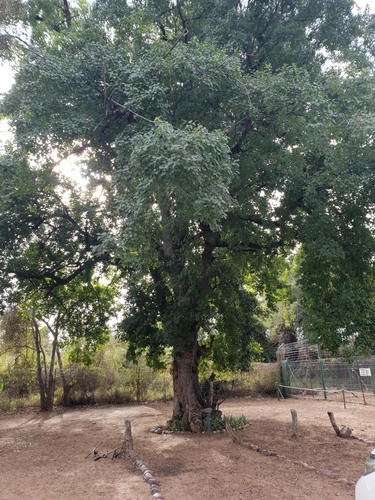
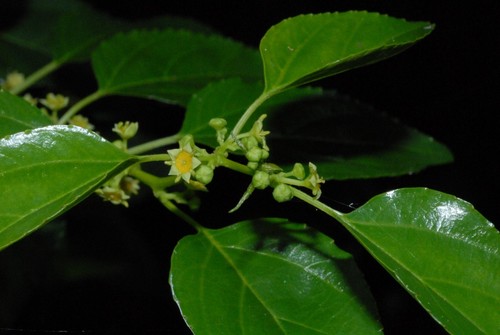
A tall shrub 3-7 m high. It tends to climb. The branches are slender and flexible. They are often trailing. The leaves are alternate. The leaves are 5-8 cm long, by 2-3 cm wide. They are oval, and heart shaped at the base and taper to the tip. There are teeth along the edge of the leaf. The leaves are dark green and shiny, with 3 prominent veins. The flowers are in the axils of leaves, and dense. The flowers are 0.4 cm across and greenish. The fruit is 0.8 cm across, and furrowed and somewhat sunken at the top.
How to Grow
Plants can be grown from seed or cuttings.
Propagation: Seed - sow in a sunny position. The seeds can remain viable for several months when soaked in salt water, and also remain viable for several years when in the soil.
Medicinal Uses
The leaves are alterative and cooling. A decoction is used to alleviate skin irritation and to treat a variety of skin diseases. A decoction of the fruit is used as an abortifacient and tonic. Applied externally, it is used as a cicatrizant for wounds. The juice of the plant is used as a tonic. The bark contains saponins. Plant extracts contain alkaloids, flavonoids, unsaturated sterols and triterpenes, steroid glycosides, anthraquinones, saponins, tannins and phenols. The leaves contain two saponins and glycosides.
Other Uses
The leaves contain saponins and produce a lather when rubbed in water. They can be used as a soap substitute. A very vigorous and aggressive plant that scrambles over the ground forming roots as it grows. It is an excellent plant for binding the sand near the sea and can also be grown as a ground cover plant in sunny positions. It should not, however, be planted in areas outside its native range because of its ability to escape from cultivation and out-compete native species.
Wikipedia
Source ↗Colubrina asiatica is a shrub in the family Rhamnaceae that is native to tropical and subtropical regions of the Old World, from eastern Africa to India, southeast Asia, tropical Australia, and the Pacific Islands. Common names include latherleaf, Asian nakedwood and Asian snakewood.
Notes
There are about 20-31 Colubrina species. They grow in the tropics. There are 20 species in tropical America.
Names & Synonyms
Asiatic snakewood, Ewongup, Fisoa, Guti, Hoop withe, Kan-soeng, Kayu ular, Kyway-nwe, Mayirmanikkan, Peria laut, Peria pantai, Raarohi, Raaruhi, Sarunai kayu
References (29)
- Ali M. S. M., 2008, Analysis of Phenolics and Other Phytochemicals in Selected Malaysian Traditional Vegetables and Their Activities In Vitro. PhD thesis University of Glasgow.
- Altschul, S.V.R., 1973, Drugs and Foods from Little-known Plants. Notes in Harvard University Herbaria. Harvard Univ. Press. Massachusetts. no. 2647
- Ambasta, S.P. (Ed.), 2000, The Useful Plants of India. CSIR India. p 137
- Beasley, J., 2011, Plants of Tropical North Queensland - the compact guide. Footloose publications. p 33
- Borrell, O.W., 1989, An Annotated Checklist of the Flora of Kairiru Island, New Guinea. Marcellin College, Victoria Australia. p 121
- Burkill, I.H., 1966, A Dictionary of the Economic Products of the Malay Peninsula. Ministry of Agriculture and Cooperatives, Kuala Lumpur, Malaysia. Vol 1 (A-H) p 651
- Cooper, W. and Cooper, W., 2004, Fruits of the Australian Tropical Rainforest. Nokomis Editions, Victoria, Australia. p 424
- Cowie, I, 2006, A Survey of Flora and vegetation of the proposed Jaco-Tutuala-Lore National Park. Timor-Lests (East Timor) www.territorystories.nt/gov.au p 52
- Elliot, W.R., & Jones, D.L., 1984, Encyclopedia of Australian Plants suitable for cultivation. Vol 3. Lothian. p 59
- Franklin, J., Keppel, G., & Whistler, W., 2008, The vegetation and flora of Lakeba, Nayau and Aiwa Islands, Central Lau Group, Fiji. Micronesica 40(1/2): 169–225, 2008
- Heyne, K., 1927,
- Jackes, B.R., 2001, Plants of the Tropics. Rainforest to Heath. An Identification Guide. James Cook University. p 76
- Khumgratok, S., Edible Plants in Cultural Forests of Northeastern Thailand. Mahasarakham University Thailand.
- MARDI Malaysia
- Martin, F.W. & Ruberte, R.M., 1979, Edible Leaves of the Tropics. Antillian College Press, Mayaguez, Puerto Rico. p 215
- McMakin, P.D., 2000, Flowering Plants of Thailand. A Field Guide. White Lotus. p 58
- Mem. fam. Rhamnees 62. 1826 (Ann. Sci. Nat. (Paris) 10:369. 1827)
- Paczkowska, G . & Chapman, A.R., 2000, The Western Australian Flora. A Descriptive Catalogue. Western Australian Herbarium. p 507
- Palgrave, K.C., 1996, Trees of Southern Africa. Struik Publishers. p 556
- Parham, B. E. V., 1972, Plants of Samoa. New Zealand Department of Scientific and Industrial Research. Information Series. No. 85 p 33
- Peekel, P.G., 1984, (Translation E.E.Henty), Flora of the Bismarck Archipelago for Naturalists, Division of Botany, Lae, PNG. p 343, 342
- Selvam, V., 2007, Trees and shrubs of the Maldives. RAP Publication No. 2007/12 p 74
- Smith, A.C., 1985, Flora Vitiensis Nova, Lawaii, Kuai, Hawaii, Volume 3 p 688
- Stone, B.,
- Sukarya, D. G., (Ed.) 2013, 3,500 Plant Species of the Botanic Gardens of Indonesia. LIPI p 617
- Suksri, S., et al, 2005, Ethnobotany in Bung Khong Long Non-Hunting Area, Northeast Thailand. Kasetsart J., (Nat. Sci) 39: 519-533
- Thaman, R. R, 2016, The flora of Tuvalu. Atoll Research Bulletin No. 611. Smithsonian Institute p 108
- World Checklist of Useful Plant Species 2020. Royal Botanic Gardens, Kew
- Yuncker, T.G., 1959, Plants of Tonga, Bernice P. Bishop Museum, Hawaii, Bulletin 220. p 177