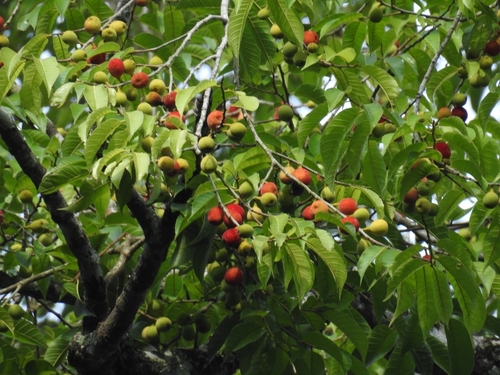
Ficus squamosa
Roxb.
MoraceaeFruit

iNaturalist · cc-by-nc
(c) onidiras-iNaturalist, some rights reserved (CC BY-NC), uploaded by onidiras-iNaturalist
(c) onidiras-iNaturalist, some rights reserved (CC BY-NC), uploaded by onidiras-iNaturalist
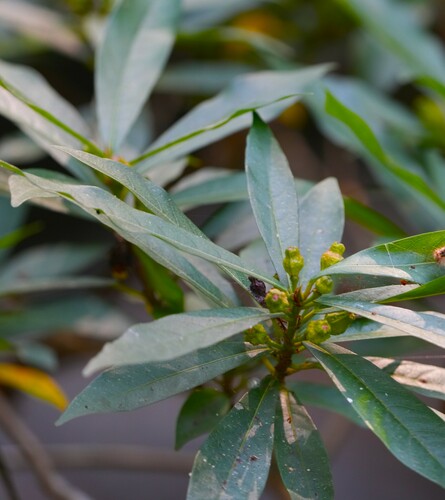
iNaturalist · cc-by-nc
(c) Dean Walton, some rights reserved (CC BY-NC)
(c) Dean Walton, some rights reserved (CC BY-NC)
What to Eat
Edible parts: Fruit
The fruit is eaten.
Where to Find It
It is a subtropical plant. In Yunnan in China it grows between 700-1,100 m above sea level.
Asia, Bhutan, China, Himalayas, India, Myanmar, Nepal, Northeastern India, SE Asia, Sikkim, Thailand,
Countries: United Arab Emirates, Afghanistan, Armenia, Azerbaijan, Bangladesh, Bahrain, Brunei, Bhutan, China, Georgia, Indonesia, Israel, India, Iraq, Iran, Jordan, Japan, Kyrgyzstan, Cambodia, North Korea, South Korea, Kuwait, Kazakhstan, Laos, Lebanon, Sri Lanka, Myanmar, Mongolia, Maldives, Malaysia, Nepal, Oman, Philippines, Pakistan, Qatar, Saudi Arabia, Singapore, Syria, Thailand, Tajikistan, Timor-Leste, Turkmenistan, Turkey, Taiwan, Uzbekistan, Vietnam, Yemen
How to Identify
A shrub. The small branches and leaf stalks are hairy. The leaves are arranged in spirals. The leaves are oblong and 5-13 cm long by 1-3 cm wide. They have rusty coloured hairs underneath. The figs are in the axils of leaves or on older branches. They are round with long ridges along them. They are 1.5-2 cm across.
Names & Synonyms
Talagi
Ficus laminosa Hardw. ex Roxb.Ficus pyrrhocarpa KurzFicus saemocarpa Miq.
References (2)
- Flora of China.
- Murtem, G. & Chaudhrey, P., 2016, An ethnobotanical note on wild edible plants of Upper Eastern Himalaya, India. Brazilian Journal of Biological Sciences, 2016, v. 3, no. 5, p. 63-81