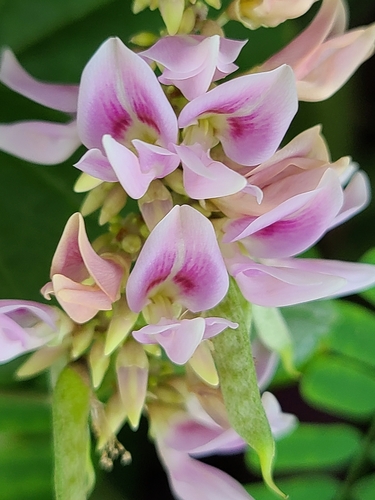
Hardwickia binata
Roxb.

(c) P Jeganathan, some rights reserved (CC BY), uploaded by P Jeganathan

(c) Mittal Gala, some rights reserved (CC BY)
What to Eat
Edible parts: Fruit
The fruit pods are edible.
Where to Find It
It is a tropical plant.
Asia, India, Pakistan,
How to Identify
A tree. It loses its leaves during the year. The leaves are alternate and have 2 leaflets. The leaves are 3-7 cm long by 1-3 cm wide. They are broadly oval. The flowering shoots are long and slender and in groups at the ends of branches. The pods are strap shaped and narrow at each end. They are 5-11 cm long by 1.3-2.5 cm wide. There is 1 seed near the tip of the pod.
How to Grow
Hardwickia binata is a plant of the dry to moist lowland tropics and subtropics, growing mainly in a climate characterized by a long period of drought, scant to moderate rainfall, and intense heat during the hot season. It it is found at elevations up to 300 metres. It grows best in areas where annual daytime temperatures are within the range 16 - 38°c, but can tolerate 5 - 46°c. Mature plants can be killed by temperatures of -2°c or lower, but new growth will be severely damaged at -1°c. In the cold season, frosts, generally mild, occur only in certain portions of its area of distribution, particularly in low-lying areas. It prefers a mean annual rainfall in the range 500 - 1,000mm, but tolerates 250 - 1,500mm. The tree grows best on sandstone, conglomerate, quartzite, granite and schist, with an overlying soil of sandy loam or, very characteristic, a quartzose reddish gravelly sand. The tree thrives in a dry climate and is capable of establishing itself and growing on dry shallow soil and rocky ground where most other species would succumb. Young trees can withstand some shade and may even require artificial shading. Later, the plants are moderately light demanding.The overlying soil does not have to be deep since the taproot has a capacity for growing through fissures in solid rock. It tolerates acidic to neutral soils. Prefers a pH in the range 5.5 - 7.5, tolerating 4.5 - 8. In its natural range, the seedlings are sensitive to drought, while frosts are not severe enough to do any harm. From the second year onwards, the plants are immune to injury from frost. A taproot that has the ability to penetrate hard soil and fissures in solid rock develops early in the life of the seedling plant. The stem usually dies back annually during the early years of developing the taproot. The tree pollards well even up to a comparatively advanced age, and old pollards when pollarded again almost invariably produce abundant new shoots. However, the tree coppices poorly. Old trees, which send out vigorous pollard shoots if cut 1 or 2 metres above the ground, produce no coppice shoots if cut flush with the ground; old pollards when felled at ground level never coppice. Young shoots are sensitive to fire, but recovery is good. A nodulating species, but there is considerable doubt about whether it is nitrogen fixing or not.
Propagation: Seed - fresh mature seed has a high fertility rate and germinates readily with moderate moisture. Germination is epigeous. Growth and survival of seedlings are improved by mulching and shade. Seed may sometimes retain viability for 1 or even 2 years.
Medicinal Uses
The bark of the tree is used for making ropes. The timber obtained from Hardwickia binata is used for making agricultural equipment like cart wheels, oil mills, pestles and ploughs. The leaves, succulent stems, and twigs serve as fodder for livestock. The bark is found to have a good adsorption capacity for mercury, and a modification of the bark is found to be useful for the removal of mercury from water under certain conditions. Oleo-resin extracted from the heart wood is used in manufacture of varnishes. Resin exuding from the heartwood is used for dressing the sores of elephants. The balsam, combined with cubebs and sandal, is used for treating sexually transmitted diseases like leucorrhoea, chronic cystitis, and gonorrhoea. The resin (not the oleo-resin) derived from the tree is used as a diuretic
Other Uses
The bark yields a strong fibre largely employed for making ropes, paper, cordage and sails. The bark contains tannins. A balsam similar to copaiba balsam (obtained from Copaifera species) is obtained from the trunk. The resin cannot be used in the same ways as copaiba resin. It is used as a wood preservative. The wood is perhaps the hardest and heaviest in India. The heartwood is dark reddish-brown streaked with purple; it is clearly demarcated from the thin band of white sapwood. The wood is close grained, difficult to season but fairly durable. The wood is used for beams and mine props, bridge and house construction, agricultural implements, carts and wheel work. The tree provides excellent firewood and good charcoal. Branches are much lopped for manure; leaves can be used as mulch. The plant has a deep rooting system and therefore does not compete much with any arable crops grown near it.
Names & Synonyms
Aacha maram
References (1)
- Kannan, M., et al, 2015, Ethnobotanical survey on wild edible plants of Kalrayan Hills, Salem District, Tamil Nadu, India. Global J. Res. Med Plants & Indigen. med. 4(12): 236-246