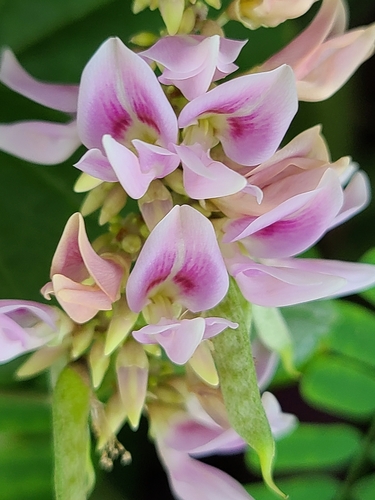
Crotalaria longipes
Wight & Arn.
FabaceaeLeaves

iNaturalist · cc-by-nc
(c) Brandon Fountain, some rights reserved (CC BY-NC)
(c) Brandon Fountain, some rights reserved (CC BY-NC)

iNaturalist · cc-by-nc
(c) Brandon Fountain, some rights reserved (CC BY-NC)
(c) Brandon Fountain, some rights reserved (CC BY-NC)

iNaturalist · cc-by-nc
(c) Joshua Doby, some rights reserved (CC BY-NC)
(c) Joshua Doby, some rights reserved (CC BY-NC)
What to Eat
Edible parts: Leaves
Young leaves are cooked as a vegetable.
Where to Find It
It is a tropical plant.
Asia, India,
Countries: United Arab Emirates, Afghanistan, Armenia, Azerbaijan, Bangladesh, Bahrain, Brunei, Bhutan, China, Georgia, Indonesia, Israel, India, Iraq, Iran, Jordan, Japan, Kyrgyzstan, Cambodia, North Korea, South Korea, Kuwait, Kazakhstan, Laos, Lebanon, Sri Lanka, Myanmar, Mongolia, Maldives, Malaysia, Nepal, Oman, Philippines, Pakistan, Qatar, Saudi Arabia, Singapore, Syria, Thailand, Tajikistan, Timor-Leste, Turkmenistan, Turkey, Taiwan, Uzbekistan, Vietnam, Yemen
How to Identify
A tropical tree in the legume family (Fabaceae) with young leaves that are cooked as a vegetable.
Names & Synonyms
Thukkan chedi
References (1)
- Kannan, M., et al, 2015, Ethnobotanical survey on wild edible plants of Kalrayan Hills, Salem District, Tamil Nadu, India. Global J. Res. Med Plants & Indigen. med. 4(12): 236-246 (As Crotalaria shevaroyensis)