Baissea multiflora
A. DC.
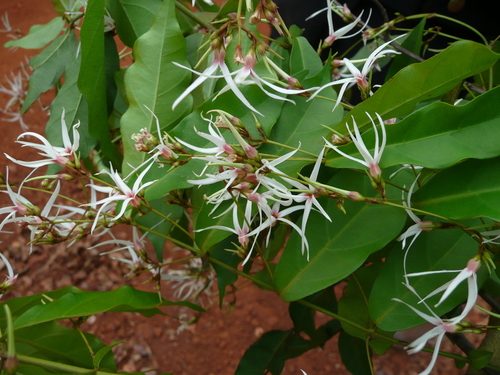
(c) Carel Jongkind, some rights reserved (CC BY-NC), uploaded by Carel Jongkind
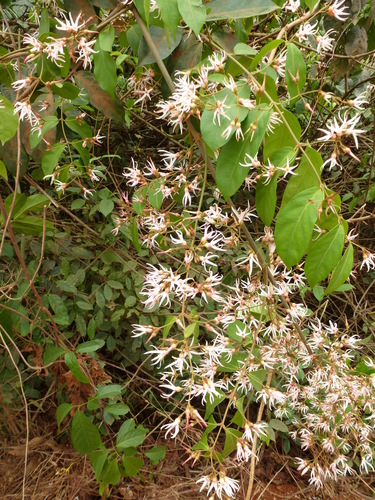
(c) Carel Jongkind, some rights reserved (CC BY-NC), uploaded by Carel Jongkind
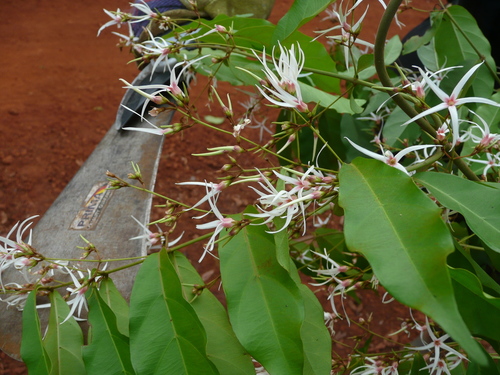
(c) Carel Jongkind, some rights reserved (CC BY-NC), uploaded by Carel Jongkind
What to Eat
Edible parts: Fruit
The fruit is eaten.
Where to Find It
It is a tropical plant. It grows in forests between 150 m to 1,400 m above sea level.
Africa, Angola, Burkina Faso, Cameroon, Central Africa, Central African Republic, CAR, Congo DR, Congo R, Côte d'Ivoire, East Africa, Gabon, Gambia, Ghana, Guinea, Guinée, Guinea-Bissau, Ivory Coast, Liberia, Mali, Niger, Nigeria, Sahel, Senegal, Sierra Leone, West Africa,
How to Identify
A shrub or creeper. It can grow 6 m tall or be 30 m long. The stem is 12 cm across. The flowers are white, pink or orange.
How to Grow
The plant can flower and produce fruit all year round.
Medicinal Uses
A decoction of the roots and bark has a good reputation for calming colic without causing diarrhoea, and also for treating infantile diarrhoea and female sterility. The bark, and more especially leafy twigs rich in latex, are taken in various preparations for treating oedemas arising through deficiencies. The root-powder mixed with food or drink is a treatment for appendicitis. Mixed in water, the root powder is dripped into the eye when treating conjunctivitis and cataracts. The root powder is also applied to snake bites. An aqueous decoction of the stem is considered diuretic and is taken by draught for the treatment of rheumatism, arthritis, kidney troubles, lumbago, and for general lassitude. The treatment is enhanced by applying the lees from the decoction as a friction rub. A few drops of the sap are given to children with fever. Ash of the plant is rubbed on the back to treat backache.
Other Uses
The stems are very strong and are used for tying house-roofs. The bark is made into rope. The plant contains a white latex which has in the past been collected to produce a good quality rubber.
Wikipedia
Source ↗Baissea multiflora is a plant in the family Apocynaceae.
Names & Synonyms
Bokila, Botohe'o'okila, Longongya
References (3)
- Harris, D. J., 2002, The vascular plants of the Dzanga-Sangha Reserve, Central African Republic. National Botanic Garden of Belgium, 2002. – 274 pages p 49
- Terashima, H., Ichikawa, M. & Ohta, L., (Ed.), 1991, A Flora: Catalog of Useful Plants of Tropical Africa. African study monographs. Supplementary issue (1991), 16:195 (As Baissea thollonii)
- von Katja Rembold, 2011, Conservation status of the vascular plants in East African rain forests. Dissertation Universitat Koblenz-Landau p 157


