Commelina diffusa
Burm. f.
Wandering Jew, Spreading Dayflower
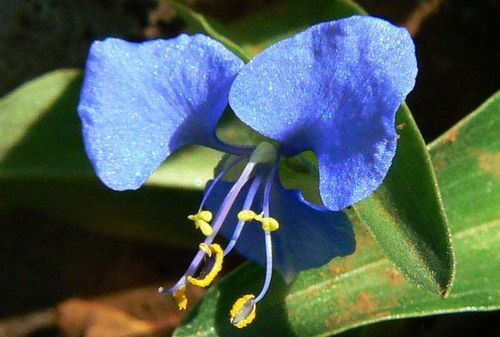
(c) lougarou, some rights reserved (CC BY-NC), uploaded by lougarou
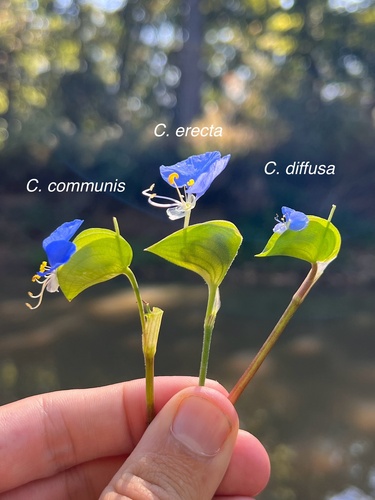
(c) Nathan Aaron, some rights reserved (CC BY)

(c) Saryu Mae 前 朝琉, some rights reserved (CC BY), uploaded by Saryu Mae 前 朝琉
What to Eat
Edible parts: Leaves, Vegetable
The young leaf tips are cooked and eaten, commonly stewed with pork or used in soups.
Where to Find It
A tropical plant. It grows in moist places. It can grow in shady places. It occurs from sea level up to about 1600 m altitude in the tropics. In Ethiopia it grows between 500-2,400 m above sea level. In Yunnan.
Africa, American Samoa, Andaman Is., Angola, Argentina, Asia, Australia, Bahamas, Bangladesh, Belize, Benin, Bolivia, Botswana, Brazil, Burkina Faso, Burundi, Cambodia, Cameroon, Central Africa, Central African Republic, CAR, Chad, China, Comoros, Congo DR, Congo R., Côte d'Ivoire, Dominican Republic, East Africa, East Timor, Easter Island, Ecuador, El Salvador, Equatorial Guinea, Eswatini, Ethiopia, Fiji, Gabon, Ghana, Guam, Guatemala, French Guiana, Guinea, Guinée, Guinea-Bissau, Guyana, Haiti, Hawaii, Himalayas, Honduras, India, Indochina, Indonesia, Ivory Coast, Jamaica, Laos, Malaysia, Marquesas, Marshall Islands, Mexico, Micronesia, Myanmar, New Caledonia, Nicaragua, Nigeria, Niue, North America, Pacific, Panama, Papua New Guinea, PNG, Paraguay, Peru, Philippines, Puerto Rico, Rotuma, Samoa, Sao Tome and Principe, SE Asia, Sierra Leone, South Africa, South America, Southern Africa, St Helena, St Lucia, Suriname, Swaziland, Taiwan, Tanzania, Thailand, Tibet, Timor-Leste, Togo, Tokelau, Tonga, Trinidad-Tobago, Tuvalu, Uganda, Uruguay, USA, Vanuatu, Venezuela, Vietnam, West Africa, West Indies, Yemen, Zambia, Zimbabwe,
How to Identify
A small leafed, straggling herb, with blue flowers. It continues to grow from year to year. It can grow to 1 m long. The stems are weak. The stem is fleshy, and it roots at the nodes. The leaves are alternate and sword shaped. They are 4-10 cm long. They have short stalks and a stem clasping sheath. The flowers are blue and 2.5-3 cm across. One of the 3 petals is smaller than the others. The seeds have fine patterns on one side. They are angular and about 2 mm long.
How to Grow
It grows easily from stem pieces. It prefers poorly drained soil, in open sunny positions, but can grow quite well in shady places. Plants can also be grown from seed.
Medicinal Uses
Within China, Commelina diffusa is used as a medicinal herb with febrifugal and diuretic effects. A dye is also obtained from the juice of the petals for use in painting. Within Hawaii, "honohono grass" was used as medicine to aid with deep cuts. While other Hawaiian herbs just get superficial cuts, honohono grass is an herb to aid with deeper troubling issues. According to a work by Bruce French published on papuaweb.org, the young leaf tips are cooked and eaten in New Guinea. (See page 80.)
Other Uses
The juice of the petals can be used as a dye for painting.
Wikipedia
Source ↗Commelina diffusa, sometimes known as the climbing dayflower or spreading dayflower, is a pantropical herbaceous plant in the dayflower family. It has been introduced to the southeastern United States where it is most common in wet disturbed soils. There are two recognised varieties, one being the type and the other being C. diffusa var. gigas, which is native to Asia and has been introduced to Florida. It flowers from spring to fall and is most common in disturbed situations, moist places and forests. In China the plant is used medicinally as a febrifuge and a diuretic. A blue dye is also extracted from the flower for paints. In the Hawaiian Islands, it is known as "honohono grass", although it is technically not a grass. "Honohono" refers to the alternating structure of the leaves. At least one publication lists it as an edible plant in New Guinea.
Other Information
In Papua New Guinea it is declining in importance as a cultivated crop but still harvested from the wild in a number of places. It is sold in local markets.
Notes
There are about 230 Commelina species.
Names & Synonyms
Alikbangon, Awarang, Brambangan, Ekwangalele, Gandologi, Gatilang, Gewor lalakina, Gondo, Hombiyhaem, Jie jie cao, Kondo, Kondow, Kulkul-lasi, Kunchindo, Mau'utoga, Nuo niu pao, Ondos-do-mar, Pagei, Phak kab pi, Phak pab, Punyopujyu, Pup, Rumput aur, Sau rangi, Semprebiban-damalong, Trapoeraba, Welilo, Wetkyok, Zobut
References (49)
- Achigan-Dako, E, et al (Eds), 2009, Catalogue of Traditional Vegetables in Benin. International Foundation for Science.
- Awas, T., 1997, A Study on the Ecology and Ethnobotany of Non-cultivated Food Plants and Wild Relatives of Cultivated crops in Gambella Region, Southwestern Ethiopia. Addis Ababa University. p 72
- Balemie, K., & Kebebew, F., 2006, Ethnobotanical study of wild edible plants in Derashe and Kucha Districts, South Ethiopia. Journal of Ethnobiology and Ethnomedicine.
- Belem, M., et al, 2017, Strategy of Conservation and Protection of Wild Edible Plants Diversity in Burkina Faso. ANADOLU 27 (2) 2017, 82- 90
- Borrell, O.W., 1989, An Annotated Checklist of the Flora of Kairiru Island, New Guinea. Marcellin College, Victoria Australia. p 18
- Burkill, H. M.,
- Burkill, I. H.,
- Chauhan, S. H., et al, 2018, Consumption patterns of wild edibles by the Vasavas: a case study from Gujarat, India. Journal of Ethnobiology and Ethnomedicine (2018) 14:5
- Cowie, I, 2006, A Survey of Flora and vegetation of the proposed Jaco-Tutuala-Lore National Park. Timor-Lests (East Timor) www.territorystories.nt/gov.au p 45
- Diaz-Betancourt, M., et al, 1999, Weeds as a future source for human consumption. Rev. Biol. Trop. 47(3):329-338
- Duke, J.A., 1992, Handbook of Edible Weeds. CRC Press. p 76
- FAO, 1988, Traditional Food Plants, FAO Food and Nutrition Paper 42. FAO Rome p 214
- Fl. indica 18, t. 7, fig. 2. 1768
- Franklin, J., Keppel, G., & Whistler, W., 2008, The vegetation and flora of Lakeba, Nayau and Aiwa Islands, Central Lau Group, Fiji. Micronesica 40(1/2): 169–225, 2008
- French, B.R., 1986, Food Plants of Papua New Guinea, A Compendium. Asia Pacific Science Foundation p 80
- Goode, P., 1989, Edible Plants of Uganda. FAO p 36
- Grubben, G. J. H. and Denton, O. A. (eds), 2004, Plant Resources of Tropical Africa 2. Vegetables. PROTA, Wageningen, Netherlands. p 560
- Haberle, S., 2005, Ethnobotany of the Tari basin, Southern Highlands Province, Papua New Guinea. Palaeoworks Technical Paper 6.
- Henty, E.E., & Pritchard, G.S., 1973, Weeds of New Guinea and their control. Botany Bulletin No 7, Division of Botany, Lae, PNG. p 29
- Hide, R., et al, 1979, A checklist of some plants in the territory of the Sinasina Nimai (Simbai Province, Papua New Guinea), with notes on their uses. Department Anthropology, University of Aukland
- Hong Deyuan; Robert A. DeFilipps, COMMELINACEAE, Flora of China
- Jadhav, R., et al, 2015, Forest Foods of Northern Western Ghats: Mode of Consumption, Nutrition and Availability. Asian Agri-History Vol. 19, No. 4: 293-317
- Kew Plants of the World Online
- Kidane, B., et al, 2014, Wild and semi-wild leafy vegetables used by the Maale and Ari ethnic communities in southern Ethiopia. Genetic Resour Crop Evol. Springer. p 8
- Kinupp, V. F., 2007, Plantas alimenticias nao-convencionais da regiao metropolitana de Porto Alegre, RS, Brazil p 74
- Kuo, W. H. J., (Ed.) Taiwan's Ethnobotanical Database (1900-2000), http://tk.agron.ntu.edu.tw/ethnobot/DB1.htm
- Long, C., 2005, Swaziland's Flora - siSwati names and Uses http://www.sntc.org.sz/flora/
- Luczaj, L., et al, 2021, Wild food plants and fungi sold in the markets of Luang Prabang, Lao PDR. Journal of Ethnobiology and Ethnomedicine (2021) 17:6
- Lulekal, E., et al, 2011, Wild edible plants in Ethiopia: a review on their potential to combat food insecurity. Afrika Focus - Vol. 24, No 2. pp 71-121
- Luo, B., et al, 2019, Wild edible plants collected by Hani from terraced rice paddy agroecosystem in Honghe Prefecture, Yunnan, China. Journal of Ethnobiology and Ethnomedicine 15:56
- N'Danikou, S. et al, 2010, Eliciting Local Values of Wild Edible Plants in Southern Bénin to Identify Priority Species for Conservation. Economic Botany, 20(10), 2011, pp. 1–15.
- Okigbo, B.N., Vegetables in Tropical Africa, in Opena, R.T. & Kyomo, M.L., 1990, Vegetable Research and development in SADCC countries. Asian Vegetable Research and development Centre. Taiwan. p 38
- Peekel, P.G., 1984, (Translation E.E.Henty), Flora of the Bismarck Archipelago for Naturalists, Division of Botany, Lae, PNG. p 78, 79
- Peters, C. R., O'Brien, E. M., and Drummond, R.B., 1992, Edible Wild plants of Sub-saharan Africa. Kew. p 14
- Powell, J.M., Ethnobotany. In Paijmans, K., 1976, New Guinea Vegetation. Australian National University Press. p 109
- Powell, 1982,
- PROSEA (Plant Resources of South East Asia) handbook, Volume 2, 1991, Edible fruits and nuts.
- Quintana, C. M., 2010, Wild Plants in the Dry Valleys Around Quito Ecuador. An Illustrated Guide. Publicationes del Harbario, QCA p 99
- Sillitoe, P. 1995, An Ethnobotanical Account of the Plant Resources of the Wola Region, Southern Highlands Province, Papua New Guinea. J. Ethnobiol. 15(2): 201-235
- Smith, A.C., 1979, Flora Vitiensis Nova, Lawaii, Kuai, Hawaii, Volume 1 p 280
- Swapna, M. M. et al, 2011, A review on the medicinal and edible aspects of aquatic and wetland plants of India. J. Med. Plants Res. 5 (33) pp. 7163-7176
- Swaziland's Flora Database http://www.sntc.org.sz/flora
- Thaman, R. R, 2016, The flora of Tuvalu. Atoll Research Bulletin No. 611. Smithsonian Institute p 44
- Thoa, P. T. K., et al, 2013, Biodiversity indices and utilization of edible wild plants a case study of the Cham Island in Quang Nam Province, Vietnam. Journal of research in Environmental Science and Toxicology Vol. 2(9): 167-174
- Vander Velde, N, 2003, The Vascular Plants of Majuro Atoll, Republic of the Marshall Islands. Atoll research Bulletin. No. 503. Smithsonian Institute. p 32
- World Checklist of Useful Plant Species 2020. Royal Botanic Gardens, Kew
- Xu, You-Kai, et al, 2004, Wild Vegetable Resources and Market Survey in Xishuangbanna, Southwest China. Economic Botany. 58(4): 647-667.
- Yimer, A., et al, 2021, Ethnobotanical study of wild edible plants used by Meinit Ethnic Community at Bench-Maji Zone, Southwest Ethiopia. Research Square. p 5
- Yuncker, T.G., 1959, Plants of Tonga, Bernice P. Bishop Museum, Hawaii, Bulletin 220. p 77


