Cotoneaster rotundifolius
Wall. ex Lindl.
RosaceaeFruit
iNaturalist · cc-by-nc
(c) mike_act, some rights reserved (CC BY-NC)
(c) mike_act, some rights reserved (CC BY-NC)

iNaturalist · cc-by-nc
(c) Solomonfrank, some rights reserved (CC BY-NC)
(c) Solomonfrank, some rights reserved (CC BY-NC)
What to Eat
Edible parts: Fruit
Ripe fruits are eaten raw.
Where to Find It
It is a temperate plant. It grows between 2,000-3,000 m above sea level in the Himalayas. It grows on rocky exposed slopes on the edges of the forests.
Asia, China, Himalayas, India,
Countries: United Arab Emirates, Afghanistan, Armenia, Azerbaijan, Bangladesh, Bahrain, Brunei, Bhutan, China, Georgia, Indonesia, Israel, India, Iraq, Iran, Jordan, Japan, Kyrgyzstan, Cambodia, North Korea, South Korea, Kuwait, Kazakhstan, Laos, Lebanon, Sri Lanka, Myanmar, Mongolia, Maldives, Malaysia, Nepal, Oman, Philippines, Pakistan, Qatar, Saudi Arabia, Singapore, Syria, Thailand, Tajikistan, Timor-Leste, Turkmenistan, Turkey, Taiwan, Uzbekistan, Vietnam, Yemen
How to Identify
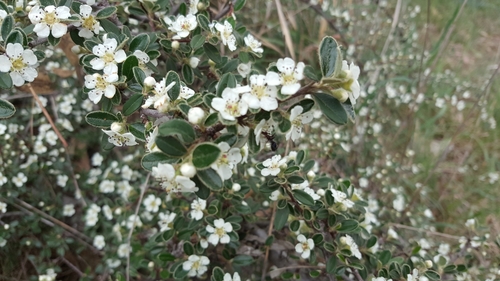
A shrub. It grows 4 m tall. It is rigidly branched and keeps its leaves throughout the year. The leaves are narrowly oval and have their edges curved back. They are hairy underneath. The flowers are white and usually occur singly. The fruit are round and red when ripe.
Production
Fruit are available August to September.
Names & Synonyms
Rainshi, Riunsh
Cotoneaster microphyllus var. rotundifolius (Wall. ex Lindl.) Wenz.Cotoneaster microphyllus var. uva-ursi Lindl.
References (4)
- Masoodi, H. U. R. & Sundriyal, R. C., 2020, Richness of non-timber forest products in Himalayan communities—diversity, distribution, use pattern and conservation status. Journal of Ethnobiology and Ethnomedicine 16:56
- Thakur, D., et al, 2017, Why they eat, what they eat: patterns of wild edible plants consumption in a tribal area of Western Himalaya. Journal of Ethnobiology and Ethnomedicine (2017) 13:70
- Upreti, K., et al, 2010, Diversity and Distribution of Wild Edible Fruit Plants of Uttarakhand. Bioversity Potentials of the Himalaya. p 167
- Wild edible plants of Himachal Pradesh
More from Rosaceae

Acaena anserinifolia
Bidgee widgee, Buzzy, New Zealand Bur
No photo
Acaenia anserinifolia - (J.R.Forst.&G.Forst.)Druce.
Pirri-Pirri Bur

Adenostoma sparsifolium
Red shanks, Ribbonwood

Agrimonia eupatoria
Agrimony, Salt and Pepper

Agrimonia odorata
Adour agrimony, Liver-wort

Agrimonia pilosa
Indian chestnut, Agrimony