Coscinium fenestratum
(Goetgh.) Colebr.
False calumba, Yellow vine

(c) Vinayaraj, some rights reserved (CC BY-SA)
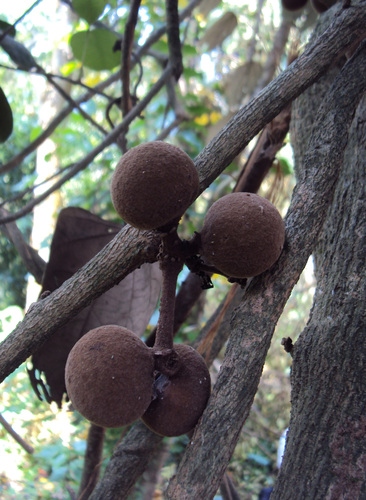
(c) Vinayaraj, some rights reserved (CC BY-SA)
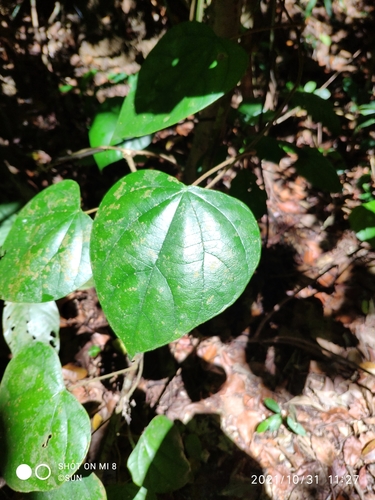
(c) SunGW, some rights reserved (CC BY-NC)
What to Eat
Edible parts: Caution, Medicine, Flavouring
Used as a bitter tonic and flavouring.
Known Hazards
Where to Find It
It is a tropical plant. It grows in the Western Ghats in India. It grows in deciduous and evergreen forests.
Asia, Cambodia, India, Indonesia, Malaysia, SE Asia, Sri Lanka, Thailand, Vietnam,
How to Identify
A vine or woody climber. The leaves are leathery and shiny. It has a bright yellow sap. The fruit occur as 1 or 2 fleshy fruit 2 cm across.
How to Grow
A dioecious species, both male and female forms need to be grown if seed is required.
Medicinal Uses
Coscinium fenestratum has a long history as a medicinal plant in the various traditional medicines of the region where it grows. This includes Ayurveda, Unani and Siddha medicine in India, Sinhala medicine in Sri Lanka, the Kru Khmer healing traditions in Cambodia, traditional Vietnamese medicine of Thuốc Nam, etc. The plant is used for a large variety of diseases and conditions, from fevers and diabetes to celiac disease and snake bites. It is unclear if all these medicinal uses of C. fenestratum are backed up by science, but laboratory tests have shown that the plant has potent bioactive properties. There is speculation that C. fenestratum might also have found a modern use in the illegal drug market industry.
Other Uses
A yellow dye resembling turmeric is obtained from the yellow wood. It is sometimes used in combination with turmeric (Curcuma longa). The freshly cut stems can be made into a strong rope by twisting them.
Wikipedia
Source ↗Coscinium fenestratum, or yellow vine as it is sometimes referred to in English, is a flowering woody climber, native to South Asia and Mainland Southeast Asia. It is rare and critically endangered in many of its habitats. Coscinium fenestratum is a member of the family Menispermaceae and the genus Coscinium. The plant is known by many different names, such as: Tree turmeric, False calumba, Colombo weed, Venivel or Weni wel (වෙනිවැල්), Weniwelgeta (වෙනිවැල්ගැට), Baanvalgata (බාන්වැල්ගැට) (in Sinhala), Dāru Haridrā or Kāleyaka (दारुहरिद्रा, कालेयकः in Sanskrit), Mara Manjal (in Tamil and Malayalam), Haem herb (in Thai), Voer Romiet (in Khmer), etc.
Production
In India it flowers and fruits August to October. Plants can live for 25 years.
Notes
It is used as medicine. Due to over-harvesting it is an endangered species.
Names & Synonyms
Colombo weed, Daru haridra, Haem herb, Mara manjal, Tree turmeric, Vor romiet, Weniwel
References (3)
- Encyclopedia of Life.
- Wiersema, J. H. & Leon, B., 2013, World Economic Plants. A Standard Reference CRC Press. 2nd Ed. p 205
- World Checklist of Useful Plant Species 2020. Royal Botanic Gardens, Kew


