Convolvulus scammonia
L.
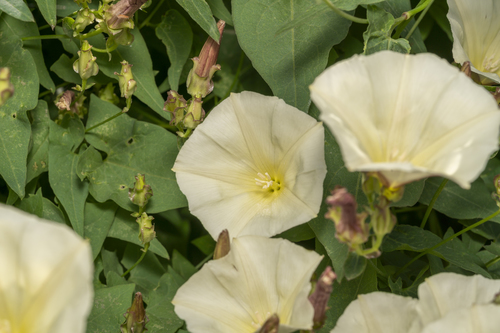
(c) Eleftherios Katsillis, some rights reserved (CC BY), uploaded by Eleftherios Katsillis
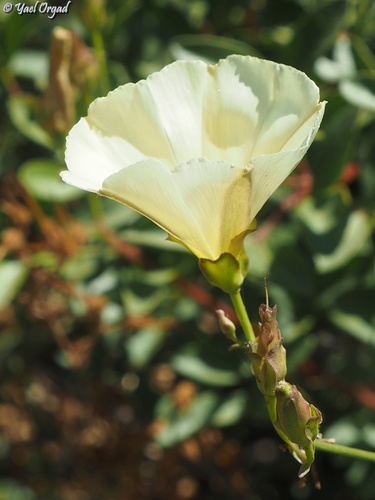
(c) Yael Orgad, some rights reserved (CC BY-NC), uploaded by Yael Orgad
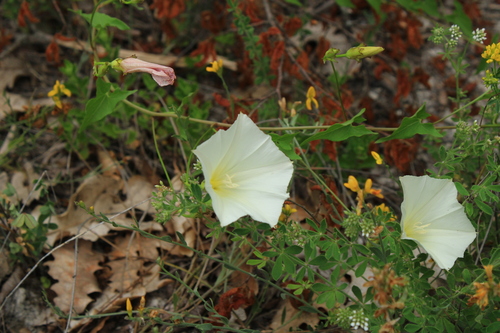
(c) Динасафина, some rights reserved (CC BY-NC), uploaded by Динасафина
What to Eat
Edible parts: Leaves
No edible uses are known for this plant.
Where to Find It
It is a temperate plant.
Europe, Turkey, Türkiye,
How to Identify
Perennial plant reaching 0.8 m with hermaphrodite flowers in July and seeds ripening in September. Flourishes in light sandy and medium loamy well-drained soil, including nutrient-poor conditions. Prefers neutral to mildly alkaline pH. Requires full sun exposure and tolerates both dry and moist soil. Hardy to UK zone 7.
How to Grow
Prefers a light basic sharply drained soil of low to medium fertility. Prefers a sunny sheltered position. Thrives in dry soils and succeeds in ordinary garden soils. The root can be up to 1.2 metres long, so for best results a deep soil is required.
Propagation: Sow seed in spring in a greenhouse. Germination can be slow and erratic; cold stratification may help reduce the germination period. Prick seedlings out into individual pots when large enough to handle and grow on in the greenhouse through their first winter. Plant out in late spring or early summer after the last expected frosts. Divide in spring. Take cuttings of young shoots in August and root in a frame in sand.
Medicinal Uses
A resin is obtained from the root by clearing away the earth around the top of the root and cutting it obliquely about 5cm below where the stalks emerge. The exuding juice is collected and gradually hardens into a resin. This resin is a drastic cathartic and hydrogogue and should be used with great caution. The roots contain approximately 8% resin.
Other Uses
No other uses are known.
Wikipedia
Source ↗Convolvulus scammonia, commonly known as scammony, is a bindweed native to the countries of the eastern part of the Mediterranean basin; it grows in bushy waste places, from Syria in the south to Crimea in the north, its range extending westward to the Greek islands, but not to northern Africa or Italy. It is a twining perennial, bearing flowers like those of Convolvulus arvensis, and having irregularly arrow-shaped leaves and a thick fleshy root. A cathartic resinous tincture known as scammoniae resina, which is obtained from the dried root by digestion with ethanol has been used as a traditional medicine. Upon consumption, the resin is inert until it has passed from the stomach into the duodenum, where it meets the bile. A chemical reaction occurs between it and taurocholate and glycocholate in the bile, whereby it is converted into a powerful purgative which in high doses becomes a violent gastrointestinal irritant. Scammony kills both roundworm and tapeworm, especially the former, and it was therefore used as an anthelmintic. The principal bioactive component is the lipid glycoside scammonin (also known as jalapin, molecular formula C34H56O16).
Names & Synonyms
Bingözotu, Dolasgan, Sarmasik
References (3)
- Cakir, E. A., 2017, Traditional knowledge of wild edible plants of Iğdır Province (East Anatolia, Turkey). Acta Soc Bot Pol. 2017;86(4):3568.
- Ertug, F, Yenen Bitkiler. Resimli Türkiye Florası -I- Flora of Turkey - Ethnobotany supplement
- Özdemir, E. and Kültür, S., 2017, Wild Edible Plants of Savaştepe District (Balıkesir, Turkey), Marmara Pharm J 21/3: 578-589


