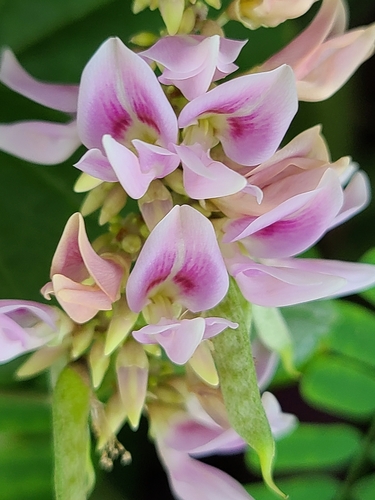
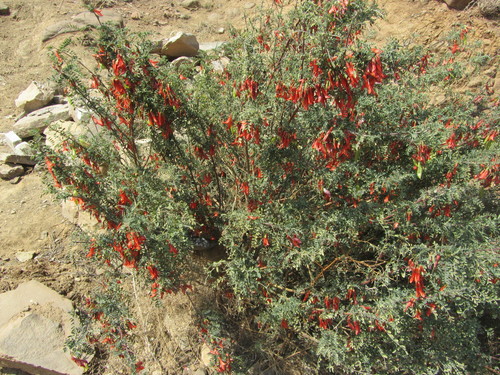
Sutherlandia frutescens
(L.) R. Br.
Cancer bush
iNaturalist · cc-by-nc
(c) Deon du Plessis, some rights reserved (CC BY-NC)
(c) Deon du Plessis, some rights reserved (CC BY-NC)

iNaturalist · cc-by-nc
(c) sgplantsanimalsinsects, some rights reserved (CC BY-NC)
(c) sgplantsanimalsinsects, some rights reserved (CC BY-NC)

iNaturalist · cc-by-nc
(c) sgplantsanimalsinsects, some rights reserved (CC BY-NC)
(c) sgplantsanimalsinsects, some rights reserved (CC BY-NC)
What to Eat
Edible parts: Leaves - drink, Seeds
The leaves are used to make a health drink, and the unripe seeds are eaten as a snack.
Where to Find It
It is a subtropical plant. It grows in drier places.
Africa, South Africa, Southern Africa,
Countries: Angola, Burkina Faso, Burundi, Benin, Botswana, Congo (DRC), Central African Republic, Congo (Republic), Cote d'Ivoire, Cameroon, Cape Verde, Djibouti, Algeria, Egypt, Eritrea, Ethiopia, Gabon, Ghana, Gambia, Guinea, Equatorial Guinea, Guinea-Bissau, Kenya, Comoros, Liberia, Lesotho, Libya, Morocco, Madagascar, Mali, Mauritania, Mauritius, Malawi, Mozambique, Namibia, Niger, Nigeria, Rwanda, Seychelles, Sudan, Sierra Leone, Senegal, Somalia, South Sudan, Sao Tome & Principe, Eswatini, Chad, Togo, Tunisia, Tanzania, Uganda, South Africa, Zambia, Zimbabwe
How to Identify
A shrub of the Fabaceae family growing about 1 m tall with red-orange flowers. It is found in subtropical, drier regions and is noted for anti-cancer properties.
How to Grow
Seeds germinate easily.
Medicinal Uses
The leaves are used for a health drink, traditionally valued for anti-cancer properties.
Notes
It has anti-cancer properties.
Names & Synonyms
Balloon pea, Kankerbossie, Keurtjie, Phetola, Sutherlandia
Colutea frutescens L.Lessertia frutescens (L.) Goldblatt & J. C. Manning
References (2)
- De Vynk, J. C., et al, 2016, Indigenous edible plant use by contemporary Khoe-San descendants of South Africa's Cape South Coast. South African Journal of Botany. 102 (2016) 60-69
- van Wyk, B-E., 2011, The potential of South African plants in the development of new food and beverage products. South African Journal of Botany 77 (2011) 857–868