Convolvulus erubescens
Sims
Blushing bindweed, Australian Bindweed, Pink Bindweed, Tarook

(c) Harry Rose, some rights reserved (CC BY)

(c) Ella Rudland, some rights reserved (CC BY-NC-SA), uploaded by Ella Rudland
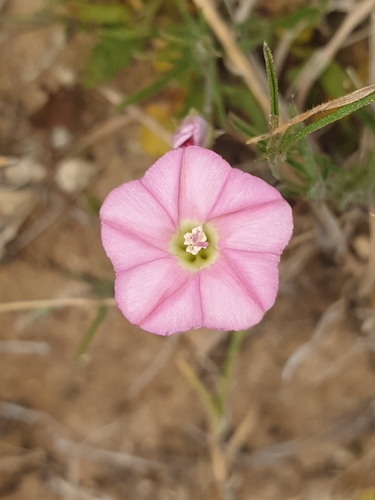
(c) naturehoodz, some rights reserved (CC BY-NC)
What to Eat
Edible parts: Leaves, Root
No edible uses are known for this plant.
Where to Find It
It grows in subtropical and temperate places. It grows in open places from coastal heathland to forest and inland areas. It needs well drained soil. It suits hot sunny positions. It often grows in dry open grassland. It is resistant to drought and frost. It can grow in arid places. Tasmania Herbarium.
Australia*, Hawaii, Pacific, Tasmania*,
How to Identify
A hairy twiner. It grows 10-30 cm high and spreads 50 cm wide. The stems are hairy. The leaves are arrowhead shaped. They are 5 cm long. Often the leaves near the base have broad lobes and those higher up are more narrow. There can be teeth along the edge. The flowers are bright rose-pink. They are 15-25 mm across. They are held upright along the stems. The flowers are funnel shaped. The fruit is a capsule about 0.5 cm across.
How to Grow
We have very little information on this species and do not know how cold hardy it will be in British gardens. It is hardy to about -7°c in Australian gardens, though this cannot be applied directly to British gardens due to our cooler summers and longer, colder and wetter winters. It is likely that this species will only succeed outdoors in the milder areas of the country. The following notes are based on the general needs of the genus. Prefers a lighter basic soil of low to medium fertility. Bindweed is a very deep-rooting plant with a vigorous root system that extends to a considerable distance and is very hard to eradicate from the soil. Even a small piece of the root will grow into a new plant if it is left in the ground. Once established this plant soon becomes a pernicious weed. It is a climbing plant that supports itself by twining around any support it can find and can soon swamp and strangle other plants. The flowers close at night and also during rainy weather. Some members of this genus harbour tobacco mosaic virus of the Solanaceae and so should not be grown near potatoes, tomatoes and other members of that family.
Propagation: Sow seed in situ as soon as it is ripe; it germinates in autumn. This species can become a serious garden weed, so encouraging it is inadvisable.
Medicinal Uses
The plant is astringent and stomachic, and is used in the treatment of diarrhoea, indigestion, and stomach pains.
Other Uses
No other uses are known.
Wikipedia
Source ↗Convolvulus erubescens, commonly known as blushing bindweed, or Australian bindweed, is a perennial herbaceous plant in the family Convolvulaceae that is endemic to Australia.
Production
It is fast growing.
Notes
There are about 250 Convolvulus species. Plants have been used in medicine. Possibly now Convolvulus angustissimus subsp. angustissimus
Names & Synonyms
Anulytja, Tarook
References (27)
- Baker, M. L. & de Salas, M. F., 2012, A Census of the Vascular Plants of Tasmania. (On line)
- Bodkin, F., 1991, Encyclopedia Botanica. Cornstalk publishing, p 278
- Cameron, M., (Ed.) 1981, A Guide to Flowers & Plants of Tasmania. Reed p 84
- Cherikoff V. & Isaacs, J., The Bush Food Handbook. How to gather, grow, process and cook Australian Wild Foods. Ti Tree Press, Australia p 194
- Cronin, L., 1989, The Concise Australian Flora. Reed. p 27
- Curtis, W.M., 1993, The Student's Flora of Tasmania. Part 3 St David's Park Publishing, Tasmania, p 497
- Dashorst, G.R.M., and Jessop, J.P., 1998, Plants of the Adelaide Plains & Hills. Botanic Gardens of Adelaide and State Herbarium. p 122
- De Angelis, D., 2005, Aboriginal Plant Use of the Greater Melbourne Area. La Trobe University Environment Collective
- Elliot, W.R., & Jones, D.L., 1984, Encyclopedia of Australian Plants suitable for cultivation. Vol 3. Lothian. p 82
- Gilfedder, L et al, 2003, The Nature of the Midlands. Midlands Bushweb. PO Box 156 Longford, Tasmania. p 108
- Gott, B & Conran, J., 1991, Victorian Koorie Plants. PO Box 666 Hamilton, Victoria 3300, Australia. p 22
- Hibbert, M., 2002, The Aussie Plant Finder 2002, Florilegium. p 72
- Hussey, B.M.J., Keighery, G.J., Cousens, R.D., Dodd, J., Lloyd, S.G., 1997, Western Weeds. A guide to the weeds of Western Australia. Plant Protection Society of Western Australia. p 136
- Hyde-Wyatt, B.H. & Morris D.I., 1975, Tasmanian Weed Handbook. Dept of Ag Tasmania. p 89
- Jones, D.L. & Gray, B., 1977, Australian Climbing Plants. Reed. p 95
- Lamp, C & Collet F., 1989, Field Guide to Weeds in Australia. Inkata Press. p 83
- Latz, P.K., 1996, Bushfires and Bushtucker: Aboriginal plant use in Central Australia. IAD Press Alice Springs p 151
- Lazarides, M. & Hince, B., 1993, Handbook of Economic Plants of Australia, CSIRO. p 64
- Lim, T. K., 2015, Edible Medicinal and Non Medicinal Plants. Volume 9, Modified Stems, Roots, Bulbs. Springer p 28
- Low, T., 1992, Bush Tucker. Australia’s Wild Food Harvest. Angus & Robertson. p 108
- Morley, B.D., & Toelken, H.R., (Eds), 1983, Flowering Plants in Australia. Rigby. p 261
- Paczkowska, G. & Chapman, A.R., 2000, The Western Australian Flora. A Descriptive Catalogue. Western Australian Herbarium. p 217
- Smith, N. M., 1991, Ethnobotanical Field Notes from the Northern Territory, Australia, J. Adelaide Bot. Gard. 14(1): 1-65
- Whiting, J. et al, 2004, Tasmania's Natural Flora. Tasmania's Natural Flora Editorial Committee PO Box 194, Ulverstone, Tasmania, Australia 7315 p 97
- Wrigley, J.W., & Fagg, M., 1982, Australian Native Plants. Collns. p 77
- www.ceres.org.au/bushfoodcatalogue
- Zola, N., & Gott, B., 1992, Koorie Plants Koorie People. Koorie Heritage Trust. p 45


