Copaifera baumiana
Harms

(c) National Geographic Okavango Wilderness Project, some rights reserved (CC BY), uploaded by National Geographic Okavango Wilderness Project

(c) Bart Wursten, some rights reserved (CC BY-NC)
What to Eat
Edible parts: Seeds
The seeds are edible, with the aril or layer around the seed being the edible portion.
Where to Find It
A tropical plant. It grows on Kalahari sands and in grassland and woodland. It grows between 750-1,400 m altitude.
Africa, Angola, Central Africa, Congo, East Africa, Zambia,
How to Identify
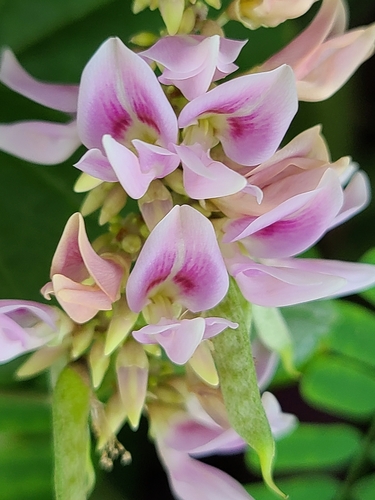
A small shrub. It can grow 3 m tall. It has woody rootstock. The small branches are brown. There are fine cracks along them. The leaves have leaflets along the stalks and one at the end. There are 4-5 pairs of leaflets and they are 3-5 cm long by about 1 cm wide. They are often unequal and rounded at the tip and with a wedge shaped base. The flowers are in the axils of the leaves and at the ends of the branches. The flowers are tightly packed and 5-7 mm long. The fruit is a pod with one seed. It is 2.5-3 cm across. It is almost round but flattened. The seed is 15 mm long by 12 mm wide.
Notes
There are 35-40 Copaifera species. They are tropical trees. Several Copaifera have the aril or layer around the seed edible. van Roosmalen, M.G.M., 1985, Fruits of the Guianan Flora. Utrecht Univ. & Wageningen Univ. p 181. Also as Caesalpinaceae.
Names & Synonyms
Mukuwa
References (5)
- Baidu-Forson, J.J., et al ,2014,. Assessment of agrobiodiversity resources in the Borotse flood plain, Zambia. CGIAR Research Program on Aquatic Agricultural Systems. Penang, Malaysia. Working Paper: AAS-2014-12.
- Brown, D., 2002, The Royal Horticultural Society encyclopedia of Herbs and their uses. DK Books. p 179
- Flora Zambesiaca. http://apps.kew.org/efloras
- Fowler, D. G., 2007, Zambian Plants: Their Vernacular Names and Uses. Kew. p 30
- Menninger, E.A., 1977, Edible Nuts of the World. Horticultural Books. Florida p 92