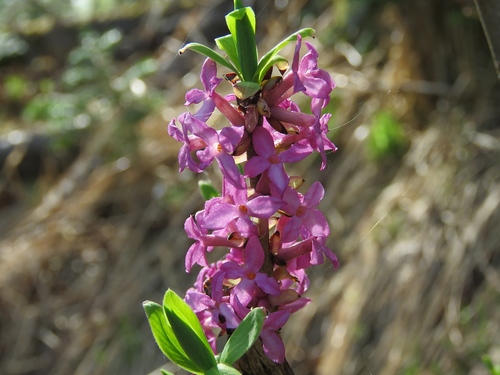
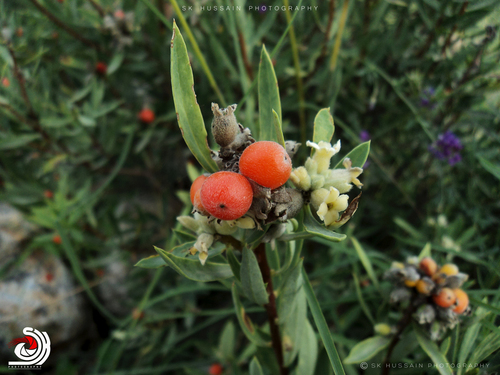
Daphne sericea
Vahl
ThymelaeaceaeLeaves

iNaturalist · cc-by-nc-nd
(c) Nicholas Turland, some rights reserved (CC BY-NC-ND)
(c) Nicholas Turland, some rights reserved (CC BY-NC-ND)
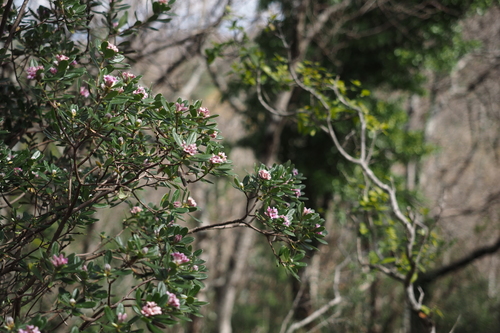
iNaturalist · cc-by-nc
(c) felixf, some rights reserved (CC BY-NC)
(c) felixf, some rights reserved (CC BY-NC)
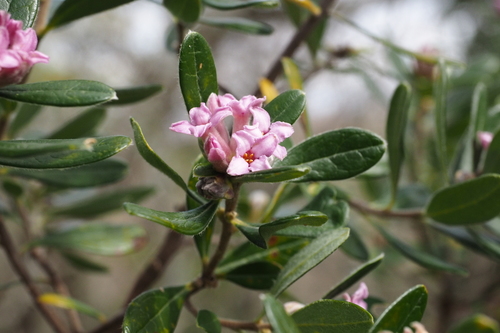
iNaturalist · cc-by-nc
(c) felixf, some rights reserved (CC BY-NC)
(c) felixf, some rights reserved (CC BY-NC)
What to Eat
Edible parts: Leaves
The leaves are used as a spice in fish and meat dishes.
Where to Find It
It is a temperate plant.
Europe, Turkey, Türkiye,
Countries: Andorra, Albania, Austria, Bosnia & Herzegovina, Belgium, Bulgaria, Belarus, Switzerland, Cyprus, Czechia, Germany, Denmark, Estonia, Spain, Finland, France, United Kingdom, Greece, Croatia, Hungary, Ireland, Iceland, Italy, Liechtenstein, Lithuania, Luxembourg, Latvia, Monaco, Moldova, Montenegro, North Macedonia, Malta, Netherlands, Norway, Poland, Portugal, Romania, Serbia, Russia, Sweden, Slovenia, Slovakia, San Marino, Turkey, Ukraine
How to Identify
A temperate-climate shrub in the Thymelaeaceae family with aromatic foliage.
Wikipedia
Source ↗Daphne sericea is a shrubby species of flowering plant in the genus Daphne with purple flowers. It was first described by Martin Vahl. Daphne collina has been treated as a separate species, but is considered to be a cultivar or group of cultivars of D. sericea. It is a parent, with Daphne caucasica, of the popular hybrid garden plant Daphne × transatlantica.
Names & Synonyms
Develik
Daphne aurea Poir.Daphne australis CirilloDaphne blagayana Meisn.Daphne buxifolia Ledeb.Daphne collina Sm. ex Dicks.Daphne collina Dicks. ex Sm.Daphne elisae Vis.Daphne oleifolia Lam.Daphne vahlii Keissl.
References (1)
- Gunes, S. et al, 2018, Survey of wild food plants for human consumption in Karaisali (Adana-Turkey). Indian Journal of Traditional Knowledge. Vol. 17(2), April 2018, pp 290-298