Coprinus comatus
(Mull. ex Fries) S.F. Gray
Shaggy Mane Ink Cap
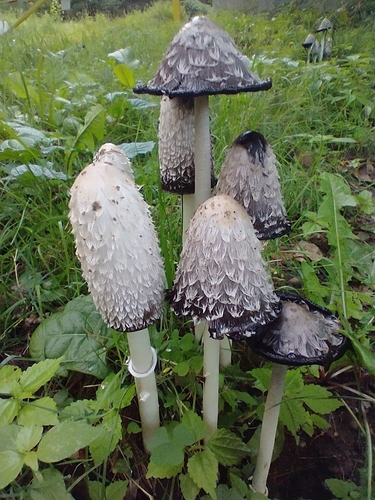
(c) Tom Norton, some rights reserved (CC BY), uploaded by Tom Norton
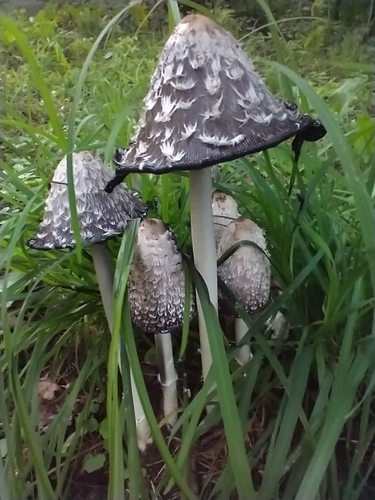
(c) Tom Norton, some rights reserved (CC BY)
What to Eat
Edible parts: Fungus, Mushroom
The young fruiting bodies are eaten and can be baked, cooked with eggs, made into ketchup, or simmered with butter. They must be prepared and served quickly to prevent softening.
Known Hazards
Where to Find It
It grows in temperate regions in the Northern Hemisphere. It can grow in clusters or individually in fields.
Africa, Alaska, Asia, Australia, Balkans, Britain, Bulgaria, Canada, Caucasus, Central America, Chile, China, Costa Rica, East Africa, Europe, France, Georgia, Himalayas, India, Indochina, Italy, Kyrgyzstan, Malaysia, Mediterranean, Mexico, Nepal, New Zealand, North America, Pakistan, Russia, Scandinavia, SE Asia, Sicily, Slovenia, South Africa, South America, Southern Africa, Spain, Sweden, Tanzania, Turkey, Türkiye, USA,
How to Identify
A mushroom. The cap is barrel-shaped. It can be 15 cm long and 3-5 cm thick. It is white and covered with large shaggy scales. As the cap gets old a black ink like liquid drips from the gills. The spores are black.
Nutrition Score: 25/100
| Part | Moisture | kJ | kcal | Protein | Vit A | Vit C | Iron | Zinc |
|---|---|---|---|---|---|---|---|---|
| Mushroom | 90.8 | 123 | 29 | 2.1 | — | 3.6 | 0.5 | 0.3 |
Wikipedia
Source ↗Coprinus comatus, commonly known as the shaggy ink cap, lawyer's wig, or shaggy mane, is a species of fungus. The young fruit bodies first appear as white cylinders emerging from the ground, then the bell-shaped caps open out. The white caps are covered with scales, the origin of its common names. The gills beneath the cap are white, then pink, then turn black. This mushroom is unusual because it will turn black and dissolve itself in a matter of hours after being picked or depositing spores. The mushroom is often seen growing about lawns, gravel roads, and waste areas in the Northern Hemisphere and more locally in the Southern Hemisphere. When young it is an excellent edible mushroom but it spoils quickly and resembles some poisonous species.
Notes
It has medicinal benefits.
Names & Synonyms
Chyapu, Fjallig blacksvamp, Gvelis soko, Guchi, Khumbhi, Klikchok, Lawyer's wig, Maotou guisan, Mertskhala, Shaggy Cap, Shaggy Ink Cap
References (41)
- Akata, I., et al, 2012, Chemical Composition and Antioxidant Activities of 16 Wild Edible Mushroom Species Grown in Anatolia. International Journal of Pharmacology 8(2): 134-138
- Ambasta, S.P. (Ed.), 2000, The Useful Plants of India. CSIR India. p 139
- Boa, E. R., 2004, Wild edible fungi and their importance to people. FAO Non Wood Forest Products Booklet 17
- Bougher, N.L. & Syme, K., 1998, Fungi of Southern Australia. UWA Press p 290
- Burkill, I.H., 1966, A Dictionary of the Economic Products of the Malay Peninsula. Ministry of Agriculture and Cooperatives, Kuala Lumpur, Malaysia. Vol 1 (A-H) p 663
- Bussman, R. W., et al, 2016, A comparative ethnobotany of Khevsureti, Samtskhe-Javakheti, Tusheti, Svaneti, and Racha-Lechkhumi, Republic of Georgia (Sakartvelo), Caucasus. Journal of Ethnobiology and Ethnomedicine (2016) 12:43
- Bussman, R. W., et al, 2021, Unity in diversity—food plants and fungi of Sakartvelo (Republic of Georgia), Caucasus. Journal of Ethnobiology and Ethnomedicine (2021) 17:72 p 16
- Christensen, M., et al, 2008, Collection and Use of Wild Edible Fungi in Nepal. Economic Botany, 62(1), 2008, pp. 12–23
- Cocchi, L. et al, 2006, Heavy metals in edible mushrooms in Italy. Food Chemistry 98: 277-284
- Crowe, A., 1997, A Field Guide to the Native Edible Plants of New Zealand. Penguin. p 133
- Dashorst, G.R.M., and Jessop, J.P., 1998, Plants of the Adelaide Plains & Hills. Botanic Gardens of Adelaide and State Herbarium. p 26
- Cribb, A.B. & J.W., 1976, Wild Food in Australia, Fontana. p 201
- Cronin, L., 1989, The Concise Australian Flora. Reed. p 299
- Dongol, et al, 1995, Edible Mushrooms in Nepal
- Facciola, S., 1998, Cornucopia 2: a Source Book of Edible Plants. Kampong Publications, p 251
- Fox, F. W. & Young, M. E. N., 1982, Food from the Veld. Delta Books. p 234
- Fuhrer, B., 2005, A field guide to Australian Fungi. Bloomings Books. p 43
- Gryzenhout, M., 2010, Mushrooms of South Africa. Pocket Guide. Struik. p 37
- Guild, B., 1979, The Alaskan Mushroom Hunter's Guide. Alaska Northwest Publishing Company. p 162
- Hall, I. R., et al, 2003, Edible and Poisonous Mushrooms of the World. Timber Press. p 199
- http://www.mykoweb.com/CAF/edible.html
- Jordan, P., 2000, The Mushroom Guide and Identifier, Hermes House, p 52
- Kaufmann, B. et al, 1999, The Great Encyclopedia of Mushrooms. Konemann. p 158
- Kaul, 1981,
- Kiple, K.F. & Ornelas, K.C., (eds), 2000, The Cambridge World History of Food. CUP p 318
- Low, T., 1992, Bush Tucker. Australia’s Wild Food Harvest. Angus & Robertson. p 167
- Lentini, F. and Venza, F., 2007, Wild food plants of popular use in Sicily. J Ethnobiol Ethnomedicine. 3: 15
- Li, H., et al, 2020, Reviewing the world’s edible mushroom species: A new evidence-based classification system. Compr Rev Food Sci Food Saf. 2021;20:1982–2014.
- Mabey, R., 1973, Food for Free. A Guide to the edible wild plants of Britain, Collins. p 47
- Majeed, M., et al, 2021, Gathered Wild Food Plants among Diverse Religious Groups in Jhelum District, Punjab, Pakistan. Foods 2021, 10, 594.
- Michael, P., 2007, Edible Wild Plants and Herbs. Grub Street. London. p 215
- Ostry, M. E., et al, 2010, Field Guide to Common Macrofungi in Eastern Forests and Their Ecosystem Functions. USDA Forest Service General Technical Report NRS-79 p 46
- Pace, G., 1998, Mushrooms of the world. Firefly books. p 50 (Also as Coprinus ovatus)
- Quinonez-Martinez, M., et al, 2014, Knowledge and use of edible mushrooms in two municipalities of the Sierra Tarahumara, Chihuahua, Mexico. Journal of Ethniobiology and Ethnomedicine 10:6
- Ren, J., et al, 2012, Isolation and biological activity of triglycerides of the fermented mushroom of Coprinus comatus. BMC Complementary and Alternative Medicine, 12:52
- Stoyneva-Gartner, M.P. & Uzunov, B.A., 2015, An Ethnobiological Glance on Globalization Impact on the Traditional Use of Algae and Fungi as Food in Bulgaria. J Nutr Food Sci 2015, 5:5
- Svanberg, I., & Lindh, H., 2019, Mushroom hunting and consumption in twenty-first century post-industrial Sweden. Journal of Ethnobiology and Ethnomedicine (2019) 15:42
- Tibuhwa, 2013, Wild Mushroom - an underutilized healthy food resource and income generator: experience from Tanzania rural areas. Journal of Ethnobiology and Ethnomedicine 9:49
- Turner, N., 1997, Food Plants of Interior First Peoples. Royal BC Museum Handbook p 40
- Uphof,
- Wehmeyer, A. S, 1986, Edible Wild Plants of Southern Africa. Data on the Nutrient Contents of over 300 species


