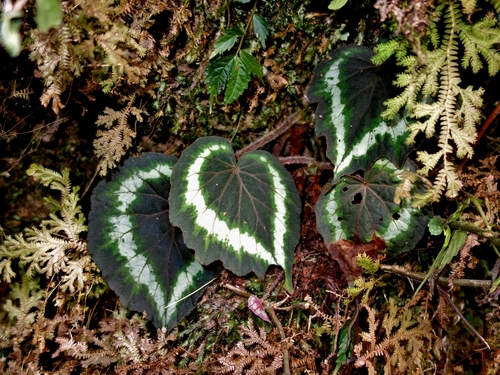
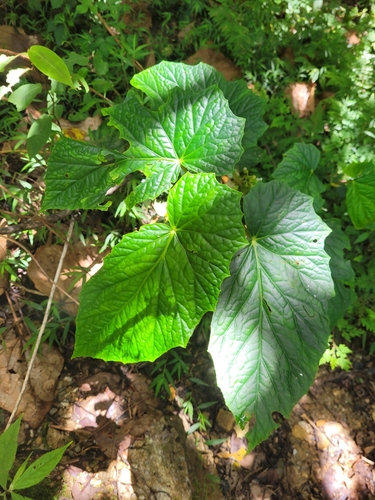
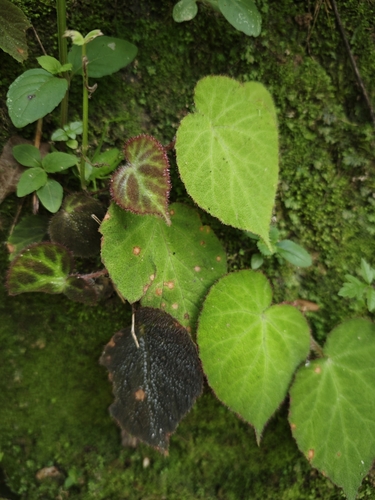
Begonia hatacoa
Buch.-Ham. ex D. Don
BegoniaceaeLeaves
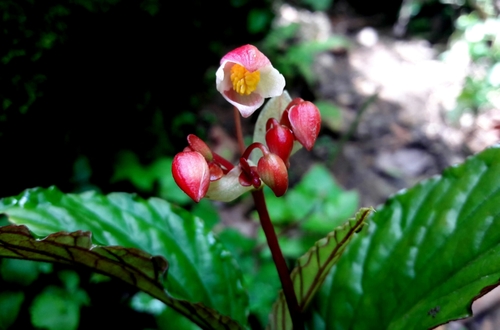
iNaturalist · cc-by-nc-sa
(c) Phuentsho, some rights reserved (CC BY-NC-SA), uploaded by Phuentsho
(c) Phuentsho, some rights reserved (CC BY-NC-SA), uploaded by Phuentsho

iNaturalist · cc-by-nc
(c) spitzenkorper, some rights reserved (CC BY-NC)
(c) spitzenkorper, some rights reserved (CC BY-NC)
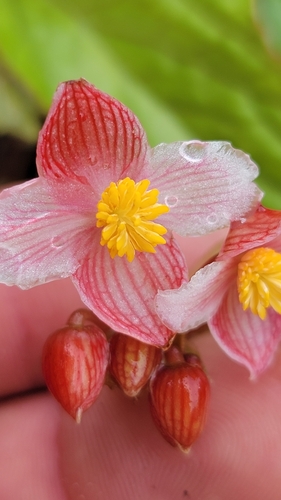
iNaturalist · cc-by-nc
(c) T. Abe Lloyd, some rights reserved (CC BY-NC), uploaded by T. Abe Lloyd
(c) T. Abe Lloyd, some rights reserved (CC BY-NC), uploaded by T. Abe Lloyd
What to Eat
Edible parts: Leaves, Leaf stalks
The young leaves and leaf stalks are eaten.
Where to Find It
It is a temperate plant.
Asia, Himalayas, India, Northeastern India, Sikkim,
Countries: United Arab Emirates, Afghanistan, Armenia, Azerbaijan, Bangladesh, Bahrain, Brunei, Bhutan, China, Georgia, Indonesia, Israel, India, Iraq, Iran, Jordan, Japan, Kyrgyzstan, Cambodia, North Korea, South Korea, Kuwait, Kazakhstan, Laos, Lebanon, Sri Lanka, Myanmar, Mongolia, Maldives, Malaysia, Nepal, Oman, Philippines, Pakistan, Qatar, Saudi Arabia, Singapore, Syria, Thailand, Tajikistan, Timor-Leste, Turkmenistan, Turkey, Taiwan, Uzbekistan, Vietnam, Yemen
How to Identify
A temperate herb in the Begoniaceae family.
Wikipedia
Source ↗Begonia hatacoa is a species of flowering plant in the family Begoniaceae, native to Tibet, Nepal, the eastern Himalayas, Assam, Bangladesh, Myanmar, Thailand, and Vietnam. Its best-known cultivar is 'Silver'.
Names & Synonyms
Begonia rubrovenia Hook.Platycentrum rubrovenium (Hook.) Klotzsch
References (2)
- Balkrishna, A., et al, 2022, Indigenous Uses of Plants among Forest-dependent Communities of Seijosa, Arunachal Pradesh. International Journal of Economic Plants 2022, 9(1):064-080
- Sundriyal, M., et al, 2004, Dietary Use of Wild Plant Resources in the Sikkim Himalaya, India. Economic Botany 58(4) pp 626-638