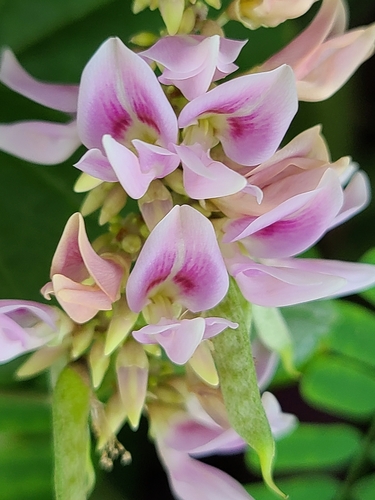
Copaifera coriacea
Mart.
Sapucaia tree
What to Eat
Edible parts: Resin - flavouring
The resin has been officially approved in the United States as a food additive and is used in small amounts as a flavouring agent in foods and beverages.
Where to Find It
It is a tropical plant. It grows near stream banks in the rainforest.
Brazil, South America,
How to Identify
Evergreen tree reaching 20 m × 20 m at slow growth rate with nitrogen-fixing capability. Tolerates light sandy, medium loamy, and heavy clay well-drained soils across mildly acid, neutral, and mildly alkaline pH ranges. Grows in semi-shade or full sun, prefers moist soil but tolerates drought. Hardy to UK zone 10.
How to Grow
A tropical tree. Copaifera is a genus of flowering plants in the legume family. Producing economically important resins and essential oils. Also important for production of biodiesel and wood. The scientific name means 'copal-bearer'.
Propagation: Propagate by seed.
Medicinal Uses
Copaiba balsam, an oily oleoresin tapped from the trunk, has a long history of medicinal use, valued by indigenous peoples of South America well before European contact. It is particularly prized for countering mucous conditions of the chest and genito-urinary system. Both the resin and the bark are aromatic, stimulant, anodyne, antacid, antibacterial, antifungal, antiinflammatory, antimicrobial, astringent, cytostatic, demulcent, digestive, disinfectant, diuretic, expectorant, mildly laxative, vermifuge, and vulnerary. The resin contains 30 to 90% essential oils and unusual condensed tannins, along with alpha- and beta-caryophyllene, sesquiterpenes, resins, and terpenic acids. Clinical research has confirmed many traditional uses, notably its effectiveness as a topical wound healer and anti-inflammatory agent, with the anti-inflammatory action attributed mainly to sesquiterpenes, particularly caryophyllene, which has also shown pain-relieving, antifungal, and gastroprotective properties. The resin as a whole, and specifically the diterpenes copalic acid and kaurenic acid, has demonstrated significant antimicrobial activity against gram-positive bacteria. Another constituent, kaurenoic acid, has shown selective antibacterial activity against gram-positive bacteria, while other constituents have demonstrated antitumor activity. Taken internally, it is used to treat respiratory conditions including tuberculosis, bronchitis, and sinusitis, and urinary and reproductive conditions such as cystitis, kidney and bladder infections, vaginal discharge, and gonorrhoea, as well as stomach ulcers, tetanus, herpes, pleurisy, and haemorrhages. Externally, it treats insect bites, eczema, chilblains, sores, psoriasis, wounds, and bleeding. As an antiseptic gargle it is used for sore throats and tonsillitis. The resin should be used with care. It is used in infusions or distilled for its essential oil, and is tapped from the tree at intervals with the holes filled in afterwards.
Other Uses
An oleoresin obtained from the tree is used in varnishes, lacquers, photographic paper, and for removing varnish from old oil paintings. The resin can also be used directly from the tree as a substitute for diesel oil. Suitable for nitrogen-fixing applications.
Wikipedia
Evergreen tree reaching 20 m × 20 m at slow growth rate with nitrogen-fixing capability. Tolerates light sandy, medium loamy, and heavy clay well-drained soils across mildly acid, neutral, and mildly alkaline pH ranges. Grows in semi-shade or full sun, prefers moist soil but tolerates drought. Hardy to UK zone 10.
Names & Synonyms
Baru, Cumbaru, Guranazinho
References (1)
- Bortolotto, I. M., et al, 2018, Lista preliminar das plantas alimenticias nativas de Mato Grosso do Sul, Brasil. Iheringia, Serie Botanica, Porto Alegre, 73 (supl.):101-116