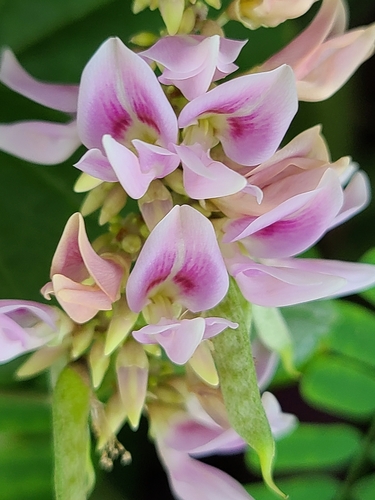
Lathyrus rotundifolius
Willd.

iNaturalist · cc-by
(c) Dmitriy Bochkov, some rights reserved (CC BY), uploaded by Dmitriy Bochkov
(c) Dmitriy Bochkov, some rights reserved (CC BY), uploaded by Dmitriy Bochkov

iNaturalist · cc-by
(c) Katya, some rights reserved (CC BY), uploaded by Katya
(c) Katya, some rights reserved (CC BY), uploaded by Katya

iNaturalist · cc-by-nc
(c) Aleksandr Ebel, some rights reserved (CC BY-NC), uploaded by Aleksandr Ebel
(c) Aleksandr Ebel, some rights reserved (CC BY-NC), uploaded by Aleksandr Ebel
What to Eat
Edible parts: Leaves, Seeds
The leaves and seeds are eaten raw.
How to Identify
A temperate herb of the legume family (Fabaceae).
Wikipedia
Source ↗Lathyrus rotundifolius, the Persian everlasting pea, is a species of flowering plant in the pea family Fabaceae, native to Iran. Growing to 1.5 m (4.9 ft) tall, this herbaceous perennial climber has twining, clinging tendrils and brick red flowers in summer. Unlike its relative, the sweet pea (Lathyrus odoratus), the flowers are unscented. It is hardy to −20 °C (−4 °F), but requires a position in full sun. It holds the Royal Horticultural Society's Award of Garden Merit. It is a suitable subject for scrambling over a fence or through another shrub or tree.
Names & Synonyms
Gurul
Lathyrus latifolius var. rotundifolius (Willd.) Rchb.Lathyrus litvinovii IljinLathyrus peduncularis Poir.
References (1)
- Cakir, E. A., 2017, Traditional knowledge of wild edible plants of Iğdır Province (East Anatolia, Turkey). Acta Soc Bot Pol. 2017;86(4):3568.