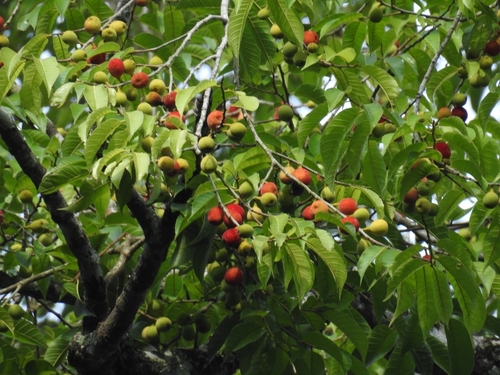
Castilla tunu
Hemsl.
Tunu
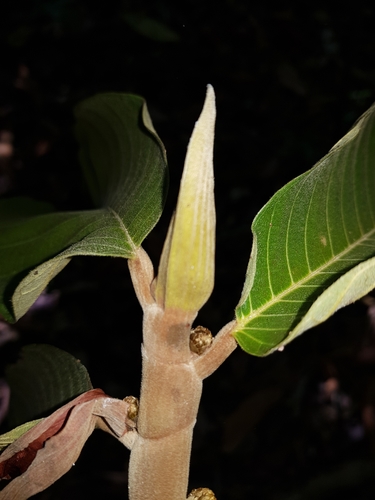
(c) Leonardo Álvarez-Alcázar, some rights reserved (CC BY-NC), uploaded by Leonardo Álvarez-Alcázar

(c) Galo Chiriboga J, some rights reserved (CC BY-NC)

(c) Galo Chiriboga J, some rights reserved (CC BY-NC)
What to Eat
Edible parts: Latex
The latex is used as a chewing gum.
Where to Find It
It is a tropical plant.
Belize, Bolivia, Central America, Colombia, Costa Rica, Ecuador, Honduras, Panama, Nicaragua, South America,
How to Identify
A tropical tree in the Moraceae family that produces latex.
How to Grow
Individual plants can either produce only male flowers (dioecious) or they can produce both male and female flowers (monoecious).
Other Uses
A latex is obtained from the plant. Unlike most other members of this genus, the latex obtained from this plant is not suitable for making rubber; it coagulates into a hard, sticky, unelastic mass that is erroneously called 'gutta-percha' locally and is considered to be of little value. The fibre-rich bark of this tree yields a soft vegetable cloth, which is used to make into clouts, skirts or sleeping mats. The heartwood is yellowish; the thin band of sapwood is a very light yellow or nearly white. The wood is straight and fairly fine-grained; moderately light in weight; soft; not strong; not very durable in contact with the soil. It is easily worked and takes a good polish. It is not much used on account of the abundant flow of cortical latex, which makes it difficult to handle. Members of this genus have a root system that consists of a rather short tap root and of several lateral roots spreading horizontally and so near the surface of the soil that they can often be followed for 20 to 30 metres. This root system makes it difficult to grow other crops under the tree.
References (2)
- Grandtner, M. M. & Chevrette, J., 2013, Dictionary of Trees, Volume 2: South America: Nomenclature, Taxonomy and Ecology. Academic Press p 110
- Roa, J. A. G. & Boada, D. S. G., 2018, Fundación para el Fortalecimiento de la Fruticultura y Plantas Alimenticias no Convencionales en Colombia.