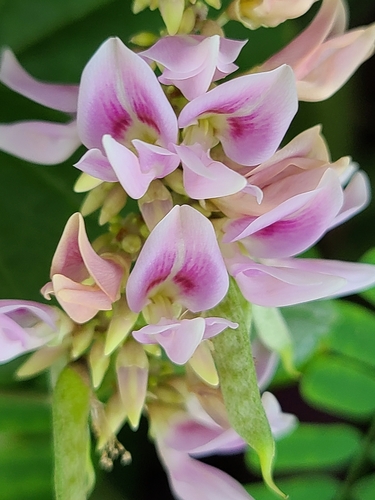
Cordyla pinnata
(Lepr. ex A. Rich.) Milne-Redh.
Bush mango, Wild Mango

(c) Hamed Ndiaye, some rights reserved (CC BY-NC)

(c) Hamed Ndiaye, some rights reserved (CC BY-NC)

(c) Hamed Ndiaye, some rights reserved (CC BY-NC)
What to Eat
Edible parts: Fruit, Seeds
The fruit pulp is eaten raw, cooked with spices and added to millet porridge, or ground into flour. The fruit can be dried and stored. The seeds are dried, pounded into flour, and used as food. The fruit is rich in Vitamin C.
Where to Find It
A tropical plant. It grows in dry forest and woody savannah in West Africa. It can grow in arid places.
Africa, Burkina Faso, Cameroon, Central Africa, Côte d'Ivoire, Gambia, Guinea, Guinée, Guinea-Bissau, Ivory Coast, Mali, Niger, Nigeria, Sahel, Senegal, West Africa,
How to Identify
A tree. It grows to 20 m high. The trunk is straight. The bark is thick and corky. The fruit has green flesh and a few very large seeds.
Nutrition Score: 28/100
| Part | Moisture | kJ | kcal | Protein | Vit A | Vit C | Iron | Zinc |
|---|---|---|---|---|---|---|---|---|
| Fruit fresh | 80 | 293 | 70 | 1.4 | — | — | 1.8 | — |
How to Grow
Plants can be grown by seed.
Medicinal Uses
Various parts of the plant are used medicinally.
Other Uses
We have no specific information for this species, but the wood of Cordyla species is generally yellowish, durable and suitable for general carpentry, joinery and plywood. Trunks of large, old, hollow trees are prized for making drums and dug-out canoes.
Notes
The fruit are rich in Vitamin C.
Names & Synonyms
Bu tiabu, But, Dimb, Dirque, Doki, Doto, Dougoura, Douki, Duco, Duki, Dunta, Duquei, Dutos, Psila, Sikor, Ulacomo-duto
References (15)
- Ayesson, N. C., 2011, Nutritional Contribution of Some Senegalese Forest Fruits Running across Soudano-Sahelian Zone. Food and Nutrition Sciences, 2011, 2, 606-612
- Burkill, H. M., 1985, The useful plants of west tropical Africa, Vol. 3. Kew.
- Catarino, L., et al, 2016, Ecological data in support of an analysis of Guinea-Bissau's medicinal flora. Data in Brief 7 (2016):1078-1097
- Dalziel, J. M., 1937, The Useful plants of west tropical Africa. Crown Agents for the Colonies London.
- Diarra, N. et al, 2016, Etude ethnobotanique des plantes alimentaires utilisées en période de soudure dans les régions Sud du Mali. Int. J. Biol. Chem. Sci. 10(1): 184-197
- Food Composition Tables for use in Africa FAO http://www.fao.org/infoods/directory No. 879
- Gueye, M., et al, 2014, Wild Fruits Traditionally Gathered by the Malinke Ethnic Group in the Edge of Niokolo Koba Park (Senegal). American Journal of Plant Sciences 5, 1306-1317
- Jardin, C., 1970, List of Foods Used In Africa, FAO Nutrition Information Document Series No 2.p 130
- Martin, F. W., et al, 1987, Perennial Edible Fruits of the Tropics. USDA Handbook 642 p 33
- Peters, C. R., O'Brien, E. M., and Drummond, R.B., 1992, Edible Wild plants of Sub-saharan Africa. Kew. p 131
- Royal Botanic Gardens, Kew (1999). Survey of Economic Plants for Arid and Semi-Arid Lands (SEPASAL) database. Published on the Internet; http://www.rbgkew.org.uk/ceb/sepasal/internet [Accessed 28th April 2011]
- Sambou, A., et al, 2016, The contribution of trees and palms to a blanced diet in three rural villages of the Fatick Province, Senegal. FORESTS, TREES AND LIVELIHOODS, 2016 VOL. 25, NO. 3, 212–225
- Terra, G.J.A., 1973, Tropical Vegetables. Communication 54e Royal Tropical Institute, Amsterdam, p 41
- Vivien, J., & Faure, J.J., 1996, Fruitiers Sauvages d'Afrique. Especes du Cameroun. CTA p 258
- World Checklist of Useful Plant Species 2020. Royal Botanic Gardens, Kew