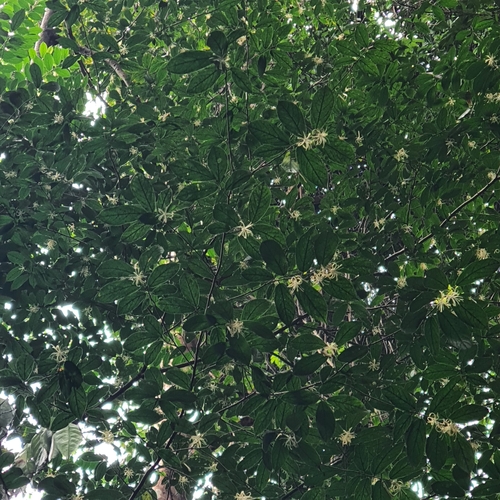
Cornus amomum
Mill.
Silk dogwood, Kinnikinnik

(c) Anita, some rights reserved (CC BY-NC)
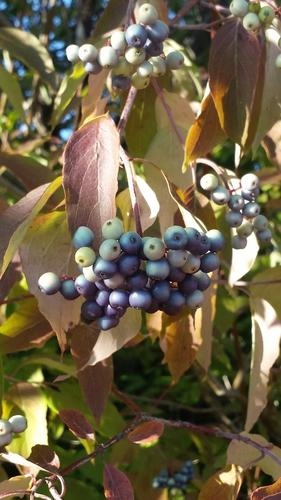
(c) Tom Norton, some rights reserved (CC BY)
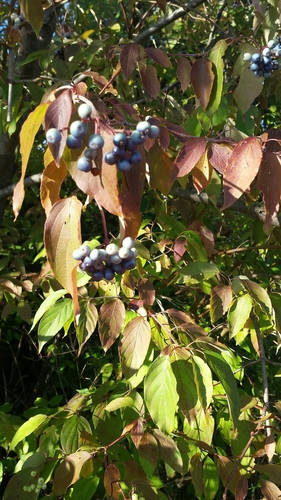
(c) Tom Norton, some rights reserved (CC BY)
What to Eat
Edible parts: Fruit
The fruit, which is 8mm in diameter, can be eaten raw or cooked and is said to be very good.
Where to Find It
Temperate. It suits hardiness zones 5-8.
Australia, North America, USA,
How to Identify
A compact deciduous shrub. It grows about 3 m high. The leaves are dark green. They turn red in autumn. The flowers are white. The fruit are purplish-black.
How to Grow
An easily grown plant that thrives in Britain, it succeeds in any soil of good or moderate fertility, ranging from acid to shallow chalk. Grows well in heavy clay soils. Succeeds in full sun or light shade. Plants in this genus are notably resistant to honey fungus.
Propagation: Seed is best sown as soon as it is ripe, either in a cold frame or an outdoor seedbed if there is sufficient seed. The seed must be separated from the fruit flesh, which contains germination inhibitors. Stored seed should be cold stratified for 3–4 months and sown as early in the year as possible. Scarification may help, as may a period of warm stratification before the cold stratification. Germination — particularly of stored seed — can be very slow, taking 18 months or more. Prick out cold-frame seedlings into individual pots once large enough to handle and grow on through their first winter in a greenhouse, planting out in spring after the last expected frosts. Take half-ripe side-shoot cuttings in July or August in a frame, or cuttings of mature wood from the current year's growth, taken with a heel if possible, in autumn in a cold frame — a high percentage will take. New growth can also be layered in June or July, which takes about 9 months.
Medicinal Uses
The dried root-bark is antiperiodic, astringent, mildly stimulant, and tonic, with the flowers said to share similar properties. A tea or tincture of the astringent root bark has been used as a quinine substitute and in the treatment of chronic diarrhoea, painful urination, and chest congestion. The bark has also been applied as a poultice on external ulcers and used as a wash for gonorrhoea sores. The glycoside cornin found in the bark contributes its astringent properties. The fruits are used as a bitter digestive tonic, and a tincture of them has been used to restore tone to the stomach in cases of alcoholism.
Other Uses
The powdered bark can be used as a toothpowder.
Wikipedia
Source ↗Cornus amomum, the silky dogwood, is a species of dogwood native to southern Ontario and the eastern United States, from Michigan and Vermont south to Alabama and Florida. Other names include red willow, silky cornel, kinnikinnick, and squawbush.
Notes
There are about 45 Cornus species. There are 4 Cornus species in tropical America.
Names & Synonyms
References (8)
- Beckstrom-Sternberg, Stephen M., and James A. Duke. "The Foodplant Database." http://probe.nalusda.gov:8300/cgi-bin/browse/foodplantdb.(ACEDB version 4.0 - data version July 1994)
- Cundall, P., (ed.), 2004, Gardening Australia: flora: the gardener's bible. ABC Books. p 415
- Etherington, K., & Imwold, D., (Eds), 2001, Botanica's Trees & Shrubs. The illustrated A-Z of over 8500 trees and shrubs. Random House, Australia. p 227
- Flowerdew, B., 2000, Complete Fruit Book. Kyle Cathie Ltd., London. p 176
- Gard. dict. ed. 8: Cornus no. 5. 1768
- Hedrick, U.P., 1919, (Ed.), Sturtevant's edible plants of the world. p 219
- Hibbert, M., 2002, The Aussie Plant Finder 2002, Florilegium. p 73
- Plants for a Future database, The Field, Penpol, Lostwithiel, Cornwall, PL22 0NG, UK. http://www.scs.leeds.ac.uk/pfaf/