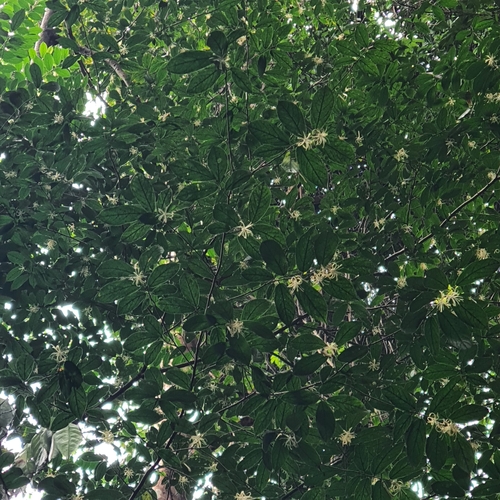
Cornus sanguinea subsp. australis
C. A. Mey.

Jaap Oosterom

Jaap Oosterom

Jaap Oosterom
What to Eat
Edible parts: Fruit, Leaves, Stems
The leaves provide food for some animals, including Lepidoptera such as the case-bearer moth Coleophora anatipennella. Dogberries are eaten by some mammals and many birds. Many frugivorous passerines find them simply irresistible, and prefer them over fruits grown by humans. The plant is thus often grown in organic gardening and permaculture to prevent harm to orchard crops, while benefiting from the fact that even frugivorous birds will hunt pest insects during the breeding season, as their young require much protein to grow. Garden varieties are often called "winter fire" because the leaves turn orange-yellow in autumn and then fall to reveal striking red winter stems. The straight woody shoots produced by the plant can be used as prods, skewers or arrows. The prehistoric archer known as Ötzi the Iceman, discovered in 1991 on the border between Italy and Austria, was carrying arrow shafts made from dogwood. The common name, dogwood, comes from C. sanguinea, the wood of which Northern Europeans frequently used to make treenails ("dags"), dowels, and pegs prior to the industrial revolution. The wood of C. sanguinea is unusually hard, dense, and tough and has an oily finish which aids in driving pegs into holes.
Where to Find It
Temperate.
Armenia, Asia, Azerbaijan, Caucasus, Europe, Georgia, Turkey, Türkiye,
How to Identify
A shrub.
Wikipedia
Source ↗Cornus sanguinea, the common dogwood or bloody dogwood, is a species of dogwood native to most of Europe and western Asia, from England and central Scotland east to the Caspian Sea. It is widely grown as an ornamental plant.
Notes
There are about 45 Cornus species.
Names & Synonyms
Kansiğdiren
References (5)
- Bussman, R. W., et al, 2021, Unity in diversity—food plants and fungi of Sakartvelo (Republic of Georgia), Caucasus. Journal of Ethnobiology and Ethnomedicine (2021) 17:72 p 8 (As Swida australis)
- Cornus-Arten 21; Ann. Sci. Nat. Bot. ser. 3, 4:65. 1845
- Ertug, F, Yenen Bitkiler. Resimli Türkiye Florası -I- Flora of Turkey - Ethnobotany supplement
- Plants for a Future database, The Field, Penpol, Lostwithiel, Cornwall, PL22 0NG, UK. http://www.scs.leeds.ac.uk/pfaf/
- Postman, J. D., et al, 2012, Recent NPGS Coordinated Expeditions in the Trans-Caucasus Region to Collect Wild Relatives of Temperate Fruit and Nut Crops. In Acta Horticulturae Number 948 p 191-198