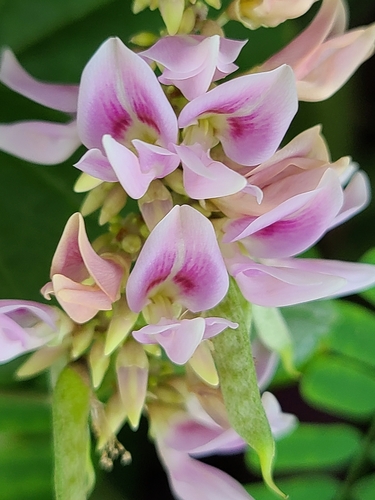
Copaifera martii
Harms
Martius copal tree
FabaceaeFruit

iNaturalist · cc-by-nc
(c) thiago_saiefert, some rights reserved (CC BY-NC)
(c) thiago_saiefert, some rights reserved (CC BY-NC)

iNaturalist · cc-by-nc
(c) thiago_saiefert, some rights reserved (CC BY-NC)
(c) thiago_saiefert, some rights reserved (CC BY-NC)

iNaturalist · cc-by-nc
(c) thiago_saiefert, some rights reserved (CC BY-NC)
(c) thiago_saiefert, some rights reserved (CC BY-NC)
What to Eat
Edible parts: Fruit
The fruit is edible.
Where to Find It
It is a tropical plant.
Brazil, South America,
How to Identify
A tropical tree in the Fabaceae family.
Other Uses
A resin obtained from this tree is of good quality but not obtained in sufficient quantity to make it commercially worthwhile. The heartwood is light red with wavy, red-brown markings. The wood is fine-grained, offering a good surface for varnishing. It is difficult to work, however, because it contains a large quantity of resin - though this makes it very durable when in water or exposed to the elements. It is used for general construction, railway sleepers, posts, poles and cabinet making.
Names & Synonyms
Guaranazinho, Pau-de-oleo-mirim, Podoinho
Copaiba martii (Hayne) KuntzeCopaiba rigida (Benth.) KuntzeCopaifera martii var. rigida (Benth.) DuckeCopaifera rigida Benth.
References (1)
- Grandtner, M. M. & Chevrette, J., 2013, Dictionary of Trees, Volume 2: South America: Nomenclature, Taxonomy and Ecology. Academic Press p 157