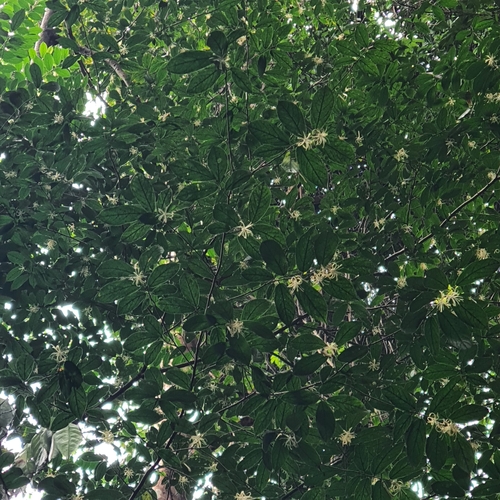
Cornus canadensis
L.
Bunchberry, Creeping dogwood, Dwarf Cornel
(c) Jason M Crockwell, some rights reserved (CC BY-NC-ND), uploaded by Jason M Crockwell

(c) Christophe Buidin, some rights reserved (CC BY-NC)

(c) courtjcam, some rights reserved (CC BY-NC)
What to Eat
Edible parts: Fruit
The fruit, about 6mm in diameter and borne in small clusters atop the plant, can be eaten raw or cooked. The fruits are rather dry, slightly gummy, and mealy, but carry a pleasant, mildly sweet flavour — though not ideal for eating raw in large quantities. They can be added to breakfast cereals or used in jams, pies, puddings, and similar preparations, and make an excellent addition to steamed plum puddings. The fruit is high in pectin, making it useful when making jam with low-pectin fruits. Pectin is said to protect the body against radiation.
Where to Find It
It is a cool temperate plant. It needs cool moist conditions. It can tolerate cold. It can grow in sun or shade. It can grow in sandy or clay soils. Moist acid soils are best but it will grow in limestone soils. It suits hardiness zones 2-8.
Alaska, Arctic, Asia, Australia, Canada, China, Japan, Korea, Mynmar, North America, Russia, Tasmania, USA,
How to Identify
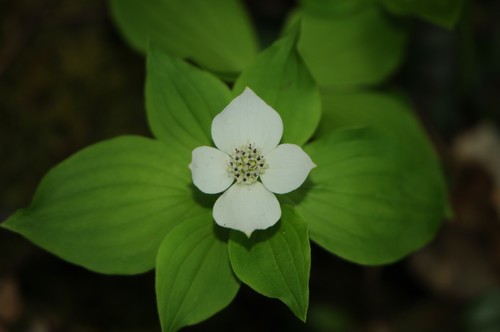
A herb which keeps growing from year to year. It is deciduous and low and spreading. It grows 10-20 cm tall. The rhizomes are creeping and slender. The leaves are in rings and are 25 mm long and oval or sword shaped. The leaves turn red in autumn. There are white bracts around the flower-heads. The flowers are silvery white. The fruit are small, bright red berries.
Nutrition Score: 24/100
| Part | Moisture | kJ | kcal | Protein | Vit A | Vit C | Iron | Zinc |
|---|---|---|---|---|---|---|---|---|
| Fruit | 81 | 318 | 76 | 0.6 | — | 2.1 | 0.6 | 0.1 |
How to Grow
Succeeds in any soil of good or moderate fertility. Easily grown in a peaty soil in shade or partial shade. Grows well in heavy clay soils. Grows best in sandy soils. Prefers a damp soil. Not suitable for alkaline soils. A very ornamental plant, it grows well with heathers. An evergreen. A clumping mat former. Forming a dense prostrate carpet spreading indefinitely.
Propagation: Seed is best sown as soon as it is ripe, either in a cold frame or an outdoor seedbed if there is sufficient seed. The seed must be separated from the fruit flesh, which contains germination inhibitors. Stored seed should be cold stratified for 3–4 months and sown as early in the year as possible. Scarification may help, as may a period of warm stratification before the cold stratification. Germination — particularly of stored seed — can be very slow, taking 18 months or more. Prick out cold-frame seedlings into individual pots once large enough to handle and grow on through their first winter in a greenhouse, planting out in spring after the last expected frosts. Division in spring is possible but the plant can be temperamental. It is best to tease out small divisions from the edges of the clump rather than digging up the whole plant. Ensure each division has already produced some roots, then pot up in light shade in a greenhouse and do not allow to dry out. Once rooting and growing well — which may take up to 12 months — they can be planted out into permanent positions.
Medicinal Uses
The leaves and stems are analgesic, cathartic, and febrifuge. A tea made from them has been used to treat aches and pains, kidney and lung ailments, coughs, and fevers. A strong decoction has been used as an eyewash. The fruits are rich in pectin, which acts as a capillary tonic and has antioedemic, anti-inflammatory, antispasmodic, and hypotensive properties. Pectin also inhibits carcinogenesis and protects against radiation. A tea made from the roots has been used to treat infant colic. Mashed roots have been strained through a clean cloth and the liquid used as an eyewash for sore eyes and to remove foreign objects from the eyes.
Other Uses
The fruit is rich in pectin. This plant also makes a good dense ground cover in light woodland. It takes a little while to establish and needs weeding for the first few years, but once settled it can spread 60–90cm per year.
Wikipedia
Source ↗Cornus canadensis is a species of flowering plant in the dogwood family Cornaceae, native to eastern Asia and North America. Common names include Canadian dwarf cornel, Canadian bunchberry, quatre-temps, crackerberry, and creeping dogwood. It is a creeping, rhizomatous perennial growing to about 20 centimetres (8 inches) tall.
Other Information
The fruit are especially eaten by children. They are edible but have little taste.
Notes
There are about 45 Cornus species. They have health benefits.
Names & Synonyms
P'xwlht
References (28)
- Beckstrom-Sternberg, Stephen M., and James A. Duke. "The Foodplant Database." http://probe.nalusda.gov:8300/cgi-bin/browse/foodplantdb.(ACEDB version 4.0 - data version July 1994)
- Brickell, C. (Ed.), 1999, The Royal Horticultural Society A-Z Encyclopedia of Garden Plants. Convent Garden Books. p 298
- Cormack, R. G. H., 1967, Wild Flowers of Alberta. Commercial Printers Edmonton, Canada. p 230
- Cundall, P., (ed.), 2004, Gardening Australia: flora: the gardener's bible. ABC Books. p 415
- Elias, T.S. & Dykeman P.A., 1990, Edible Wild Plants. A North American Field guide. Sterling, New York p 143
- Esperanca, M. J., 1988. Surviving in the wild. A glance at the wild plants and their uses. Vol. 1. p 151
- Etherington, K., & Imwold, D., (Eds), 2001, Botanica's Trees & Shrubs. The illustrated A-Z of over 8500 trees and shrubs. Random House, Australia. p 227
- Facciola, S., 1998, Cornucopia 2: a Source Book of Edible Plants. Kampong Publications, p 81
- Fisk, J. R. & Hoover, E., 2015, Wild Fruits of Minnesota. A Filed Guide. University of Minnesota p 12
- Flowerdew, B., 2000, Complete Fruit Book. Kyle Cathie Ltd., London. p 176
- Harris, C.S. et al, 2014, Investigating Wild Berries as a Dietary Approach to Reducing the Formation of Advanced Glycation Endproducts: Chemical Correlates of In Vitro Antiglycation Activity. Plant Foods Hum Nutr 69:71–77
- Hedrick, U.P., 1919, (Ed.), Sturtevant's edible plants of the world. p 218
- Hibbert, M., 2002, The Aussie Plant Finder 2002, Florilegium. p 73
- Jackes, D. A., Edible Forest Gardens
- Kiple, K.F. & Ornelas, K.C., (eds), 2000, The Cambridge World History of Food. CUP p 1763
- Kuhnlein, H. V., et al, 2009, Indigenous Peoples' food systems. FAO Rome
- Lyle, S., 2006, Discovering fruit and nuts. Land Links. p 156
- MacKinnon, A., et al, 2009, Edible & Medicinal Plants of Canada. Lone Pine. p 185
- Plants for a Future database, The Field, Penpol, Lostwithiel, Cornwall, PL22 0NG, UK. http://www.scs.leeds.ac.uk/pfaf/
- Porsild, A.E., 1974, Rocky Mountain Wild Flowers. Natural History Series No. 2 National Museums of Canada. p 294
- Ryan, S., 2008, Dicksonia. Rare Plants Manual. Hyland House. p 98 (As Chamaepericlymenum canadensis)
- Self, M., 199, Phoenix Seeds catalogue. p 14
- Slocum, P.D. & Robinson, P., 1999, Water Gardening. Water Lilies and Lotuses. Timber Press. p 114
- Sp. pl. 1:118. 1753
- Toupal, R. S. & Hollenback, K., 2009, An Ethnobotany of Indiana Dunes National Lakeshore: Plant Uses of the Ojibwa People. Bureau of Applied Research in Anthropology. University of Arizona
- Turner, N., 1995, Food Plants of Coastal First Peoples. Royal BC Museum Handbook p 71
- Turner, N., et al, 2011, "Up on the Mountain": Ethnobotanical Important of Montane Sites in Pacific Coastal North America. Journal of Ethnobiology 31(1): 4-43
- Xiang Qiuyun; David E. Boufford, CORNACEAE [Draft], Flora of China