Cornus capitata
Wall. in Roxb.
Evergreen dogwood, Mountain lychee
(c) Temjen, some rights reserved (CC BY-NC), uploaded by Temjen
(c) Andrew Kelly, some rights reserved (CC BY-NC), uploaded by Andrew Kelly
(c) richardprovo, some rights reserved (CC BY-NC)
What to Eat
Edible parts: Fruit
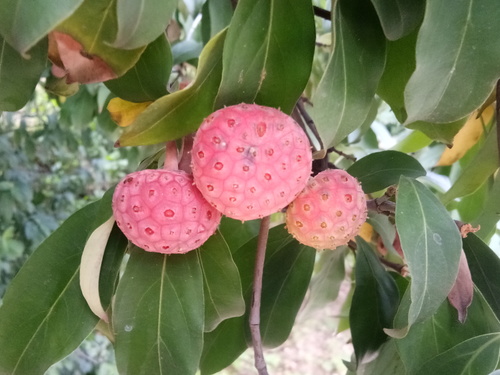
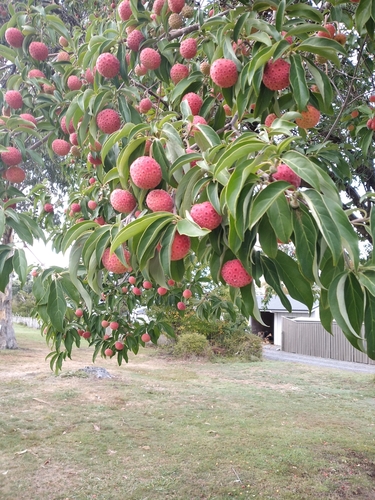
The fruit, about 25mm in diameter, can be eaten raw or used in preserves. It has a bittersweet flavour reminiscent of an over-ripe banana, is fleshy with several seeds, and has a tough, slightly bitter skin. Some trees produce quite pleasant fruit while many others yield fruit with a distinct and unpleasant bitterness. The fruit ripens in late autumn to early winter and will not ripen properly in very cold weather.
Known Hazards
Where to Find It
It is a temperate plant. It grows in evergreen and mixed forests between 1000-3200 m altitude in China. In Nepal is grows between 1700-2600 m altitude. In the Indian Himalayas it grows between 1,500-2,200 m above sea level. It is mostly on moist hillsides. It will grow on most soils and in most positions. It is resistant to frost but sensitive to drought. Hobart Botanical Gardens. It suits hardiness zones 8-9. Arboretum Tasmania.
Asia, Australia, Bhutan, Britain, China, Europe, Himalayas*, India, Indochina, Indonesia, Laos, Myanmar, Nepal, Northeastern India, Pakistan, SE Asia, Sikkim, Tasmania, Tibet,
How to Identify
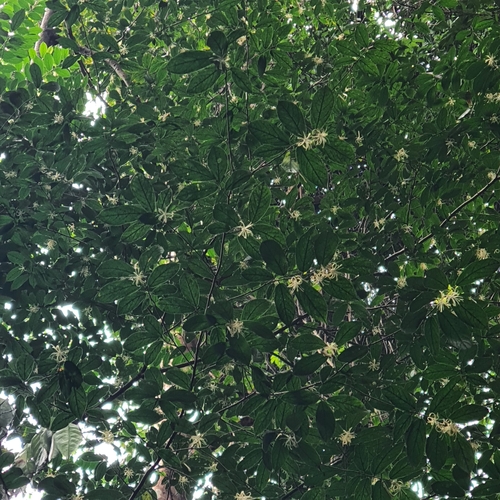
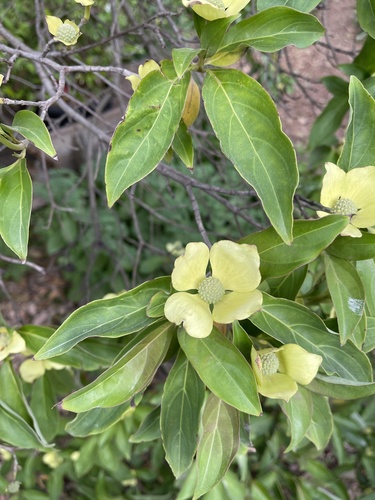
An evergreen tree or shrub. It can lose its leaves. It grows 3-15 m high. The bark is greyish brown. The leaves are opposite. They are 4-9 cm long by 1.2-3 cm wide. They are oval and leathery. They are pale underneath. The flowers are yellowish. Flowers are closely packed in heads. These are 1-1.5 cm across. The fruit join into a fleshy, strawberry-like head. These are 2.5-5 cm across. They are juicy but tasteless.
How to Grow
An easily grown plant, it succeeds in any soil of good or moderate fertility, ranging from acid to shallow chalk. Grows well in heavy clay soils. Succeeds in full sun or light shade. Prefers semi-shade. This species is hardy to between -5 and -10°c, it grows very well in S.W. England, self-sowing and fruiting prolifically in Cornish woodland gardens[11, 49, 59, , 104, 182] and doing well by the coast where it tolerates sea winds. Plants are not hardy in the London area, being killed even when on a south-facing wall. Another report says that it succeeds as far north as Edinburgh. Squirrels are very fond of this fruit. This species has been known to hybridize with C. kousa, the cultivar 'Norman Hadden' could be such a hybrid. Plants in this genus are notably resistant to honey fungus.
Propagation: Seed is best sown as soon as it is ripe, either in a cold frame or an outdoor seedbed if there is sufficient seed. The seed must be separated from the fruit flesh, which contains germination inhibitors. Stored seed should be cold stratified for 3–4 months and sown as early in the year as possible. Scarification may help, as may a period of warm stratification before the cold stratification. Germination — particularly of stored seed — can be very slow, taking 18 months or more. Prick out cold-frame seedlings into individual pots once large enough to handle and grow on through their first winter in a greenhouse, planting out in spring after the last expected frosts. Take half-ripe side-shoot cuttings in July or August in a frame, or cuttings of mature wood from the current year's growth taken with a heel if possible in autumn in a cold frame — a high percentage will take. New growth can also be layered in June or July, taking about 9 months.
Medicinal Uses
The bark is used medicinally and is a source of tannin, which has astringent properties.
Other Uses
The branches and leaves are a source of tannin. The wood is very hard and close-grained but warps during seasoning; it is used mainly as fuel and for making tools.
Wikipedia
Source ↗Cornus capitata is a species of dogwood known by the common names Bentham's cornel, evergreen dogwood, Himalayan flowering dogwood, and Himalayan strawberry-tree. It is native to the low-elevation woodlands of the Himalayas in China, India, Pakistan, Nepal, and Bhutan. It is naturalized in parts of Australia and New Zealand, but is also grown elsewhere as an ornamental. This is an evergreen tree growing to 12 meters in height and width. The leaves are gray-green and pale and fuzzy underneath, and several centimeters long. It flowers during the summer in white blooms. The infructescence is a small aggregate of several individual fruits fused into a red body 2 or 3 centimeters across. It is edible but sometimes bitter. There are several varieties and hybrids. The species is naturalised in the states of New South Wales and Victoria in Australia. The common name Bentham's cornel derives from the alternative label Benthamia fragifera, coined by John Lindley in honour of fellow botanist George Bentham.
Production
In Yunnan fruit are available from August to September.
Other Information
It is enjoyed in some places.
Notes
There are about 45 Cornus species.
Names & Synonyms
Bamora, Bentham’s cornel, Bhamora, Damaru, Da-ming-der-shing, De ji er, Dieng-soh-japhon, Himalayan strawberry tree, Jisuo, Jisuziguo, Krimbal, Laka, Namet, Phastil naminpluse, Phaytse, Pohon kornus himalaya, Poitsi, Thammal, Thanboi, Tharbal, Tharma, Tharmal, Tharwar, Thesi, Tou zhuang si zao hua, Tumbuk
References (53)
- Abrol, G. S., et al, 2018, Evaluation of Spiced Ready-to-Serve Beverage Prepared form Wild Edible under-Utilized Bhamora (Benthamidia capitata (Wallich Ex Roxb.) Hara) Fruit. Novel Techniques in Nutrition and Food. 1(2)
- Altschul, S.V.R., 1973, Drugs and Foods from Little-known Plants. Notes in Harvard University Herbaria. Harvard Univ. Press. Massachusetts. no. 3167
- Ambasta S.P. (Ed.), 2000, The Useful Plants of India. CSIR India. p 71 (As Benthamidia capitata)
- Anonymous, 2000, Selected edible wild plants of Pakistan north of Lahore, Including Pakistan-held Jammu-Kashmir. Central Intelligence Agency.
- Bodkin, F., 1991, Encyclopedia Botanica. Cornstalk publishing, p 282
- Brickell, C. (Ed.), 1999, The Royal Horticultural Society A-Z Encyclopedia of Garden Plants. Convent Garden Books. p 298
- Cheng, Z., et al, 2022, Ethnobotanical study on wild edible plants used by Dulong people in northwestern Yunnan, China. Journal of Ethnobiology and Ethnomedicine (2022) 18:3
- Chase, P. & Singh, O. P., 2016, Bioresources of Nagaland: A Case of Wild 4 Edible Fruits in Khonoma Village Forest. in J. Purkayastha (ed.), Bioprospecting of Indigenous Bioresources of North-East India. p 50
- Cundall, P., (ed.), 2004, Gardening Australia: flora: the gardener's bible. ABC Books. p 415
- Etherington, K., & Imwold, D., (Eds), 2001, Botanica's Trees & Shrubs. The illustrated A-Z of over 8500 trees and shrubs. Random House, Australia. p 227
- Facciola, S., 1998, Cornucopia 2: a Source Book of Edible Plants. Kampong Publications, p 81
- Flora of China. Vol. 14, p 217 and Flora of China. www.eFloras.org
- Flora of Pakistan. www.eFloras.org
- Flowerdew, B., 2000, Complete Fruit Book. Kyle Cathie Ltd., London. p 176
- Gautam, R. S., et al, 2020, Wild Edible Fruits of Nepal. Int. J. Appl. Sci. Biotechnol. Vol 8(3): 289-304
- Geng, Y., et al, 2016, Traditional knowledge and its transmission of wild edibles used by the Naxi in Baidi Village, northwest Yunnan province. Journal of Ethnobiology and Ethnomedicine. 12:10
- GUPTA,
- Hedrick, U.P., 1919, (Ed.), Sturtevant's edible plants of the world. p 219
- Hibbert, M., 2002, The Aussie Plant Finder 2002, Florilegium. p 73
- Hu, Shiu-ying, 2005, Food Plants of China. The Chinese University Press. p 607
- Jeeva, S., 2009, Horticultural potential of wild edible fruits used by the Khasi tribes of Meghalaya. Journal or Horticulture and Forestry Vol. 1(9) pp. 182-192
- Joshi, A. R.. and Joshi, J., 2009, Plant Diversity and Ethnobotanical Notes on tree species of Syabru Village, Langtang National Park, Nepal. Ethnobotanical Leaflets 13:651-64 (As Benthamidia capitata)
- Ju, Y., et al, 2013, Eating from the wild: diversity of wild edible plants used by Tibetans in Shangri-la region, Yunnan, China, Journal of Ethnobiology and Ethno medicine 9:28
- Kala, C. P., 2007, Prioritization of cultivated and wild edibles by local people in the Uttaranchal hills of Indian Himalaya. Indian Journal of Traditional Knowledge. 6(1) pp 239-244 (As Benthamidia capitata)
- Li, S., et al, 2020, Monpa, memory, and change: an ethnobotanical study of plant use in Mêdog County, South-east Tibet, China. Journal of Ethnobiology and Ethnomedicine. (2020) 16:5 p 17
- Lord, E.E., & Willis, J.H., 1999, Shrubs and Trees for Australian gardens. Lothian. p 218
- Lyle, S., 2006, Discovering fruit and nuts. Land Links. p 156
- Manandhar, N.P., 2002, Plants and People of Nepal. Timber Press. Portland, Oregon. p 170
- Mehta, P. S. et al, 2010, Native plant genetic resources and traditional foods of Uttarakhand Himalaya for sustainable food security and livelihood. Indian Journal or Natural products and Resources. Vol 1(1), March 2010 pp 89-96 (As Benthamidia capitata)
- Mukhia, P.K., et al, 2013, Wild plants as Non Wood Forest Products used by the rural community of Dagana, a southern foothill district of Bhutan, SAARC Journal, 27 pages (As Benthamidia capitata)
- Plants for a Future database, The Field, Penpol, Lostwithiel, Cornwall, PL22 0NG, UK. http://www.scs.leeds.ac.uk/pfaf/
- Polunin, O., & Stainton, A., 2006, Flowers of the Himalaya, Oxford India Paperbacks. p 162 (As Benthamidia capitata)
- Radha, B., et al, 2013, Wild Edible Plant Resources of the Lohba Range of Kedarnath Forest Division (KFD), Garhwal Himalaya, India. Int. Res J. Biological Sci. Vol. 2 (11), 65-73 (As Benthamidia capitata)
- Recher, P, 2001, Fruit Spirit Botanical Gardens Plant Index. www.nrg.com.au/~recher/ seedlist.html p 2
- Reis, S. V. and Lipp, F. L., 1982, New Plant Sources for Drugs and Foods from the New York Botanical Garden herbarium. Harvard. p 225
- W. Roxburgh, Fl. ind. 1:434. 1820
- Ryan, S., 2008, Dicksonia. Rare Plants Manual. Hyland House. p 16
- Sahni, K.C., 2000, The Book of Indian Trees. Bombay Natural History Society. Oxford. p 113 (As Benthamidia capitata)
- Sawian, J. T., et al, 2007, Wild edible plants of Meghalaya, North-east India. Natural Product Radiance Vol. 6(5): p 415
- Singh, H.B., Arora R.K.,1978, Wild edible Plants of India. Indian Council of Agricultural Research, New Delhi. p 54
- Singh, V. B., et al, (Ed.) Horticulture for Sustainable Income and Environmental Protection. Vol. 1 p 214 (As Benthamidia capitata)
- Sundriyal, M., et al, 1998, Wild edibles and other useful plants from the Sikkim Himalaya, India. Oecologia Montana 7:43-54 (As Benthamia capitata)
- Sundriyal, M., et al, 2004, Dietary Use of Wild Plant Resources in the Sikkim Himalaya, India. Economic Botany 58(4) pp 626-638
- Sukarya, D. G., (Ed.) 2013, 3,500 Plant Species of the Botanic Gardens of Indonesia. LIPI p 210
- Tsering, J., et al, 2017, Ethnobotanical appraisal on wild edible plants used by the Monpa community of Arunchal Pradesh. Indian Journal of Traditional Knowledge. Vol 16(4), October 2017, pp 626-637
- Upreti, K., et al, 2010, Diversity and Distribution of Wild Edible Fruit Plants of Uttarakhand. Bioversity Potentials of the Himalaya. p 166
- Uprety, Y., et al, 2016, Traditional use and management of NTFPs in Kangchenjunga Landscape: implications for conservation and livelihoods. Journal of Ethnobiology and Ethnomedicine (2016) 12:19
- Weckerle, C. S., et al, 2006, Plant Knowledge of the Shuhi in the Hengduan Mountains, Southwest China. Economic Botany 60(1):2-23
- Wiersema, J. H. & Leon, B., 2013, World Economic Plants. A Standard Reference CRC Press. 2nd Ed. p 201
- Wild edible plants of Himachal Pradesh (As Benthamidia capitata var. khasiana)
- World Checklist of Useful Plant Species 2020. Royal Botanic Gardens, Kew
- Xiang Qiuyun; David E. Boufford, CORNACEAE [Draft], Flora of China
- Young, J., (Ed.), 2001, Botanica's Pocket Trees and Shrubs. Random House. p 271