Cornus chinensis
Wangerin
Chinese Hazelnut
(c) Lukasz Madrzynski 孟巨石, some rights reserved (CC BY-NC), uploaded by Lukasz Madrzynski 孟巨石

(c) Cristina Krippahl, some rights reserved (CC BY-NC)

(c) mah2441169, some rights reserved (CC BY-NC)
What to Eat
Edible parts: Fruit
The following notes refer to the closely related Cornus officinalis and probably apply to this species as well. The fully ripe fruit is quite pleasant but slightly astringent, measuring about 1.5cm long. It can be eaten raw or cooked and contains approximately 8.6% sugars, 2.9% malic acid, and 0.74% ash.
Where to Find It
It is a warm temperate plant. It grows on slopes, margins of mixed forests, dense forests between 700-2500 (-3500) m in China. It suits hardiness zones 8-10. In Sichuan and Yunnan.
Asia, China, Myanmar, SE Asia, Tibet,
How to Identify
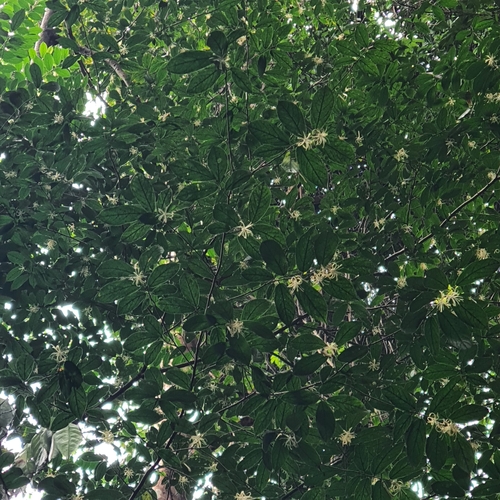
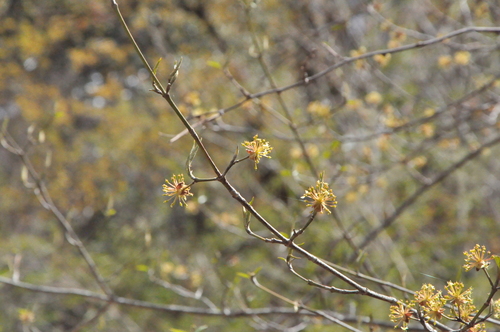
A deciduous tree. It is often 4-8 m tall but can grow 18 m tall. The leaves are narrowly oval and 6-11 cm long by 3-6 cm wide. The leaves are pale green. The veins are easy to see and the leaves are downy underneath. The flowers are yellow. The flowers appear before the leaves.
How to Grow
An easily grown plant, it succeeds in any soil of good or moderate fertility, ranging from acid to shallow chalk. Grows well in heavy clay soils. Succeeds in full sun or light shade. Prefers semi-shade. Plants are not very cold-tolerant, they succeed outdoors only in the milder areas of the country where winter temperatures do not fall below about -5°c. A specimen growing in a fairly open sunny position at Kew Gardens in April 1999 was about 10 years old and 2 metres tall. It had no sign of flowers, though it is obviously more cold hardy than believed since it has already tolerated temperatures rather lower than -5°c. This species is very closely related to C. mas and C. officinalis, differing mainly in having black instead of red fruit. Plants in this genus are notably resistant to honey fungus.
Propagation: Seed is best sown as soon as it is ripe, either in a cold frame or an outdoor seedbed if there is sufficient seed. The seed must be separated from the fruit flesh, which contains germination inhibitors. Stored seed should be cold stratified for 3–4 months and sown as early in the year as possible. Scarification may help, as may a period of warm stratification before the cold stratification. Germination — particularly of stored seed — can be very slow, taking 18 months or more. Prick out cold-frame seedlings into individual pots once large enough to handle and grow on through their first winter in a greenhouse, planting out in spring after the last expected frosts. Take half-ripe side-shoot cuttings in July or August in a frame, or cuttings of mature wood from the current year's growth taken with a heel if possible in autumn in a cold frame — a high percentage will take. New growth can also be layered in June or July, taking about 9 months.
Medicinal Uses
The fruit is used medicinally in the same ways as that of Cornus officinalis. Known in Chinese herbal medicine as Shan Zhu Yu, it has been used for at least 2,000 years as a herb that "stabilizes and binds," principally to reduce heavy menstrual bleeding and excessive secretions including copious sweating, excessive urine, spermatorrhoea, and premature ejaculation. Because herbs that suppress bodily fluids can prolong or worsen symptoms if used alone, it is normally combined with tonic or detoxifying herbs such as Rehmannia glutinosa, and is an ingredient of the "Pill of eight ingredients" used in China to warm and invigorate the yang of the loins. The fruit is antibacterial, antifungal, hypotensive, antitumor, astringent, diuretic, hepatic, and tonic. A decoction of the fruit without the seed is used to treat arthritis, fever, and a wide range of other ailments, including senile lumbago, diabetes, cystitis, and tinnitus. The fruit inhibits the growth of Bacillus dysenteriae and Staphylococcus. Fruit is harvested when fully ripe and dried for later use. The stem bark is astringent, antimalarial, and tonic. The plant as a whole is antibacterial, diuretic, hypotensive, and a urinary antiseptic.
Other Uses
None known.
Wikipedia
Deciduous tree growing to 10 m with upright habit. Hardy to UK zone 8. Flowers February to March with seeds ripening in September. Hermaphroditic and insect-pollinated. Adapts to light sandy, medium loamy, and heavy clay soils including very alkaline conditions. Grows in semi-shade or full sun with preference for moist soil.
Notes
The fruit is used in medicine. There are about 45 Cornus species.
Names & Synonyms
Hua zhu yu
References (4)
- Etherington, K., & Imwold, D., (Eds), 2001, Botanica's Trees & Shrubs. The illustrated A-Z of over 8500 trees and shrubs. Random House, Australia. p 227
- Plants for a Future database, The Field, Penpol, Lostwithiel, Cornwall, PL22 0NG, UK. http://www.scs.leeds.ac.uk/pfaf/
- Repert. Spec. Nov. Regni Veg. 6:100. 1908
- Xiang Qiuyun; David E. Boufford, CORNACEAE [Draft], Flora of China